


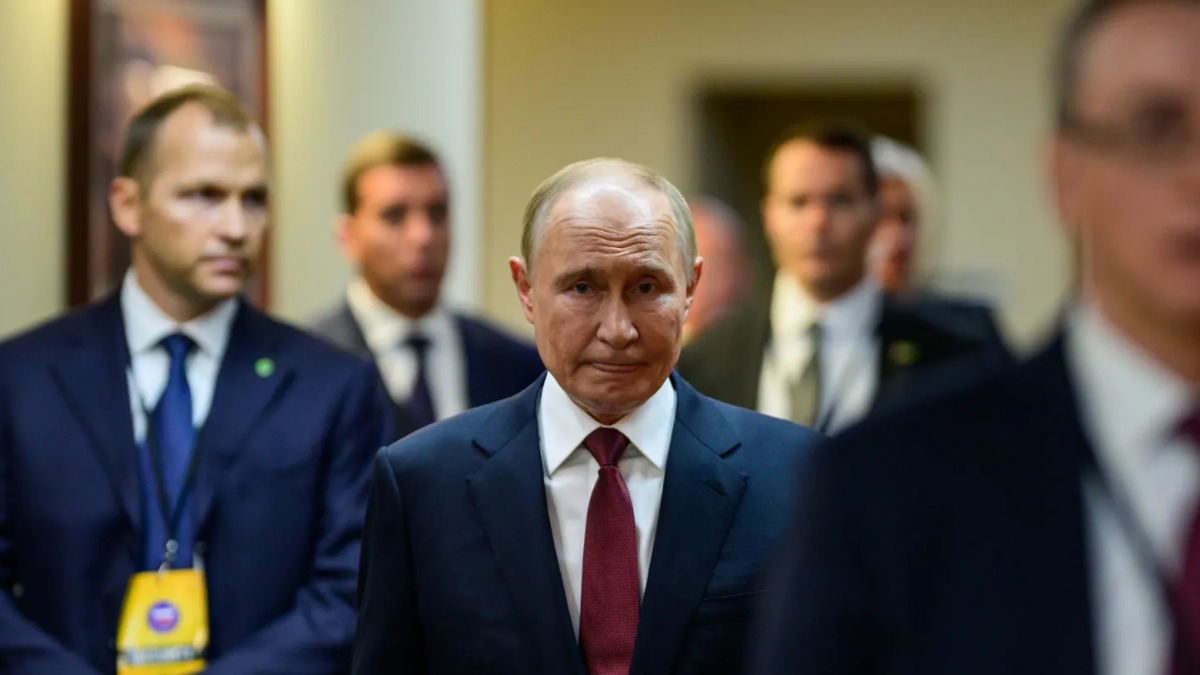

It appears that Russian President Vladimir Putin could potentially test the resolve of NATO by launching a limited assault on an allied country within the next few years. First reported by The Wall Street Journal, new U.S. intelligence reports detail various scenarios of this possible attack, which range from cyberattacks to small-scale land incursions.
Per CNN, these assessments suggest that if Putin finds himself unable to secure a face-saving exit from the war in Ukraine, he might turn his attention toward challenging the unity of the alliance. The strategic goal here would be to fracture NATO, specifically by targeting countries like Poland or those in the Baltics. While experts have long considered a direct land incursion highly unlikely because it would trigger Article 5, the calculus is shifting.
According to WSJ, Article 5 dictates that an attack on one member is an attack on all, but it isn’t clear how the alliance should respond to hybrid or cyber threats. As Heather Conley, a senior fellow with the American Enterprise Institute, noted, “The question mark is how the United States would respond in that case. It has always been a goal [of Russia’s] to challenge the credibility of NATO and to separate the United States from its allies.”
Concerns about preparedness
Conley also told WSJ, “This has always been NATO’s challenge to respond to a sub-Article Five attack, and it’s been very true that to this point, NATO allies have preferred not to escalate.”
The outlet noted that the timing for such a move is estimated to fall between this autumn and 2029. U.S. and European leaders are already observing signs of Russian probing, including drones entering Romanian airspace and cruise missiles landing in Poland.
CNN reported that just this week, U.S. officials assessed that an explosive-laden drone found at an airport in Germany belonged to a Russian intelligence service. German Interior Minister Alexander Dobrindt addressed the situation, stating, “Drone sightings, drone threats including in a hybrid context, are something we know from the past. That a drone armed with explosives is at an airport is a new threat scenario.”
According to the outlet, these concerns are being exacerbated by a significant shortfall in critical munitions. The U.S. military has seen its stockpiles of long-range Precision Strike Missiles, Army Tactical Missile Systems, and short-range Stinger surface-to-air missiles degraded due to transfers to Ukraine and the ongoing conflict with Iran.
CNN reported that roughly half of the U.S. Patriot interceptors and nearly 80 percent of THAAD missile interceptors have been exhausted. This has sparked intense debate regarding the ability of the U.S. to deter adversaries globally, including Russia and China.
Despite these reports, officials within the administration maintain that the country is prepared. Per WSJ, White House spokeswoman Anna Kelly stated that the U.S. military had “more than enough” munitions to “serve all of President Trump’s strategic goals.”
Chief Pentagon spokesman Sean Parnell also reportedly dismissed claims of shortages, stating, “We have everything required to strike at the time and place of the President’s choosing. Across multiple combatant commands, we have already executed successful operations while maintaining a deep, ready arsenal to defend our people and our interests. Any adversary who confuses media noise with American weakness will discover the truth the hard way.”
Claims of shortages were recently also dismissed by Ambassador to the UN Mike Waltz. However, other reports suggest that Trump may have confronted Hegseth over the same, which the White House then dismissed as “100% fake news.”
According to CNN, President Trump addressed the situation late Thursday night on Truth Social, writing, “The U.S. has massive amounts of munitions, especially of certain types. Additionally, large amounts are being manufactured and shipped to the U.S. as needed. Defense companies are building the largest number of plants and factories in our country’s history.”
For now, NATO remains in a state of high alert. Col. Martin O’Donnell, a NATO spokesman, emphasized to WSJ that the alliance is continuously monitoring the situation. “NATO is watching and we are ready to deter and defend as necessary, which we continue to demonstrate,” O’Donnell said.









Published: Aug 9, 2026 07:30 am