


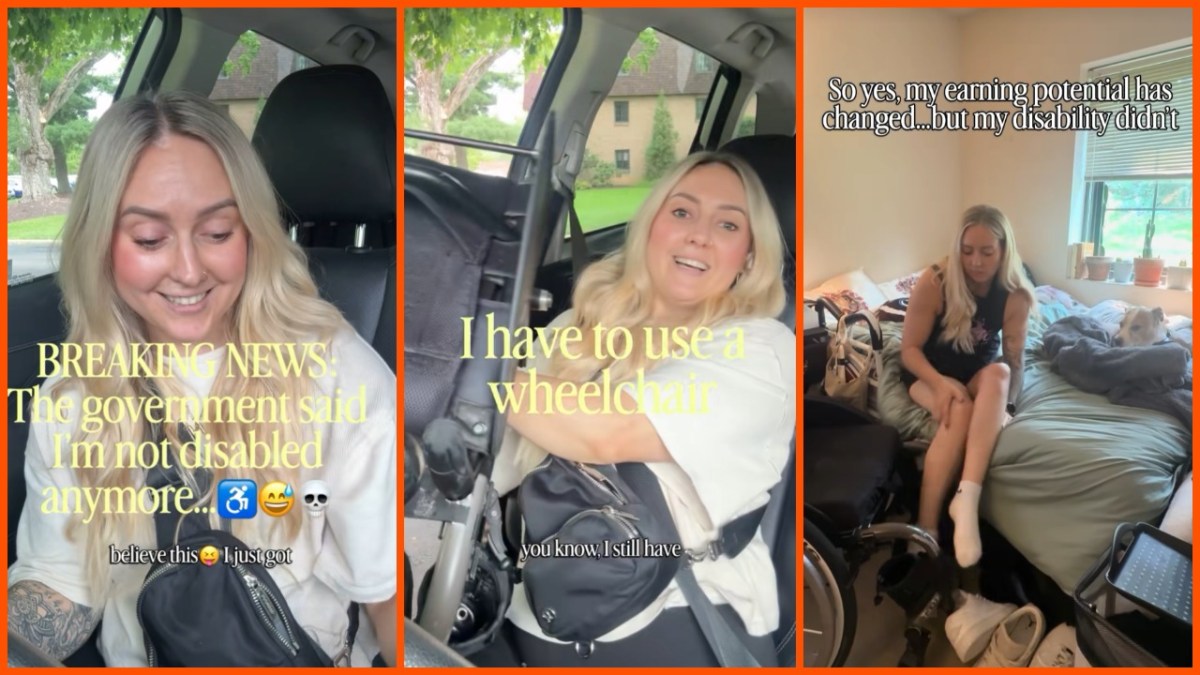

Adaptive personal trainer Nikki Walsh (nikkiwalsh.adaptfit) says she recently received a notice from the Social Security Administration that her disability has ended. After eight years of receiving benefits while living with a T2 spinal cord injury, Walsh took to Instagram and TikTok to share the news with a heavy dose of sarcasm, saying the reality of her situation is very different from what the letter suggests.
In her viral video, which has drawn over 1.4 million views, Walsh gets out of her car after parking. “Y’all are never going to believe this. I just got the best news ever from Social Security in the mail. They told me, which I think is a little weird. They told me that my disability has ended. I am no longer disabled,” she said. As she talked, she pulled out her wheelchair and put it together.
“I think it’s weird,” she said with a grin. “Because, you know, I still have to use a wheelchair. I still can’t walk, still need to park in handicap spots. But I guess because I make over 1450, whatever the minimum is, I think that’s about it. Less than 1500 dollars a month. I’m no longer disabled. Thank you, American government. Let me put my handicap sign up. Yay!”
Why she says her benefits ended
In a detailed caption, Walsh said her spinal cord did not spontaneously regenerate. She said she no longer qualifies for Social Security Disability Insurance (SSDI) benefits because she has built a career and now earns above the monthly income limit. Her account could not be independently verified. The Social Security Administration had not commented on her case at the time of publication.
The Social Security Administration uses a threshold called substantial gainful activity (SGA) to decide whether someone’s work shows they can support themselves. In 2026, that limit is $1,690 a month for most people with disabilities, according to Allsup. Earning above it can lead the agency to decide a person is no longer eligible for SSDI.
The agency also has work incentives. During a nine-month Trial Work Period, beneficiaries can earn above the limit without losing benefits, with any month over $1,210 counting in 2026. A 36-month Extended Period of Eligibility follows, during which benefits are paid in months earnings stay under the SGA limit, according to Allsup. If earnings stay above the limit after that, benefits are likely to end.
Walsh said she is proud of her professional accomplishments and wrote that she has built multiple businesses and works for herself. She emphasized, however, that her income does not erase the high costs of her disability. Other disabled creators have described similar costs, such as Los Angeles actress and disability advocate Cassidy Huff, who said her BiPAP machine was on a “forever rental” costing $200 to $300 a month.
In a follow-up video detailing her morning routine, she said, “I have to spend over $15,000 A YEAR just on the supplies I need to pee and poop. Not vacations. Not luxuries. Not things that make my life more convenient. Basic. Bodily. Functions.” She said her expenses also include wheelchair maintenance, medical equipment, prescriptions, and accessible transportation, costs that remain regardless of her income. Another wheelchair user, Chris Cox, described being stranded when his power wheelchair broke down and said a long repair wait could leave him bedbound and unable to work.
The video resonated with many of her followers, who shared their own frustrations in the comments.
One Instagram user remarked, “Who the f— live off of $1500 a month with disability expenses????” Another commenter added, “Disability in America is LEGISLATED POVERTY.” A TikTok user shared a similar sentiment regarding the importance of medical coverage, stating, “people will never understand that the SSI/SSDI medical coverage is more important than the actual check. Both are important, but being able to monitor your disability with doctors is what keeps us alive.”
The Social Security Administration also conducts Continuing Disability Reviews to check whether a recipient still meets the medical requirements, PLBH Law notes. Walsh described her case as one about earnings.
Walsh is now using her platform to spark a larger conversation about why the system forces individuals to choose between financial independence and the support they need to survive. “Success shouldn’t require pretending the additional cost of being disabled suddenly disappeared,” she wrote.
“Maybe the question shouldn’t be ‘Can disabled people work?’ Maybe it should be ‘Why does our system make disabled people choose between support and success?’ Because earning a paycheck didn’t make me less disabled.”








Published: Sep 20, 2026 12:30 pm