


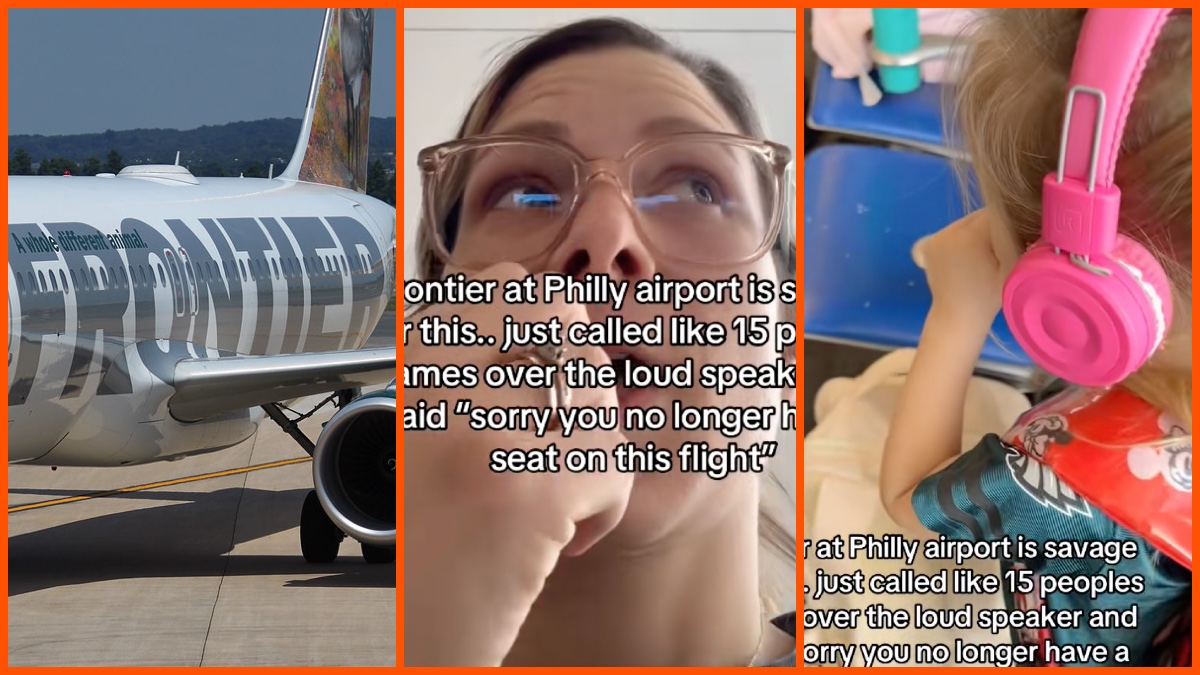

A Pennsylvania woman flying from Philadelphia International Airport shared a TikTok post of Frontier Airlines unceremoniously telling 15 ticketed passengers they “no longer have a seat on this flight.” According to the comments, it’s an all-too-common occurrence.
TikTok creator Tori (@tori.bobori) captioned her post, “‘If I didn’t call your name, it’s your lucky day, you have a seat’ is willlldddddd,” and in the video clip, you can hear an airline employee saying the same thing. Tori’s text, overlaid on her worried face, reads,
Frontier at Philly airport is savage for this. Just called 15 [people’s] names over the loud speaker and said, ‘sorry you no longer have a seat on this flight.'”
via @Tori.bobori,TikTok
Tori’s comment included, “This should be illegal,” and also, “15 people is too much like severely too much. Honestly need to be sued for overbooking.”
Airlines and overbooking
While the scenes in the viral Philadelphia airport clip are jarring, the practice is entirely legal under federal law. It’s part of a long-standing industry strategy known as overbooking, or ‘overselling,’ where airlines sell more tickets than available seats to account for no-shows. However, the Frontier Airlines employee could have shared the news with more grace.
Airlines like Frontier Airlines often sell more tickets than there are seats on a plane because they anticipate a small percentage of passengers will not show up. When that calculation is off, and more passengers arrive than expected, the result is what travelers in Tori’s video experienced: “involuntary denied boarding.”
According to the U.S. Department of Transportation, airlines are legally allowed to oversell flights, but they must follow strict rules when they need to remove passengers.
Carriers are generally required to first ask for volunteers willing to give up their seats in exchange for compensation, which can include cash, travel vouchers, or rebooking on a later flight.
If not enough people volunteer, airlines can then select passengers to be bumped based on criteria such as check-in time, fare class, or frequent flyer status.
The viral reaction to Tori’s video reflects how jarring the process can feel in real time, though. But while the moment may look chaotic, industry data shows oversales are a routine part of airline operations designed to keep flights full and fares lower overall.
Passengers who are bumped involuntarily are entitled to compensation under federal rules, often ranging from a few hundred dollars to $2150 depending on the length of the delay and ticket price.
However, many travelers are unaware of their rights or the possibility of negotiating additional compensation at the gate.
How to get your compensation
If you’re involuntarily bumped at the gate, the compensation process usually starts automatically, but you should still make sure it’s properly documented. The airline will typically issue you a written notice explaining that you were denied boarding and outlining your rights under U.S. Department of Transportation rules.
From there, you’ll either receive a voucher, travel credit, or direct payment, depending on what you’re entitled to and what the airline offers. Payment is legally required within 24 hours or on-site. if the airline can get you to your destination via a rebooked flight within one hour of your original arrival time, they are not required to pay any compensation.
Consumer advocates note that budget carriers, including Frontier Airlines, tend to draw more scrutiny because tight scheduling and high seat utilization rates can make overbooking incidents more visible when they occur. Still, the Department of Transportation emphasizes that the practice itself is legal, the controversy usually centers on how transparently passengers are notified and how fairly the process is handled in the moment.




Published: Apr 14, 2026 02:04 pm