


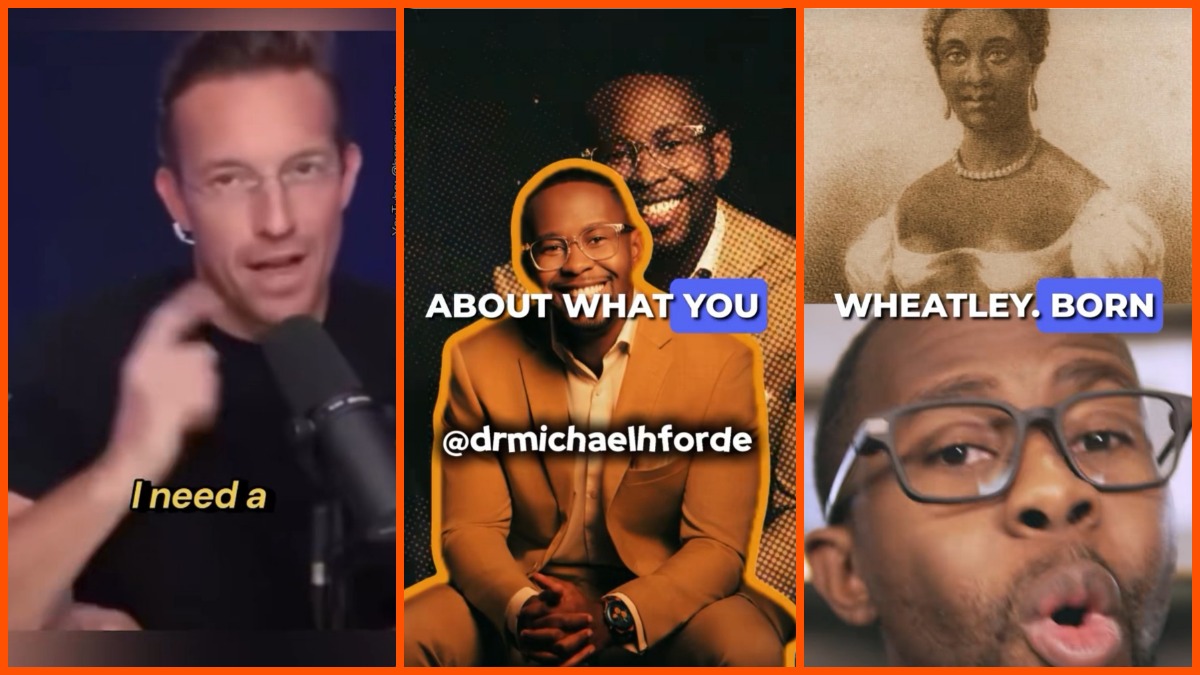

Dr. Michael H. Forde, the founder of Healing Starts With Knowing, recently took to Instagram and TikTok to address a clip featuring right-wing commentator Benny Johnson. In the video, Johnson had a challenge for his viewers. “I need a name of a single black woman that had something to do with America’s founding,” he said. He then admitted he could only think of one thing. “Didn’t Thomas Jefferson have like half his family, like out of wedlock with the slaves?”
“He asked for one name, one black woman who had something to do with America’s founding. He waited about three seconds,” Forde noted. “ And the best he could offer was Thomas Jefferson’s enslaved women. Referenced not as human beings, but as a historical footnote to a white man’s biography. That answer was not a gap in his argument. That answer was the argument.” Forde then presented two names, Phyllis Wheatley and Elizabeth Freeman.
Wheatley, he stated, was a kidnapped, enslaved woman born in West Africa. Despite that, by the time she was 12, she was already reading Greek and Latin. In 1775, she wrote a poem honoring George Washington, who personally responded and invited her to his Cambridge headquarters. “Her work was both praised by Washington and Benjamin Franklin. The Constitution Center documents her today as a forgotten founder of the Revolutionary Era.”
He named just two of many
Then he talked about Freeman, also known as Mumbet, who was born enslaved in New York around 1742. In 1781, he noted that she walked into a Massachusetts courtroom. Then, she used the language of the Declaration of Independence and the Massachusetts Constitution to secure her own freedom.
As Forde explained, “She became the first black woman to sue for freedom in an American court and win. Her case helped establish the legal end of slavery in Massachusetts. She did not wait for the founding documents to include her. She held America accountable to its own words.”
The reaction from social media users was swift, arguing about how history was often misrepresented. On TikTok, one user observed, “the sad part [is] they go to ivy league schools [where] all this is taught. A lot of them know the contributions of black women, hence why we are being targeted now.” Another commenter on Instagram added, “They use their ignorance as proof far too often.”
Other users chimed in with additional names that should be common knowledge, including Ona Judge, Sally Hemings, and Lucy Terry Prince. One user noted, “If they actually taught the full history of Harriet Tubman being a solider & a spy…actually fighting for freedom instead of making it seem like all she did was run away at night…maybe he’d be able to at least name her.”
The difficulty in finding these stories is not due to a lack of contribution. Rather, it’s a long-standing issue with how history has been recorded. According to the Library of Congress, accounts of the Revolutionary War were often written by those in power during a time when views were far less progressive. This reportedly presents a massive challenge for researchers who are trying to piece together first-hand accounts or writings from these groups.
As the Library of Congress notes, “Because accounts are often written by those in power, and during a time when views were less progressive, the perspective is almost always slanted to see women and minorities in a utilitarian light rather than view them as individuals- much less as equals.” They stated that, given the era, women’s situation depended heavily on their class, race, and family background.
White married women managed households or served as nurses in camps. However, the experiences of African-American women were complicated by their status as either free or enslaved.
Additionally, this practice of reframing history isn’t relegated only to history. Earlier this year, the administration was questioned about erasing ‘historical truths’ by removing slavery exhibits in Philadelphia. Additionally, a judge deemed the administration’s attempt to remove partisan ideology from state parks as a dangerous precedent of censorship.
One Instagram user noted, “An average person’s inability to name Black women who had something to do with America’s has nothing to do with a lack of contribution and EVERYTHING to do with a lack of truth in our education system.” So, Forde is looking to fix this.
As he told his audience, “If you want the full story on this topic, I created something for our community. A free, searchable library of black history, racism, and health equity.” He stated that every topic on there would be like this video, “Documented. Verified. Present at the founding.”




Published: Jul 11, 2026 05:09 pm