


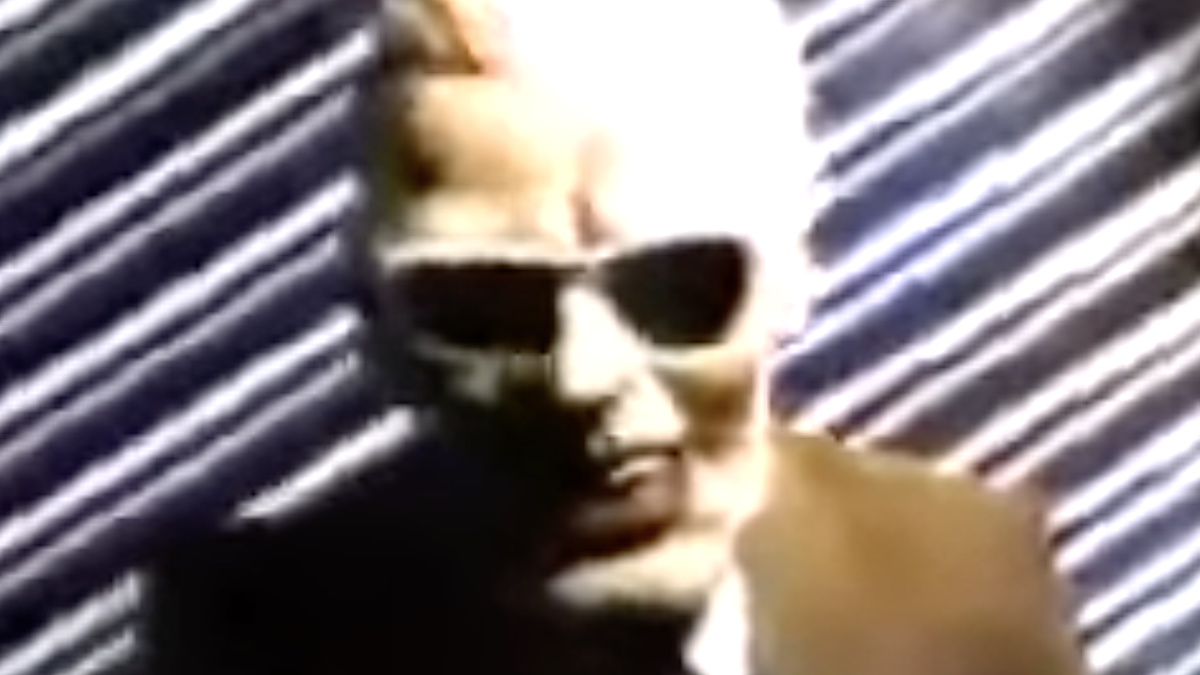

It was a quiet Sunday night in Illinois in 1987 when two separate television stations were hijacked by a man wearing a rubber Max Headroom mask, and to this day, no one knows who he was.
That night, television audiences in Chicago, one of the largest media markets in the country, were stunned when a man impersonating the artificial, glitchy TV character Max Headroom took over their screens in two separate transmissions. The bizarre “signal jacking” incident, which occurred on November 22, 1987, remains one of the most infamous mysteries in American broadcasting.
The first incident
The first intrusion occurred around 9:00 p.m. during a sports segment on WGN Channel 9, a major independent station. Viewers watching the nightly news suddenly saw the screen distort into static, followed by a man wearing a Max Headroom mask and a suit, bobbing in front of a swaying piece of corrugated metal meant to mimic the character’s signature digital backdrop. There was no sound during this initial hack, and within about 20 seconds, WGN engineers quickly regained control of the signal.
The second time, it interrupted “Doctor Who”
Less than two hours later, the same masked figure struck again on WTTW Channel 11, a PBS affiliate, during a late-night broadcast of the Doctor Who episode “Horror of Fang Rock.” This time, the hijacker’s audio came through. His words were distorted, bizarre, and laced with references that made little sense.
The man taunted WGN, mocked TV news anchor Chuck Swirsky, and referenced Coca-Cola, a nod to Max Headroom’s connection to the brand. He also held up a can of Pepsi, calling it “your greatest enemy.” The two-minute broadcast culminated in the man being spanked with a fly swatter by someone off-camera before the signal finally cut out.
According to the Federal Communications Commission, the intruder had managed to overpower the microwave transmission signals used to beam programming from studios to broadcast antennas, a feat requiring technical know-how and specialized equipment. But despite a federal investigation, the perpetrator was never identified or arrested.
At the time, signal hijacking was considered a serious federal crime, punishable by fines and potential prison time. Yet, in the decades since, no one has ever come forward to claim responsibility. The incident quickly became part of hacker lore, inspiring conspiracy theories, online sleuthing, and countless pop culture references, from The Simpsons to Mr. Robot.
The Max Headroom incident remains a time capsule of the late 1980s. For some, it was a harmless prank; for others, a reminder of how fragile television systems were before the digital age. The case has inspired YouTube documentaries, Reddit threads, and even modern-day digital artists who recreate the broadcast frame by frame. Yet, nearly 40 years later, the masked figure’s identity is still unknown.






Published: Nov 1, 2025 07:16 am