


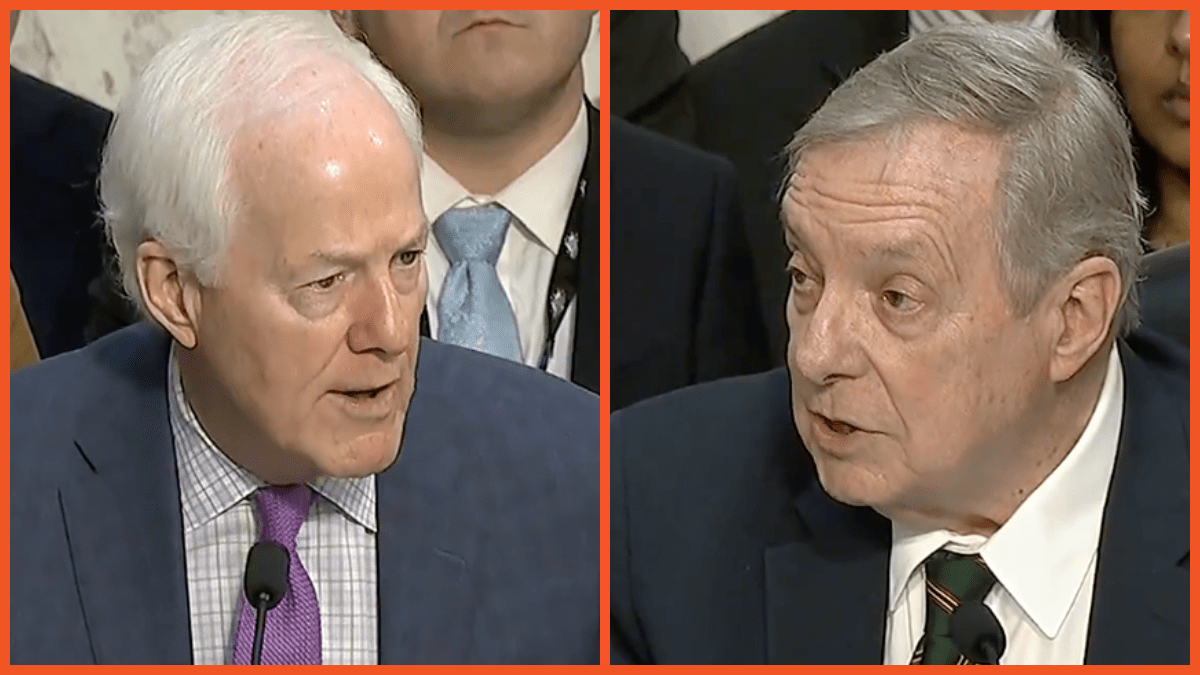

Texas Republican Senator John Cornyn got schooled on how the Trump-backed SAVE Act will disenfranchise 9% of American voters, and particularly married women, at a Senate Judiciary hearing on Thurs. March 12, 2026.
At the hearing, Cornyn asked, “I don’t understand how [the SAVE Act] could disenfranchise millions of Americans. Maybe you could explain.”
The Safeguard American Voter Eligibility (SAVE) Act is a Republican-backed bill that would require people to provide documentary proof of U.S. citizenship—such as a passport or birth certificate—to register to vote in federal elections. As of March 2026, it has passed the House but faces uncertain prospects in the Senate because it likely lacks the 60 votes needed to overcome a filibuster.
“People will not be voting”
Illinois Senator Dick Durbin responded to Cornyn, explaining that if the bill passes, state-issued driver’s licenses would no longer be sufficient ID for voter registration. A passport could work, but Durbin went on,
50% of Americans do not have a passport. Those who want to obtain it so they can vote will pay $186 and wait three or four weeks for that to happen. Secondly, you can use a birth certificate, but any person who has changed their name,” such as a married woman, he said, “has to find not only their birth certificate but some correction of it to prove that they are eligible to register to vote.”
Durbin fails to mention that $186 is a de facto poll tax, prohibited by the 24th Amendment to the United States Constitution.
Supporters say the SAVE Act does not impose a “poll tax” because it does not charge a fee to register or vote. Instead, they argue it requires proof of citizenship, similar to identification rules already used in some states.
Durbin added, “It’s estimated that 9% of the voters in America do not have the identification required by this bill. It means that, ultimately, those people will not be voting. And I think that is the ultimate goal of this administration.”
Cornyn said the Senate could address these potentially unconstitutional issues in the bill targeting married women, among other voters, by adding an amendment to modify the documentation requirements, to add exceptions to enforcement provisions, or to rewrite parts of the bill before voting on it.
Amused, Durbin said, “When’s the last time we amended a bill?” as many high-profile bills now come to the Senate floor under tightly controlled procedures where amendments are limited or not allowed at all. One Reddit comment noted, “Yes, amend the bill to allow valid state-issued ID or just you know, vote nay on the damn thing.”
SAVE Act 2026: When’s the vote?
As of mid‑March 2026, there isn’t a fixed calendar date set for when the SAVE Act will be voted on. Senate Majority Leader John Thune has said the Senate will consider the bill “at some point” soon and that GOP senators are preparing for debate rather than shutting down or changing filibuster rules, according to the AP.
In the Republican primary for the 2026 U.S. Senate election in Texas, Cornyn failed to win a majority of the vote on March 3, forcing a runoff election against Texas Attorney General Ken Paxton on May 26.
According to Politico, President Trump is holding off on endorsing Cornyn in the Texas GOP Senate primary runoff in part to pressure Senate leadership to pass the SAVE Act, signaling he wanted to see action on the bill before supporting a candidate.




Published: Mar 13, 2026 04:30 pm