


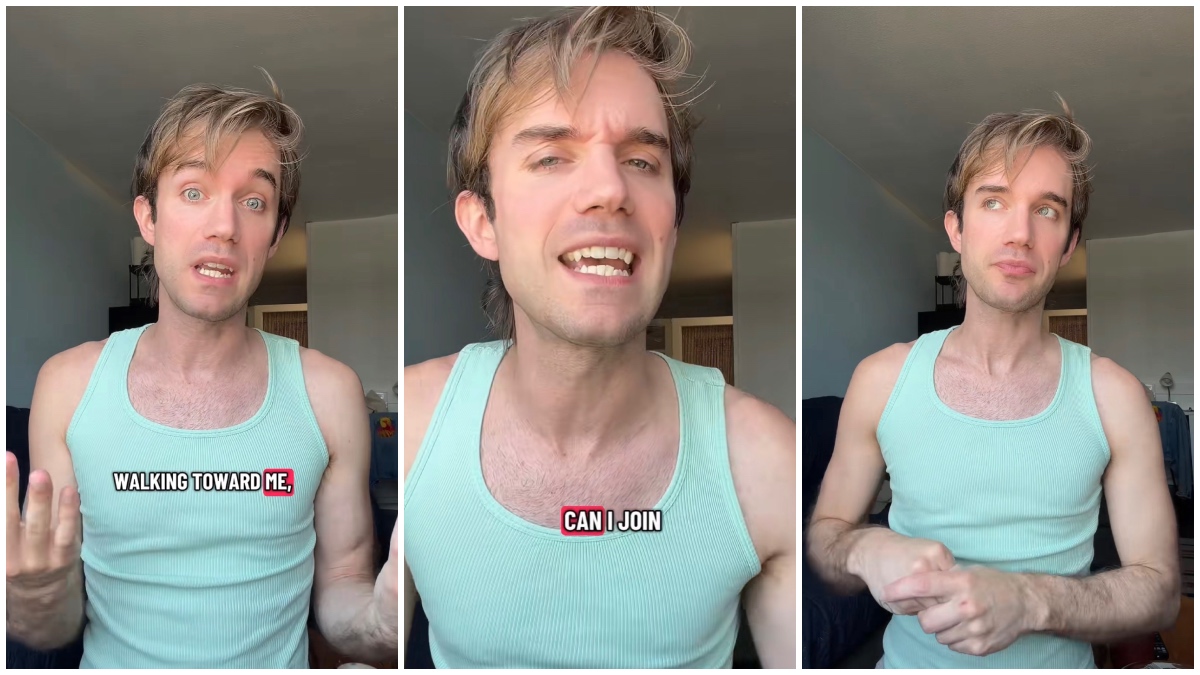

The expectation of privacy in a public restroom is a social contract most of us take for granted. But for Los Angeles-based comedian Drew Lausch (TikTok/@drewlausch), even a locked door proved to be no barrier for an entitled stranger.
In a video viewed over 11,000 times, Drew recounts a disturbing encounter at a recent party. His restroom talk with a random stranger shifted from casual “cup color” banter to a blatant violation of his personal space. All under ten seconds.
His story forces us to think about the unsettling frequency with which consent is ignored in specific social spaces.
A restroom chat about party ‘cup colors’ set a false sense of security
In the TikTok video, Drew revealed that he is “pee shy” and is always waiting for a stall in the restroom. Recently, he was in line in a restroom at a party when another man struck up a conversation. He asked about the color of Drew’s cup. The analogy is often used at gay parties to denote sexual roles like top, bottom, or vers.
Drew jokingly claimed his cup was blue (for vers), before telling the man to “have a good night.” He then entered a stall as soon as it opened and locked the door.
A stranger burst into the locked stall just seconds later
The interaction took a dark turn once Drew was inside with the door closed and locked. After only seven seconds, the man from the line “bursts the stall door open” and asked if he could join Drew. When Drew firmly said “no,” the man persisted, asking, “Can I touch you?”
Despite Drew stating he wanted “no part of that,” the stranger continued walking toward him. This forced Drew to abandon his privacy and push past the man to escape the restroom.
The creator is calling out the lack of bodily autonomy in gay spaces
Reflecting on the encounter, Drew expressed frustration that what he hoped would be a “funny” story felt anything but funny. He questioned why some individuals in social settings believe that another person’s body is “fair game” regardless of how many times they say no.
“I’m literally just trying to empty the toxic tequila sodas that are in my system right now,” he remarked. He emphasized that a person’s presence at a party, or the color of their cup, is never an invitation for a stranger to violate their physical boundaries.
The ethics of consent and the ‘Cup System’
The “cup color” system mentioned by Drew is a tool designed to facilitate communication between gay people. It helps establish baseline preferences in high-energy social environments. However, as Drew’s experience illustrates, these systems are sometimes misinterpreted by predatory individuals as a waiver of the “No means No” standard.
Bodily autonomy is not conditional based on sexual preference or social venue. Bursting into a locked restroom stall is a severe breach of safety that moves beyond “awkward.” It goes into the territory of harassment, regardless of the attacker’s intent.
How to handle a breach of personal space in private spaces like a restroom?
If you find yourself in a situation where your “no” is being ignored, keep some safety steps in mind. Like Drew, your first priority is removing yourself from the confined space as quickly as possible. Do not wait for an apology or attempt to explain your “no” further.
After you’ve left the place, alert even security or staff. Most modern venues have “Consent Monitors” or security personnel trained to handle physical boundary violations. Reporting the person immediately can prevent them from targeting others.
Additionally, the “bathroom buddy” system can help you avoid such awkward encounters. In high-intensity party environments, using the restroom in pairs can provide an extra layer of security. Do this especially if you know you are “pee shy” or vulnerable in confined spaces.
At the end, sharing the story, as Drew did, helps process the trauma. It reinforces the standard that this behavior is a violation of autonomy, not a “miscommunication.”
No is a complete sentence, even in a restroom.
Drew’s recount proves that a lock is only as strong as the person on the other side is respectful. While he ended the video with a joke about Shia LaBeouf, his underlying message was clear. Consent is not “fair game,” and privacy is a right, not a suggestion.








Published: Apr 9, 2026 11:56 am