


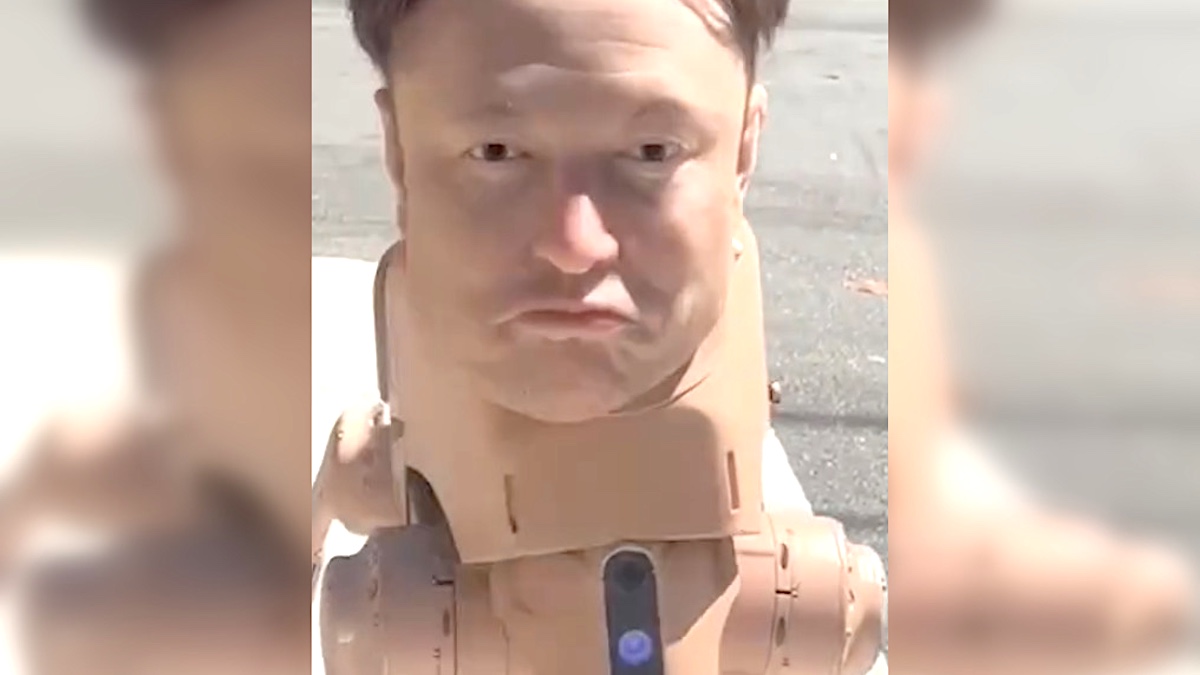

San Francisco residents who spotted a robotic dog with Elon Musk‘s face strolling along sidewalks in early April didn’t witness a prank or malfunctioning prototype. Nor was it a sign of the apocalypse.
The surreal sight was part of a deliberate public art stunt by digital artist Beeple, whose work has increasingly blurred the line between internet culture, artificial intelligence, and physical installations.
The robot dog is part of Beeple’s ongoing project “Regular Animals,” a series that transforms powerful cultural figures into autonomous, animal-like machines.
The San Francisco sighting served as a promotional activation for his exhibition “INFINITE_LOOP,” which opened April 18 at a digital art space in nearby Palo Alto.
The sight freaked dogs and humans alike
The four-legged robot, seen in areas such as the city’s waterfront around April 8, moved with the steady dog-like gait typical of modern quadruped machines. But instead of a conventional head, it carried a hyper-realistic silicone likeness of Musk’s face, mounted on a screen or sculpted mask, giving it an uncanny, almost lifelike expression.
The device itself was built using a commercially available robotic platform similar to those developed by companies like Unitree Robotics, specifically the Go2 robot dog.
The face component was created in collaboration with Hyperflesh, a studio known for producing ultra-realistic human masks.
The Musk version is only one of several. Other robot dogs in the series feature the likenesses of figures including Mark Zuckerberg, Jeff Bezos, Pablo Picasso, and Andy Warhol, reflecting a mix of tech leaders and art icons.
These machines were first introduced in a controlled installation at Art Basel Miami Beach in 2025 before being adapted for more mobile, public-facing appearances.
Online, reaction to the Musk-faced robot dog ranged from amused fascination to visible discomfort. Videos shared across platforms like TikTok and X quickly went viral, with many users initially questioning whether the footage was real. The realism of the face, combined with the increasingly common sight of robotic systems in urban environments, contributed to the confusion.
Beeple’s work frequently examines how technology, algorithms, and influential individuals shape perception and culture. By placing familiar faces onto robotic bodies and releasing them into public space, “Regular Animals” reframes those figures as both products and agents of a system driven by attention and data.
The robots are coming
The reaction highlights a broader cultural tension. Robot dogs are no longer novel in industrial or research settings. However, their appearance in everyday public life — especially when combined with recognizable human imagery — introduces a new level of unease.
In cities like San Francisco, where emerging technologies are often deployed early, these encounters can feel like glimpses of a near future arriving ahead of schedule.
City officials have not announced any enforcement action related to the robot’s appearance, and there were no reported safety incidents. The machine’s brief walk through public streets appears to have been carefully controlled, functioning as both a marketing tactic and an extension of the artwork itself.






Published: Apr 22, 2026 02:23 pm