


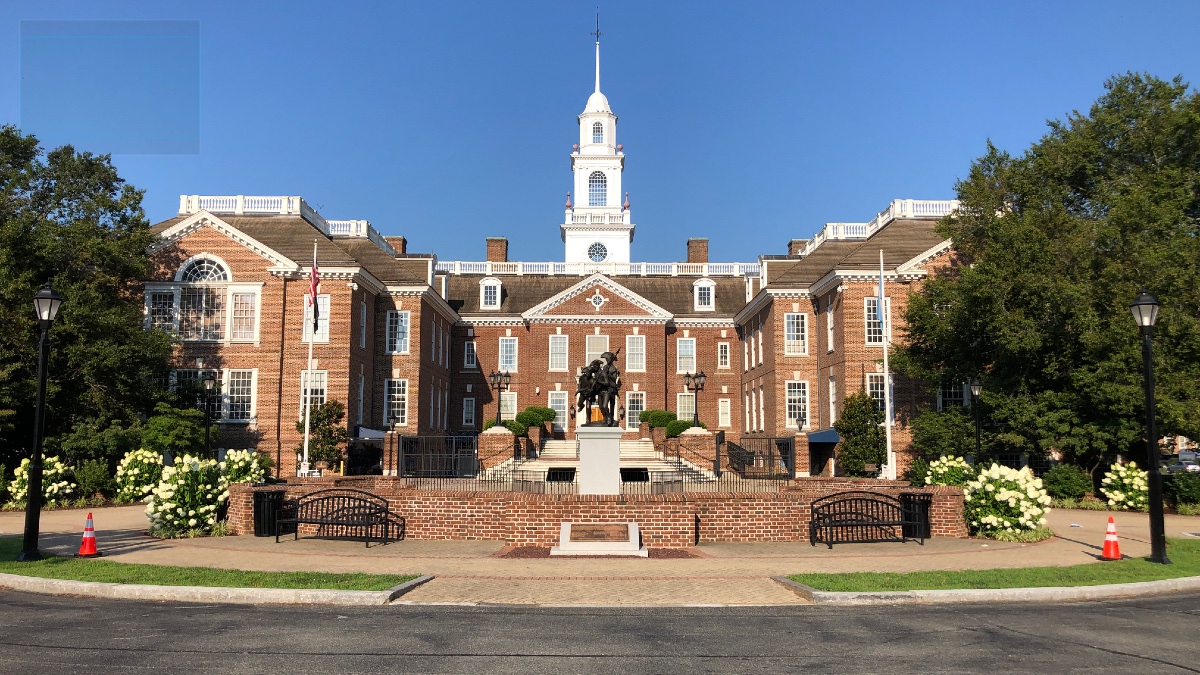

A Delaware judge has upheld a small-town charter allowing companies and other legal entities to participate in local elections. This comes after the American Civil Liberties Union of Delaware (ACLU) sued the town, arguing the provision was unconstitutional.
The ruling centers on the beach town of Fenwick Island, where Delaware Superior Court Judge Craig Karsnitz rejected the ACLU’s challenge to a local voting system that allows corporations, trusts, partnerships, and limited liability companies to cast ballots in municipal elections if they own property in town.
The ACLU of Delaware sued the town in December 2025, arguing that allowing “non-human artificial entities” to vote diluted the votes of actual residents and violated the Delaware Constitution’s requirement that elections remain “free and equal.”
The organization said more than 200 artificial entities registered to vote in Fenwick Island, representing roughly 12% of the electorate.
Karsnitz’s ruling
Karsnitz disagreed. In his ruling, the judge said the town’s charter did not violate the state constitution because courts historically interpreted the “free and equal” clause as protection against fraud and discrimination, not as a prohibition on entity voting. He also noted the lawsuit did not allege racial discrimination or election fraud.
“Visions of faceless large corporations or even HAL controlling a small town are frightening and the stuff of science fiction,” Karsnitz wrote, according to Reuters. “However, plaintiff has not demonstrated that this policy violates the principle of one person/entity/one vote.”
The judge’s reference to HAL invoked HAL 9000, the sentient computer antagonist from the 1968 film 2001: A Space Odyssey. The “one person, one vote” doctrine emerged from a series of U.S. Supreme Court decisions in the 1960s that required electoral districts to maintain roughly equal populations. Courts derived the principle from the Equal Protection Clause of the 14th Amendment.
Fenwick Island and Citizens United
Karsnitz’s decision also revived debate over the Supreme Court’s 2010 Citizens United v. Federal Election Commission ruling, which held that corporations possess First Amendment free speech rights in political spending.
Critics of the Fenwick Island charter argue the local voting system extends corporate political influence even further. Supporters counter that property owners who pay taxes and comply with town ordinances deserve representation in local government, even if ownership flows through a corporate structure.
In practice, the reality on the ground differs from fears of a corporate takeover. The vast majority of the legal entities registered to vote in Fenwick Island are not massive conglomerates, but rather family trusts and LLCs utilized by individual families for tax and estate planning to pass down beach houses.
To prevent abuse, the town enforces strict safeguards: any entity wishing to cast a ballot must submit a notarized Power of Attorney designating a human representative. Furthermore, the system maintains a strict “one person, one vote” cap, meaning a resident who also owns a property-holding LLC is still legally limited to a single ballot.
Fenwick Island has allowed nonresident property owners to vote since it incorporated in 1953. Delaware lawmakers amended the charter in 2008 to explicitly permit artificial entities to participate in elections if they are chartered in Delaware and remain in good standing. Several other Delaware municipalities maintain similar provisions.
Delaware serves as the legal home for most publicly traded U.S. companies. The state has more registered corporations than residents, making corporate law central to its economy and political identity.
The ACLU of Delaware has not announced whether it will appeal. Fenwick Island’s next municipal election is scheduled for Aug. 1, 2026.








Published: May 27, 2026 12:03 pm