


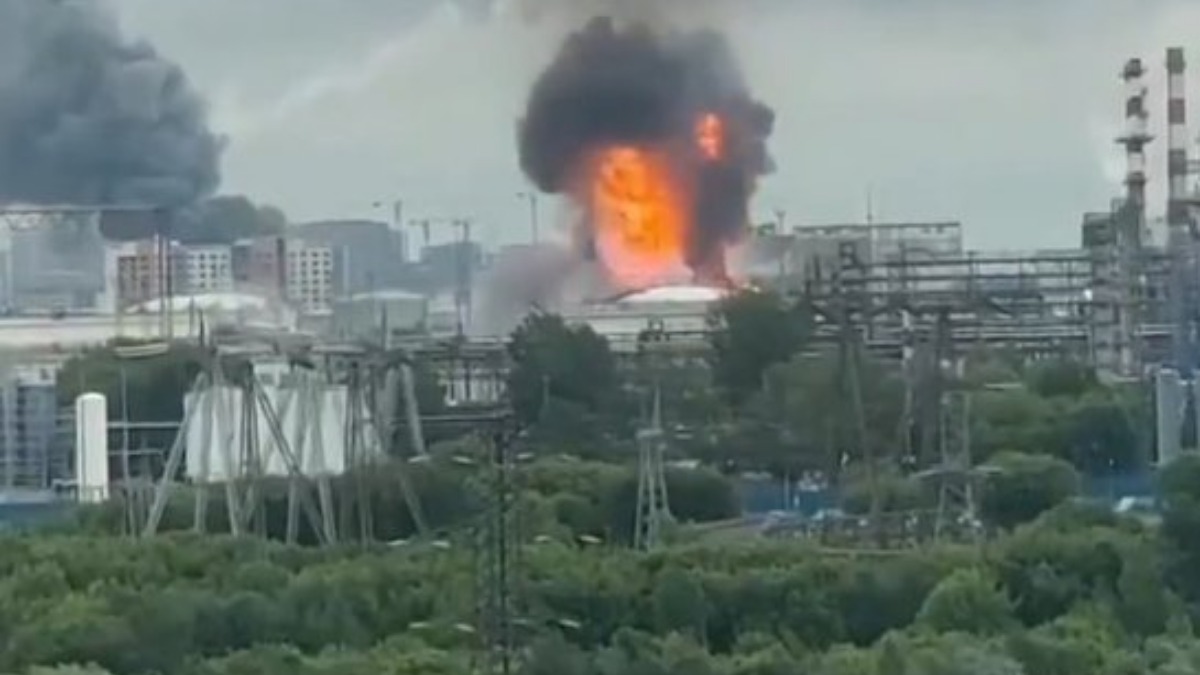

Moscow just faced the largest Ukrainian offensive since the start of the Russian-Ukrainian war, with nearly 200 drones targeting the region. This aerial assault represents a major escalation, as Kyiv continues to push its long-range capabilities deeper into Russian territory. According to the BBC, the operation forced local authorities to take drastic measures, including the temporary closure of Moscow’s four major airports.
Writing on Telegram on Thursday, June 18, as noted by the Kyiv Post, President Volodymyr Zelensky confirmed, “Our long-range sanctions once again reached the Moscow region: for the second time in a week, the Moscow Oil Refinery was hit,” he stated. He further emphasized that these strikes are a direct retaliation for Russian aggression, specifically mentioning last week’s attack on Kyiv that damaged a major religious landmark.
“This is a completely fair response to Russian strikes on our cities and communities, and another important result of our soldiers’ work against facilities that support the Russian war machine,” Zelensky said. He also issued a firm warning, stating, “We don’t want this war and have never wanted it. But if Ukraine burns, your Moscow will burn too.”
The damage across Moscow was notable
The BBC noted that the impact of the strikes was visible across the outskirts of the capital. Fires erupted at the Kapotnya refinery in south-east Moscow, marking the third time this facility has been hit in a single month and the second time this week. Footage circulating on social media showed the lid of a massive oil storage tank being launched dozens of metres into the air following a powerful explosion.
A nearby shopping centre also caught fire after falling drone debris struck the structure, leading to the evacuation of several residential high-rise buildings. Per reports, local officials have attempted to restrict the sharing of imagery regarding these strikes, but many citizens spotted and recorded the drones flying in broad daylight over industrial sectors.
The strategy behind these long-range strikes is multifaceted. The BBC explained that by targeting energy infrastructure and military sites, Ukraine aims to increase the economic and political cost of the war for the Kremlin, effectively bringing the reality of the conflict home to ordinary Russian citizens.
Ukrainian Foreign Minister Andriy Sybiha echoed this sentiment in a post on X. “One of the most popular questions asked by Muscovites this morning is ‘What is going on?’” Sybiha wrote. He continued, “I can answer. Your country started a war of aggression against ours. For years, it has been killing our people. Now that you know what’s going on, ask Putin when he is planning to end it.”
This shift toward remote, high-tech warfare is a defining feature of the current stage of the conflict and Ukraine’s strategy. As outlined by CNN, Ukraine has undergone a remarkable evolution in its military approach, heavily integrating drones, robots, and remotely piloted systems to compensate for manpower constraints.
This technological pivot reportedly allows Ukrainian forces to conduct complex missions with reduced risk to personnel. Commanders who once led brutal urban battles in places like Avdiivka and Bakhmut are now overseeing operations from control hubs, directing unmanned vehicles that Russian forces have reportedly dubbed “silent death.”
CNN notes that these systems are highly effective. By utilizing unmanned ground vehicles and aerial drones, Ukraine has been able to maintain pressure on the front lines while simultaneously executing deep-strike missions.
According to the report, this industrialization of drone warfare is a calculated effort to force the Kremlin into unpopular recruitment drives by inflicting high numbers of casualties. For the soldiers on the ground, this technology is a vital lifeline. One unit commander noted to CNN that the use of robots has saved countless Ukrainian lives, allowing them to achieve tactical goals that would have otherwise required thousands of infantry troops.
Per BBC, Russia’s defence ministry reported that nearly 1,000 drones and four cruise missiles were intercepted across the country during the 24 hours. While Russia launched its own wave of over 200 drones and multiple ballistic missiles at Ukraine, the frequency of Ukrainian strikes near Moscow, located approximately 500km from the border, indicates a significant shift in the conflict’s reach.
Just last week, Ukraine also launched an ‘unprecedented’ attack on St. Petersburg after Zelensky’s call for peace was rebuffed.








Published: Jun 19, 2026 08:40 am