


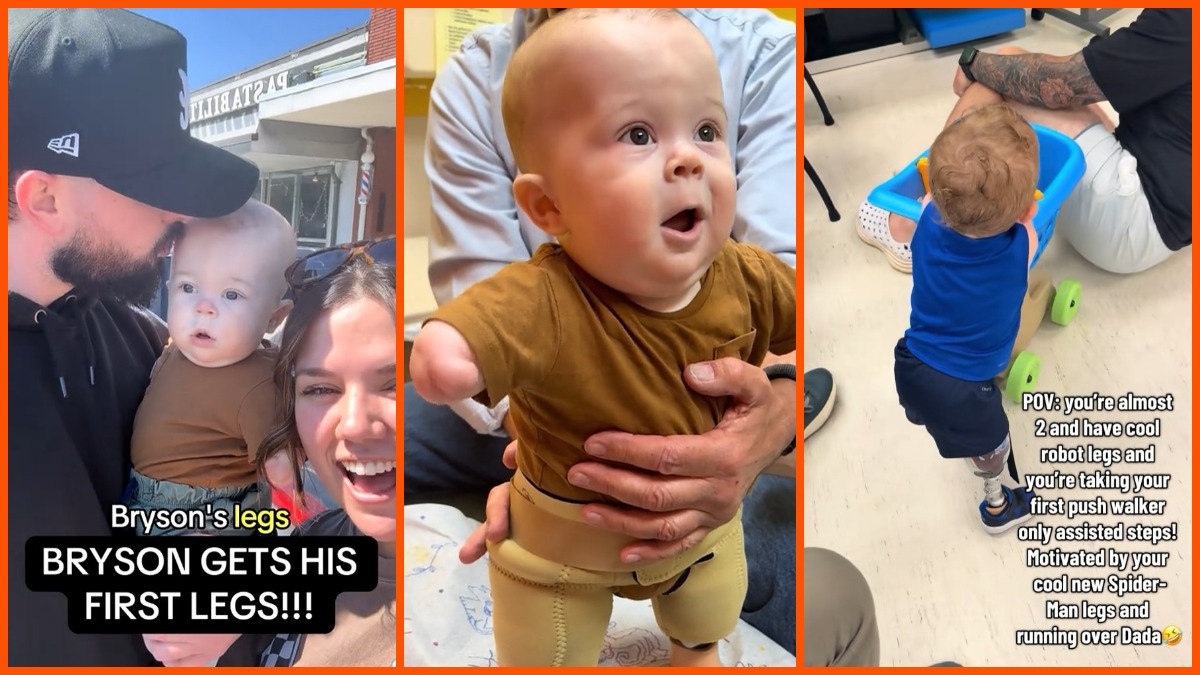

Bryson, a 2-year-old from North Carolina, has officially hit a major milestone by taking his first steps. It’s a huge deal because Bryson was born missing both of his legs from the knees down and both arms from the elbows down. Over the past year, he has been getting fitted for prosthetics and learning how to balance himself. As his hard work pays off, TikTok and Instagram have been cheering him and his parents, Tyler and Bonnie Cox, along.
Shared under the handle starfish.chronicles, the recent video of him testing his new metal prosthetics with a push cart has already racked up around 600K views on both platforms. As the on-screen text for the video states: “Pov: you’re almost 2 and have cool robot legs, and you’re taking your first push walker only assisted steps! Motivated by your cool new Spider-Man legs and running over Dada.”
The internet has been incredibly supportive of his progress. One user on TikTok commented, “Ahhhhhhh go Bryson go.” Another noted, “Love this! Look at him….not nervous at all. Just casually letting go with one arm.” On Instagram, a user was excited about his confidence, writing, “Love how he pushes therapist away! Saying ‘I got this!!!’” Another told Bonnie, “You’ll be chasing him you watch !!!”
It was a long journey
It hasn’t always been smooth sailing, though. As a post after that success highlighted, practicing at home can be much more difficult than in a controlled therapy environment. In the video, Bonnie cheers him on while he struggles to use his push cart to reach his beloved cheese puffs. As Bonnie noted in the on-screen text, “Reality of therapy with a VERY independent almost 2 year old… A lot of highs and lows, and a lot of cheesepuffs.”
Commenters were quick to praise his resilience and his mother’s support. One user said, “Hard watch but well done for helping him persevere. He’s a star.” On Instagram, one user encouraged her, saying, “You guys are doing a wonderful job. It’ll all be worth it. He might not understand it now, but he will when he gets older.” One TikToker with a similar condition shared that she was grateful for the sometimes horrifying lengths her father went to ensure she learned to swim.
On TikTok, someone shared their personal experience. “I have cerebral palsy, and my mom says one of the hardest things she ever did was just let me do things on my own, even if that meant that I failed sometimes. You see, the doctors told my parents that helping me do things on my own would one day lead to my independence. Independence that would mean everything to me. They were correct as an adult. My independence is so important to me.”
Bonnie told Newsweek that “Seeing him walk for the first time only using the little pushcart and not having anyone assist him was so emotional.” She added, “He has worked so hard for that for so long, so it was extremely exciting for us to see him accomplish that. He doesn’t let disability slow him down at all. He’s extremely mobile and independent, getting where he wants to go, feeding himself, playing, throwing a ball.”
According to Orthotics Limited, pediatric prosthetics are specialized devices designed to meet the unique needs of children, specifically adapting to their rapid growth and active lifestyles. These devices are not just smaller versions of adult prosthetics. Children grow quickly, so these devices are designed with growth adaptability in mind, often using modular parts that can be swapped out or adjusted.
This ensures the prosthetic remains comfortable and functional as the child gets bigger. Beyond just physical movement, these devices are essential for supporting a child’s self-confidence and helping them feel comfortable in social situations. The site also noted that early intervention is a major factor in a child’s success. It helps them develop their motor skills much faster and allows them to participate in physical activities sooner.
It also helps prevent the child from over-relying on other limbs, which can reduce the risk of future physical issues. No matter the technological complexity of the prosthetic, the goal is to provide the support needed for the child to move, play, and explore the world with independence. In a different case, to support a teen’s independence, doctors also harnessed technology to make her a new jaw.
For the Cox family, that is the goal of sharing their life online. According to Newsweek, she and her husband want to “convey to people that people with limb difference are just living their lives. They are happy, they have beautiful lives, and they can do so much—they just do it differently.”






Published: Jul 25, 2026 07:45 am