


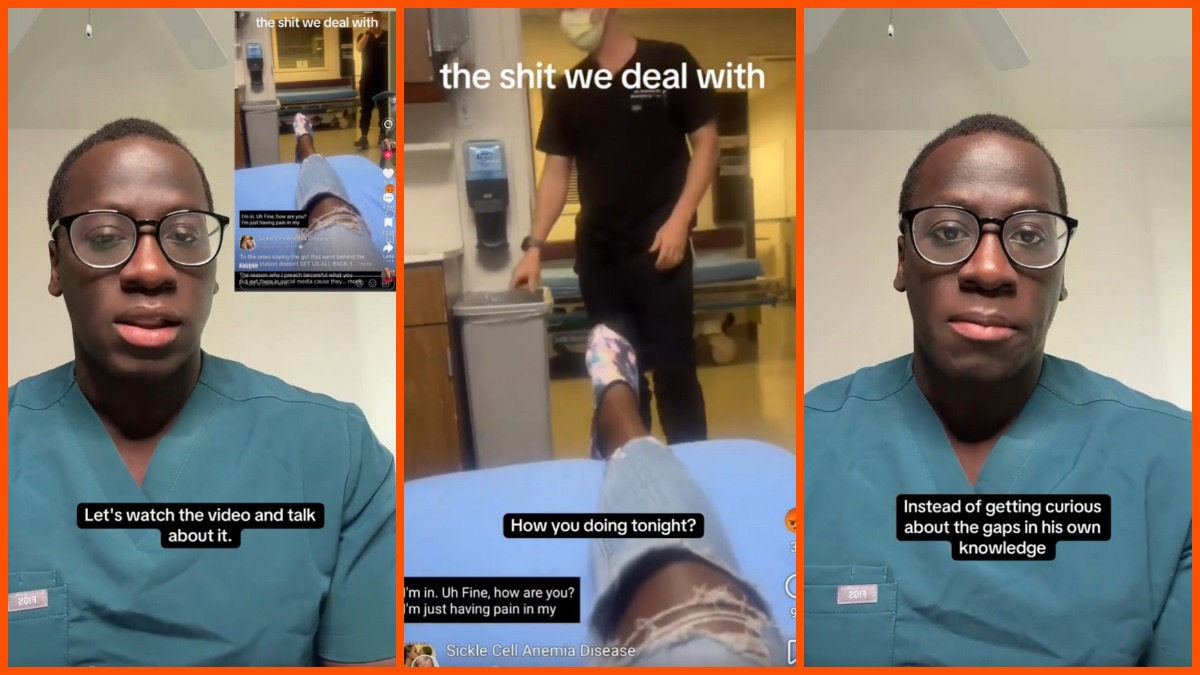

Many patients face significant barriers when seeking care for chronic conditions. This was recently highlighted by Dr Joel Bervell, who showcased a video involving a Texas woman named Charvon Putman. Putman, who lives with Sickle Cell Anemia, recorded herself at the hospital when she sought help for a flare-up. There, a doctor questioned her, stating, “The fact that you’re always asking for Benadryl makes it seem like you’re trying to get high and not trying to treat the pain.”
Bervell, a Ghanaian-American physician and resident doctor in Washington, featured this interaction on Instagram and TikTok to address the alleged inherent bias present in the clinical setting. Bervell, who won a Peabody Award for his work on racial and gender bias in healthcare, claimed that the clinician’s response was a prime example of how medical professionals can prioritize their own assumptions over a patient’s lived experience.
As Bervell’s post highlights, Putman explained that she had used Dilaudid and Benadryl for her pain for years. The clinician retorted, “I know you and I have talked about this before. Benadryl is not a normal sickle cell pain med. You know that, right?” When Putman clarified that she has been using this regimen for 34 years, the doctor insisted, “We don’t do Dilaudid and Benadryl on infants. So I know that’s not true.”
Bervell was blunt in his assessment
Dr. Bervell claimed that the clinician had a gap in his knowledge of pain protocols. He explained that “Benadryl is a legitimate part of sickle cell pain care. Opioids like Dilaudid can cause pruritus, intense itching, and Benadryl can help treat that.” By ignoring the patient’s expertise on her own body, Bevrell claimed the clinician failed to provide adequate care. As Putman poignantly told the doctor, “you read about sickle cell, and I’m living it.”
Many healthcare professionals and patients took to the comments to share similar experiences. One Instagram user, identifying as a pediatric hematology oncology nurse, commented, “We gave Dilaudid and Benadryl to pediatric patients. All the time.” Recently, a TikToker found her prescriptions mixed up, but when she contacted her pharmacist, she was accused of drug seeking.
Another user added, “Narcotics can cause itching, Benadryl (antihistamine) calm itching. Not sure how he’s a doctor and doesn’t know that.” One commenter had a sad observation, “The fact that she’s in agony and still comes up with that zinger about living it tells us how frequently she’s probably had to deal with this kind of treatment from medical providers.”
The issue extends far beyond one hospital interaction. Dr. Bervell emphasizes that sickle cell disease is often misunderstood. One show that helped get it some traction in the public consciousness was Supacell.
In a follow-up post, he used a clip from the show The Pitt to explain that the condition is caused by “misshapen blood cells that then block blood vessels.” This leads to a vaso-occlusive crisis, which causes severe, agonizing pain. He explained that most people living with sickle cell are Black, not because of race, but because the sickle cell allele provided protection against malaria for ancestors from malaria-endemic areas.
Despite the biological reality of the disease, patients frequently face stigma. One TikTok user shared, “My beautiful sister and mother. Both died from sickle cell and faced this kind of discrimination and terrible, racist bedside manner frequently.”
Bervell highlighted that “research for years has shown that patients with sickle cell face stigma, wait longer for pain medication, and are more often to be labeled as drug-seeking.” He noted that the labeling process is dangerous. That is because it can lead to severe health complications, including damage to organs like the brain, kidneys, and lungs.
Bervell concluded his first post stating that “one of the most dangerous things that we can do in medicine is assume that treating a condition means we understand the patient in front of us better than they understand themselves.” When clinicians prioritize their own ego over the patient’s voice, the system fails to protect those it is meant to serve.
As one Instagram user summarized, “This is about a healthcare system that often replaces confidence for listening.”






Published: Jul 28, 2026 08:00 am