


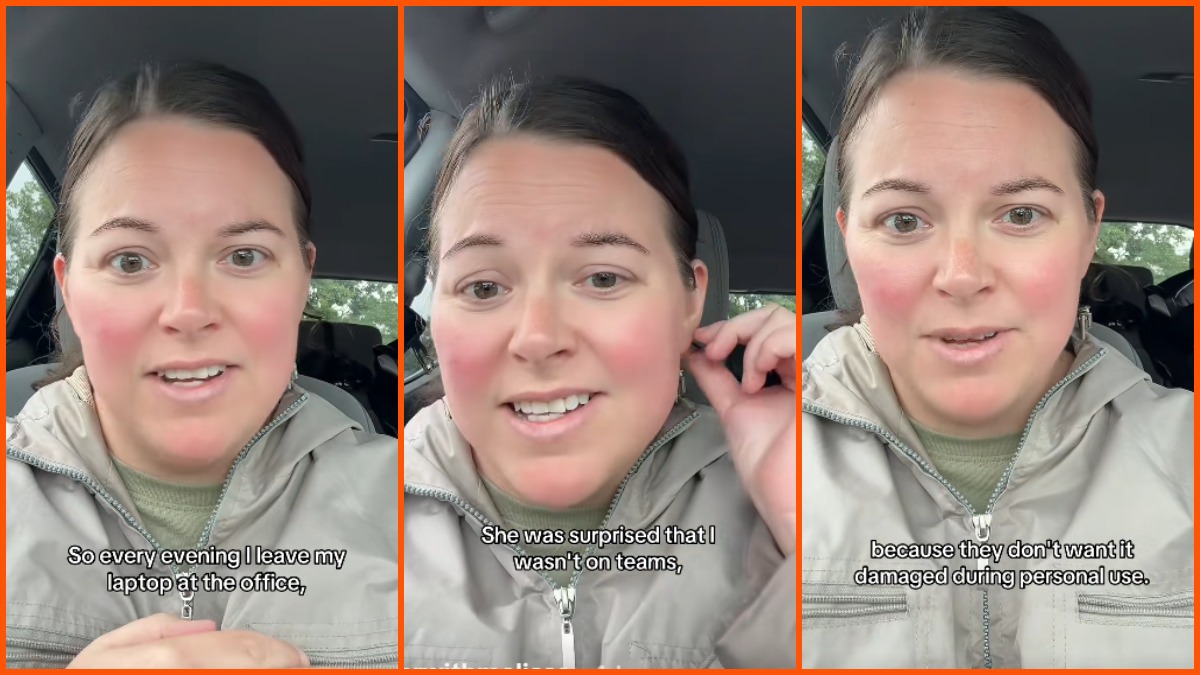

A woman on TikTok says her manager told her not to bring her work laptop home, only to later expect her to respond to an urgent message after office hours. The video, posted by user careerwithmelissa, has drawn attention on the platform for what she describes as a case of company rules working against the person who made them.
Melissa said her manager did not want the laptop damaged from personal use, so she was told to leave it at the office every day. She said she agreed to the rule without objection.
But she said the situation changed when her manager tried to contact her after work hours for something described as urgent. The video’s on-screen text summed up the situation as “Policies work both ways.”
Employee says she followed the no-laptop rule exactly as instructed
In the video, Melissa said her manager explained the reasoning behind the policy directly to her. “My manager told me I’m not allowed to take home my corporate laptop because they don’t want it damaged during personal use,” she said. She responded to the rule calmly, saying, “I said, fair enough.”
Following that conversation, Melissa said she stuck to the instruction without exception. “So every evening I leave my laptop at the office,” she said. She said this became her regular routine after the manager set the rule.
The issue came up again the following week. Melissa said her manager attempted to reach her through Microsoft Teams outside of work hours over a question described as urgent. She said her manager was confused when she did not respond. “She was surprised I wasn’t on Teams,” Melissa said.
Melissa said she then explained why she was unreachable. “And I reminded her that Teams is only on my work laptop, and my work laptop was exactly where she told me to keep it,” she said. The line closes out the video and is presented as the moment that highlights the conflict between the manager’s two expectations.
The caption of the video included the phrase “Looks like I’ll be on Zenfy,” along with hashtags related to job searching, remote work, and job listings. The exact meaning of the Zenfy reference was not explained further in the video or caption.
Melissa’s TikTok account, careerwithmelissa, describes itself as focused on career growth, extra income, and family life. As of the time of the video, the account had 511 followers and 179.8 thousand combined likes across its content.
The shift to remote work has made it harder for some employees to separate their professional and personal time, according to a 2023 CBS News report. The report noted that new laws in some countries have been introduced to address this, aiming to protect time outside of scheduled work hours. The shift to remote work has even extended to housing costs, as a California rental listing drew criticism over a $200 monthly work-from-home surcharge.
In Kenya, the report said, the Employment (Amendment) Bill would give workers the right to disconnect after working hours. According to the bill’s text cited by CBS News, if an employer contacts an employee outside of agreed working hours, the employee “shall not be obliged to respond and shall have the right to disconnect,” and may choose to respond only if compensated for doing so.
The report also said employers in Ontario, Canada, are required to have written policies that outline when work-related communications, including emails, phone calls, and video conferences, are prohibited.
Pete Havel, a workplace consultant and author of a book about toxic workplaces called “The Arsonist in the Office,” told CBS News that new conversations and legislation around after-hours boundaries suggest employers are recognizing the issue. “It looks like somebody got the memo that this is an issue,” Havel said.
According to the report, no similar legislation currently exists in the United States. Havel said this may be connected to a competitive mindset among American workers. “We’re pretty entrepreneurial as individuals and we want that advantage over a colleague. We want to be involved in that big project coming up,” he told CBS News.
Havel said in the report that both employers and employees share responsibility for setting boundaries around after-hours communication. He said managers should be aware of employees’ personal commitments, giving the example that it would be unwise to call an employee with young children around dinnertime. “I think it’s incumbent on the manager to know who he’s calling, or she, and to think before they make that call or send that email,” Havel said.
Havel added that if boundaries are clearly set, a rare after-hours call could signal genuine importance. He also said failing to respect those boundaries carries a risk for employers. “And if it’s not, you’re going to start losing people,” he told CBS News. Such disputes over remote work expectations can escalate, as a pregnant Ohio woman’s request to work from home was denied, leading to a major legal reckoning.
The TikTok video drew a large number of comments from viewers who related to the situation. Many focused on the broader issue of employers expecting availability outside of scheduled work hours.
One commenter described a similar situation involving personal phones and work communication. “‘Allow us to show you how to put this on your phone so you can respond while youre out of office’…” the commenter wrote.
Another commenter responded with a way to push back if a company requires work programs on a personal device. “checks local laws and informs boss if they require me to have work related programs on my personal phone they have to reimburse me for phone bill by state law,” the comment read. A separate comment rejected the idea of urgent after-hours contact outright. “an urgent question after work hours? hell nah,” the commenter wrote. Another added, “Exactly. Nothing is f–king urgent.”
One commenter framed the issue as a management responsibility. “Urgent question after work hours sounds like a management issue, so management should be able to handle it without me,” the comment read. Another wrote, “We’re saving documents here, not lives. Unless you’re an emergency care provider, nothing is truly urgent.”
A different commenter raised the topic from a cultural perspective, asking, “Why do Americans even consider the possibility of getting MESSAGED on personal time?!” A reply offered an explanation: “corporate america has convinced them that their lives aren’t worth anything and their purpose in life is to make their boss more wealthy by any means necessary.”



Published: Aug 9, 2026 05:51 am