


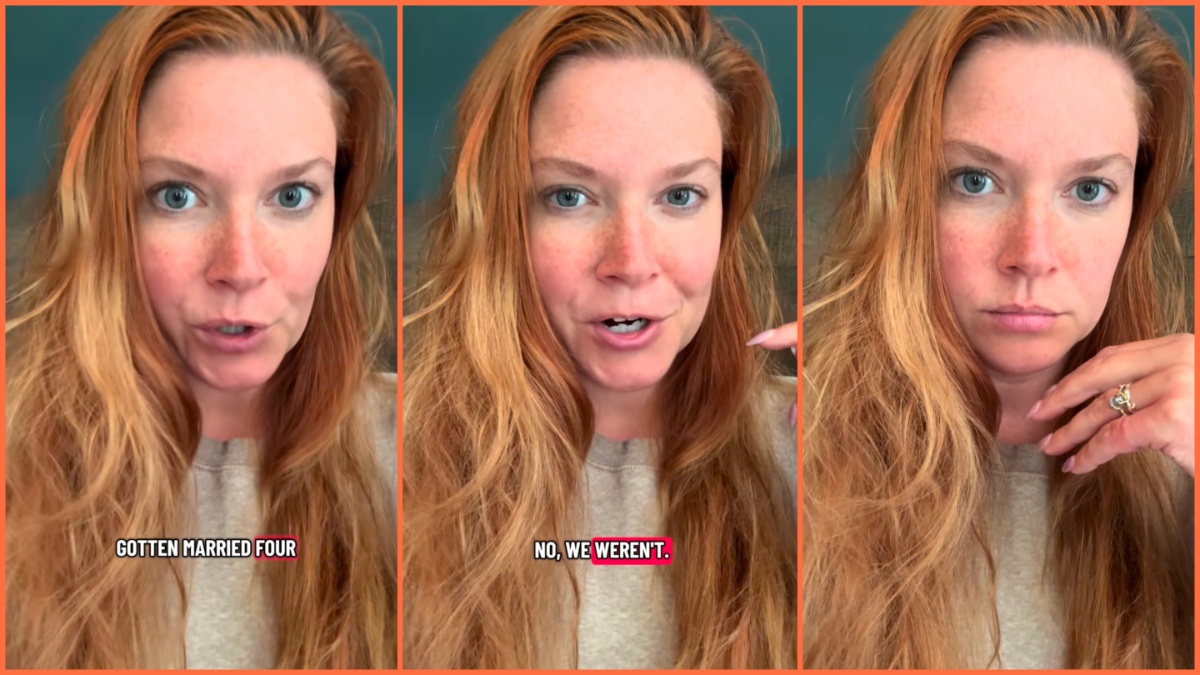

A TikTok creator’s husband called her to mark the anniversary of their honeymoon and it backfired spectacularly — though not for the reason her viewers assumed.
The husband told her that they’d been on their honeymoon exactly one year earlier. “Mmm, no, we weren’t,” the woman recalls telling him. They had been married for four years.
She made a video about the call, and commenters read it as evidence of something worse than bad math. As she describes, the worst-case was that he’d been cheating on her and traveling with a second family. The best case was that he didn’t value her at all to remember something so important.
More recently, however, a photo came up on his phone and he showed it to her father. It was him and his friend Keegan at Keegan’s wedding, he said, three years ago. She was baffled, and told him that was wrong. He tried a different number: “Was it four years ago” Does that sound more right?” Keegan, she told him, had been married for eight years. “And he has three children now,” she said. “A seven-year-old, a six-year-old, and like, a one-year-old.”
The TikToker ends her video by declaring: “It’s not just me. He’s just an idiot.”
One user summarized what everyone watching the video was thinking, or how else would one explain the 100k-plus likes? “Everything you mentioned is a medical red flag. He needs to see a doctor.”
Others echoed the same sentiment. “Girl, why are you telling us and not a doctor?” read one comment, and another added: “This might be extreme, but is it possible that he could be losing his memory or suffering from early onset dementia?”
“Hey girl, I’m bored. Let’s take our husbands for MRIs,” one user wrote.
A medical condition or psychology?
Memory research offers an explanation duller than a second family or early onset dementia. Psychologists call it forward telescoping — the habit of pulling distant events closer to the present when asked to date them. Research has found a large forward-telescoping effect for remote events alongside a smaller opposite bias for recent ones.
The pandemic might have also worsened the phenomenon. Surveying 766 UK adults around the first anniversary of lockdown, Ruth Ogden and Andrea Piovesan reported in PLOS ONE that only 9% felt the preceding 12 months had actually lasted 12 months. 57% said it felt longer, while 34% chose shorter.
That being said, this could just as well be something that needs to be looked at by professionals — as the comments section helpfully suggested — even if the couple appear to have filed it under a running gag for the time being.




Published: Aug 11, 2026 07:26 am