


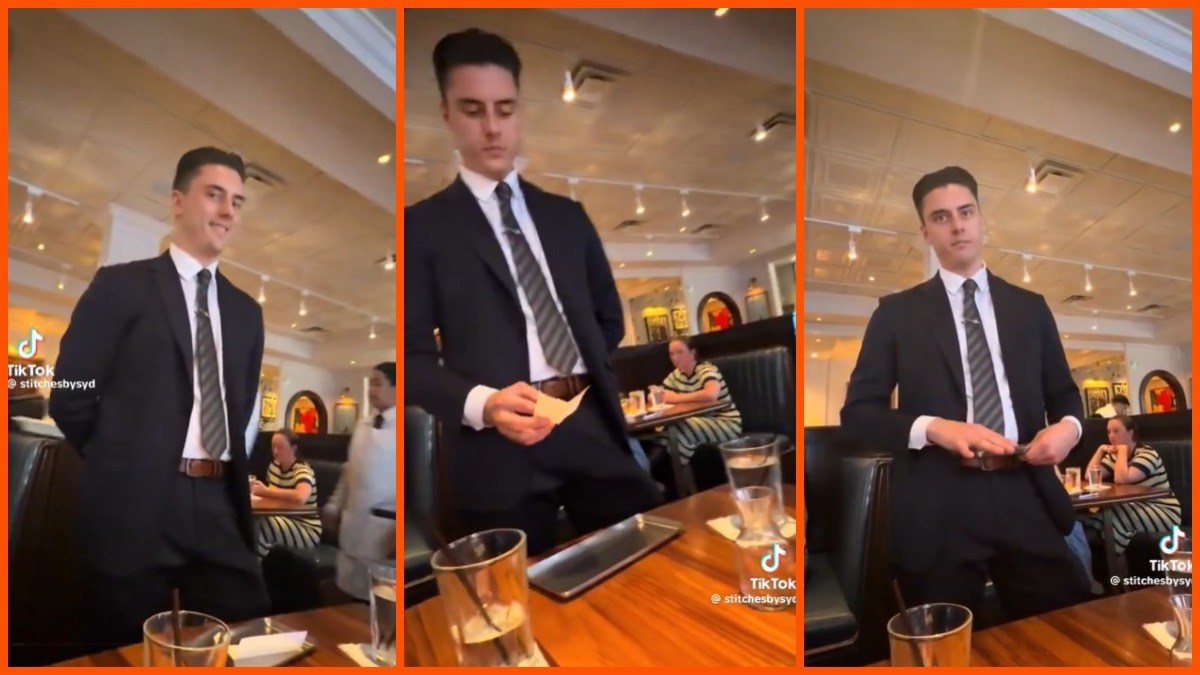

A restaurant manager recently decided that the quickest way to end a dispute with two customers was to comp their bill, but with one major condition: they couldn’t return. This incident was first shared on TikTok by stitchesbysyd, and then reposted on X by @EBTtok. The TikTok profile is private, so all we have as information about the event is from the X user. The video went on to kick up a massive debate and has more than 2.4 million views and 18,000 likes.
According to the X post, the customers were accusing the restaurant of being racist. The reason provided was “because they won’t give them happy hour prices outside of ‘happy hour’.” The post text went on to claim, “This maître d quickly realizes just comping the meal and banning them is much easier than arguing. He knows they just want free food and he can’t win.” It should be noted that this cannot be verified, especially since this isn’t the original poster.
The attached TikTok video is filmed by one of the customers, and captures the manager standing by their table as he listens to their complaint. We don’t know what they were saying at first, but the manager responds by apologizing. At this point, we hear the filmer, a woman, ask, “So, If y’all can’t discount the liquor for your mistake, why not discount the food to compensate for the liquor?”
Choosing a path
As the manager picks up the bill and studies it, a man at the table chimes in, saying, “You gotta give me something, brother. You gotta take the L.” At the same point, the woman says, “You gotta do that to compensate.” The manager sighs and then tells them, “I will go ahead and comp this entire tab.” Then he drops the ultimatum, “However, I’m gonna ask for us not to return.” However, they don’t hear it at first because both of them spoke over him.
The woman had offered a quick “thank you.” At the same time, the man retorted, “I don’t give two sh*ts about the tab; I got the money.” So when the woman asks, “Huh?” the manager repeats his requirement clearly: “I’m gonna ask us not to come back.” The woman then fires back, “It’s fine. We don’t wanna come back anyway, ’cause we done been moved too many times here. . . Thank you!”
It should be noted that a lot of the responses on the post were incredibly racist. However, amongst those who looked at the couple as customers, the response was mixed. Some thought the manager made a mistake.
One user wrote, “As a black man I will say that was the wrong way to handle this. You should have made them PAY! White people! You have to stop letting this work and letting them get away with this! They will learn nothing!” Another agreed, writing, “This was a HUGE MISTAKE by the manager! He should have said no happy hour is over and you need to pay your bill like everyone else if not you’ll be arrested!”
Others praised the manager. One user noted, “Sometimes the smartest move is ending the situation instead of proving a point.” A second user stated, “As someone who worked as a private security contractor for a very upscale bar/restaurant(celebrities/politicians/business leaders), the maitre d did the absolute right thing. Causing a scene and disrupting the atmosphere and business operations are absolute last resort.”
This situation highlights the difficulty of managing customer expectations in the era of social media. According to LS Retail, dealing with difficult customers is a delicate task that requires specific strategies. The article suggests that empowering staff to offer discounts can sometimes turn an unhappy guest into a returning one. One locksmith chose a different track with his customer, choosing threats rather than discounts.
LS Retail notes that, in many cases, providing a small discount or a free item is a low price to pay for customer loyalty. They cited data that suggests a large percentage of customers are willing to return if their complaint is resolved in their favor. However, the article also emphasizes the importance of preventing issues before they escalate. In another recent instance, a server decided to smile and carry on rather than engage.
It suggests that restaurateurs should be proactive by checking in with guests while they are still dining to ensure everything is satisfactory. When things do go wrong, the goal is typically to turn the experience into a positive one before the guest leaves the building.
The manager in this video clearly decided that the relationship with these specific customers was not worth saving. The question is, was his choice to ban them the right way to resolve the difficult situation?



Published: Aug 24, 2026 12:40 pm