



The US military is currently grappling with a widely reported missile shortage, and the US Navy‘s “top admiral” says he has the answer. The purported shortage is widely considered to be a direct consequence of the Trump administration’s war with Iran, known as “Operation Epic Fury.”
“Epic Fury” involved using “overwhelming power” to remove the Iranian regime. In practice this meant firing much of the US military’s advanced munitions at Iran (and then expending missiles to defend against the Iranian response).
To date, regime change has not happened, and, as per the Council on Foreign Relations (CFR), the military is now facing a severely limited stock of advanced munitions that will take a long time to replenish. The Trump administration has denied there is a problem, but says if there is a shortage, it’s Joe Biden’s fault.
“That future has arrived”
Among other things, the CFR report says that the military is down to fewer than 830 Patriot air-defense interceptors, fewer than 280 Terminal High Altitude Area Defense (THAAD) ballistic missile interceptors, and that stocks of Army Tactical Missile System (ATACMS) as well as stocks of precision strike missiles (PrSM) are “nearly exhausted”.
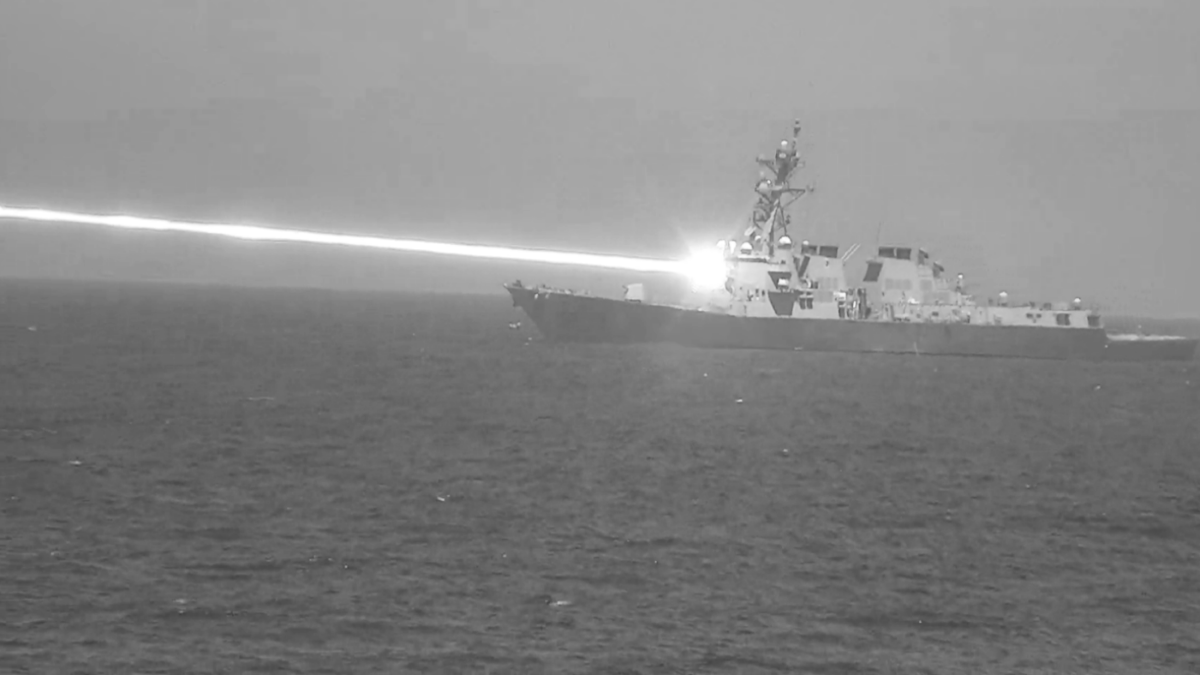
Now the US Navy’s Chief of Naval Operations Daryl Caudle has said lasers are the answer. In a Navy-wide memorandum, Caudle explained that “For decades, directed energy has been described as a future capability. That future has arrived.” He added, “Directed energy operates at the speed of light, allowing sailors to engage threats rapidly with precision and reduced collateral damage.”
He also gently criticized the tactics that have led to the reported missile shortage, saying, “A defender who fires multimillion-dollar interceptors against inexpensive drones may win the immediate engagement while losing the larger campaign of endurance.”
This underpins his case for laser weapons as they don’t require ammunition, as their only limit is the amount of electricity that must be generated to operate them. Caudle said: “Electrical power is becoming combat power. How we generate it, store it, distribute it, protect it and employ it will increasingly determine our combat effectiveness.”
He added: “The future fight will reward the fleet that sees first, decides first, delivers effects first, and sustains combat power longer than its adversary. The fleet that can generate electrical power, convert it into combat effects and adapt faster than its opponent will hold the advantage at sea. Directed energy is a critical step toward building that future fleet.”
Some of these future weapons are already in service, including the High Energy Laser with Integrated Optical-dazzler and Surveillance (HELIOS) system that aims to destroy small drones and small manned attack boats.
The US Navy also hopes the Joint Laser Weapon System (JLWS), developed in collaboration with the US Army will be online soon. This is a far more powerful containerized high-energy laser which is intended to be used defensively against incoming missiles, but would also function as anti-troop weapons, as it’s powerful enough to rapidly burn people to death if fired at them.









Published: Sep 3, 2026 07:06 am