


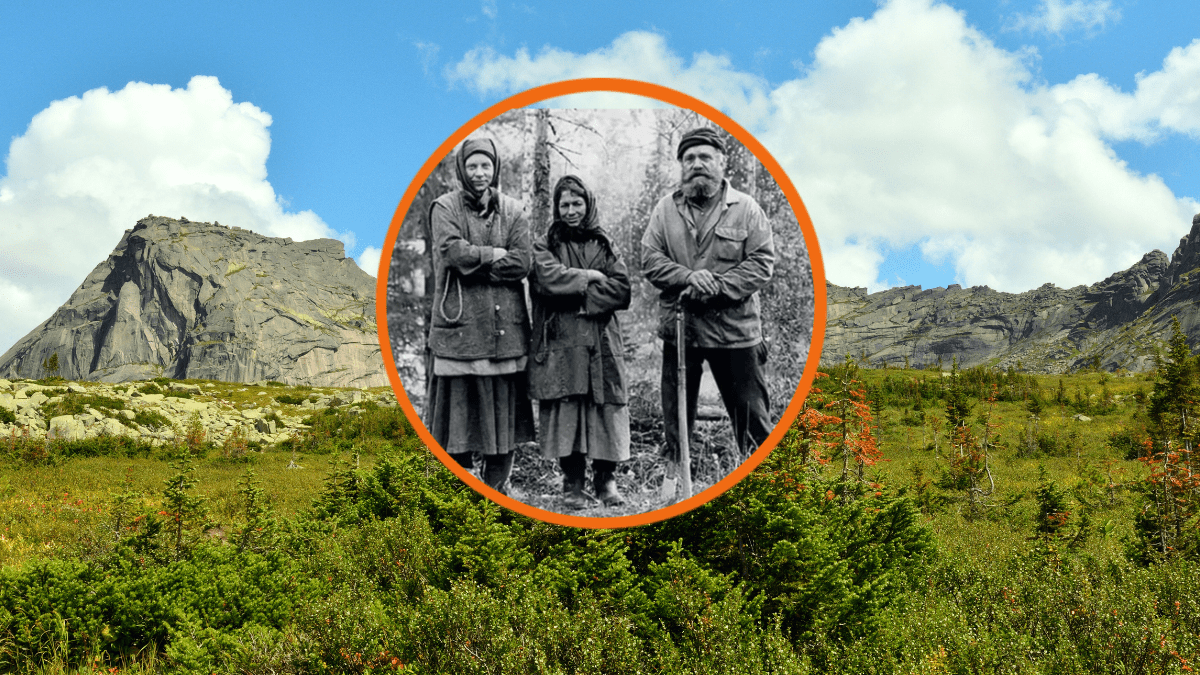

They called them the Old Believers, an apostate branch of the Russian Orthodox Church that adheres to the Old Slavonic texts, their lives spent living by the strict traditions imposed by their ancient ancestors.
Hated by both the Orthodox church and the atheistic Soviet Union, many in the clan chose exile, suffering, and death to preserve their uncorrupted ancient faith. Enter the Lykov family, who in 1936 were Old Believers living in the small village of Lykovo, Siberia, far from the political turmoil of Moscow.
But, as it turns out, not out of reach of Stalin’s purges. In 1936, family patriarch and carpenter Karp Lykov witnessed Soviet patrols gun down his brother in a field. Fearing for his family’s souls if they were forced to abandon their faith, Karp, his wife Akulina, and their two young children, nine-year-old Savin and two-year-old Natalia, entered the wilderness.
Carrying just a Bible, prayer books, axes, and seeds, the family trekked over 160 miles to a remote upland near the Yerinat River, 150 miles from the nearest human habitation. And there they stayed, so isolated from humanity they may as well have set up home on the dark side of the moon. Two more children arrived: Dmitry in 1940, Agafia in 1944.
A family frozen in time
In 1978, Soviet geologists discovered the Lykov family—Old Believers who had lived in complete isolation deep in the Siberian taiga for over 40 years.
— History Photographed (@HistoryInPics) May 22, 2025
Fleeing religious persecution during Stalin’s rule, Karp Lykov led his family into the wilderness in 1936.
They survived… pic.twitter.com/q4vJix8Wgt
World War II came and went, the Cold War and the nuclear age began, and Yuri Gagarin became the first man in space. But the Lykovs were frozen in time and utterly isolated from it all, still living in a flimsy hut and reverting to a prehistoric life with makeshift wooden tools like birch-bark buckets and eating whatever meager crops they could produce. Agafia recalling: “We ate the rowanberry leaf, roots, grass, mushrooms, potato tops, and bark. We were hungry all the time.”
For decades the Lykovs teetered on the edge of starvation. Meat was rare, as hunting meant exhausting, energy-sapping chases without bows or guns. Their crops were constantly on the edge of survival, and in 1961 a freak June blizzard wiped out their harvest. Akulina, refusing to watch her children die, starved herself to death that winter, her family describing it as “a mother’s ultimate devotion”.
They were eventually spotted in 1978 by a team of Soviet geologists scouting for iron ore, who saw the gaunt and ragged family from above. The Lykovs were terrified by the sight of their helicopter, not comprehending what it was. Agafia later described the moment:
“We saw a great black evil bird come flying toward us. It was like nothing we had ever seen before. We ran into the forest and hid, praying to God for deliverance from this devil’s machine.”
After being isolated from technology for almost half a century, even the simplest things dazzled them, with Dmitry seeing a flashlight as a miracle “flame that would never go out.”
In fall 1981, Savin and Natalia died of kidney failure from their austere diet. Dmitry died of pneumonia sometime in the mid-80s, rejecting medicine as sin. Karp passed in 1988 and was entombed on the slopes near his hut.
Only Agafia remains. Now 81, she still lives alone on the land her family claimed, determined to see out her days in the isolation her father chose back in the 1930s. The regional government periodically checks on her: “She is like a Mowgli who has never come across modern diseases. We know how disciplined and cautious we must be to ensure that she stays safe.”
Even providing help to her is difficult: “She is not an easy person to live with, and many people who wish to help her don’t understand her character. She is a child of nature. She needs somebody who would listen to her and obey her orders.”








Published: Nov 4, 2025 09:31 am