


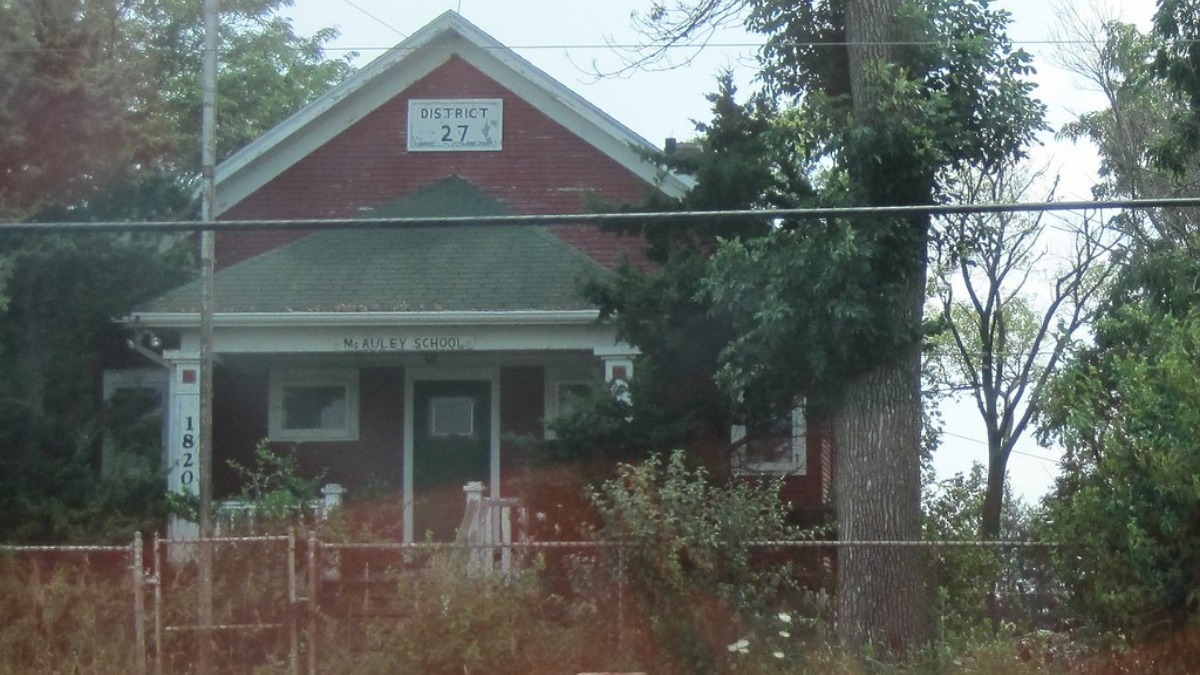

The final chapter for Illinois’ last operating one-room schoolhouse, the McAuley School, is finally being written, and it’s not ending with a wrecking ball. Per The Chicago Tribune, the long-neglected red-frame building in West Chicago, located at 1820 W. Roosevelt Road, is undergoing a $1.6 million restoration. To fit into the modern era, it is being transformed into a functional space for the West Chicago Elementary School District 33.
The schoolhouse has been listed on the National Register of Historic Places since 1982. According to the Tribune, it officially shut its doors back in 1991, largely because industrial development and major expansion at the nearby airport wiped out the student population in the surrounding area. Before it closed, McAuley held the title of the final operating one-room schoolhouse in the entire state of Illinois.
Until then, the tiny 24-by-36-foot building stood as the last holdout of an educational era that dominated the American landscape for over a century. According to Shaw Local, one-room schoolhouses were the backbone of early Illinois education. Millions of students learned their lessons in these small, basic rooms until the mid-20th century, all under the tutelage of one teacher per school.
It was a brutal workload
Per Shaw Local, teachers in those days often managed every grade level from first through eighth while simultaneously acting as the school’s janitor and maintenance worker. It wasn’t exactly a high-paying gig, either. In 1921, a 17-year-old teacher named Dorothy Atlee was hired at a rural school near Yorkville for just $90 a month. She was responsible for everything from teaching eight grades of students to preserving the schoolhouse grounds and furniture.
Not that the pay has gotten better; recently, a teacher went viral after showing how she ‘panhandles’ her way through summer break. Despite that, teachers are valuable to students for the impact they make, from lessons to fun moments. Like the teachers who trolled students last year by racing them to the door.
The reality of these schools was often much grittier than the nostalgic pictures we see today. According to the outlet, many students walked miles through dirt lanes to reach class, often without proper shoes. Inside, the heating situation was hit or miss.
The Gleim sisters, who attended school in McLean County during the 1930s and 1940s, recalled that the students sitting near the heating stove were cozy, while those in the far corners of the building were left shivering as the wind blew through the non-insulated walls. Shaw local noted that despite these rough conditions, the academic results were often surprisingly strong, with many graduates going on to become teachers, attorneys, and industry leaders.
Per The Chicago Tribune, the McAuley School itself began in 1853 after farmer George McAuley donated a small tract of land along what is now Roosevelt Road. The current building was constructed in 1913. By the 1960s, it was actually quite flush with cash thanks to property taxes from a nearby Western Electric parts plant, which provided the district with 70% of its tax support.
After District 33 absorbed the property in 1992, however, the building fell into a long period of neglect. It was used mostly for storing records and equipment. According to the outlet, multiple plans to repurpose it, including a potential Montessori school, fell through over the years.
Today, the $1.6 million renovation is moving forward with a focus on longevity. The Chicago Tribune reported that the project includes a new roof, masonry restoration, improved floor joists, and utility upgrades.
More than half of the funding is reportedly coming from a $925,000 grant from the Illinois Department of Commerce and Economic Opportunity. District 33 plans to use the site as a home for its instructional coaches and as a living history resource where students can tour the building to see what school was like for their ancestors. State Sen. Karina Villa, who helped secure the grant, believes the building is a vital link to the past.
“You think about the stories of your parents and grandparents who said how hard things were and how they had to walk to school for miles and maybe even attend school in a one-room schoolhouse,” Villa said, per the Tribune. “And you might say, ‘Yeah, right, that never existed.’ But yes, we have this beautiful building that is being restored and people will be able to visualize that yeah, that really did happen for some people.”









Published: Jul 21, 2026 11:58 am