


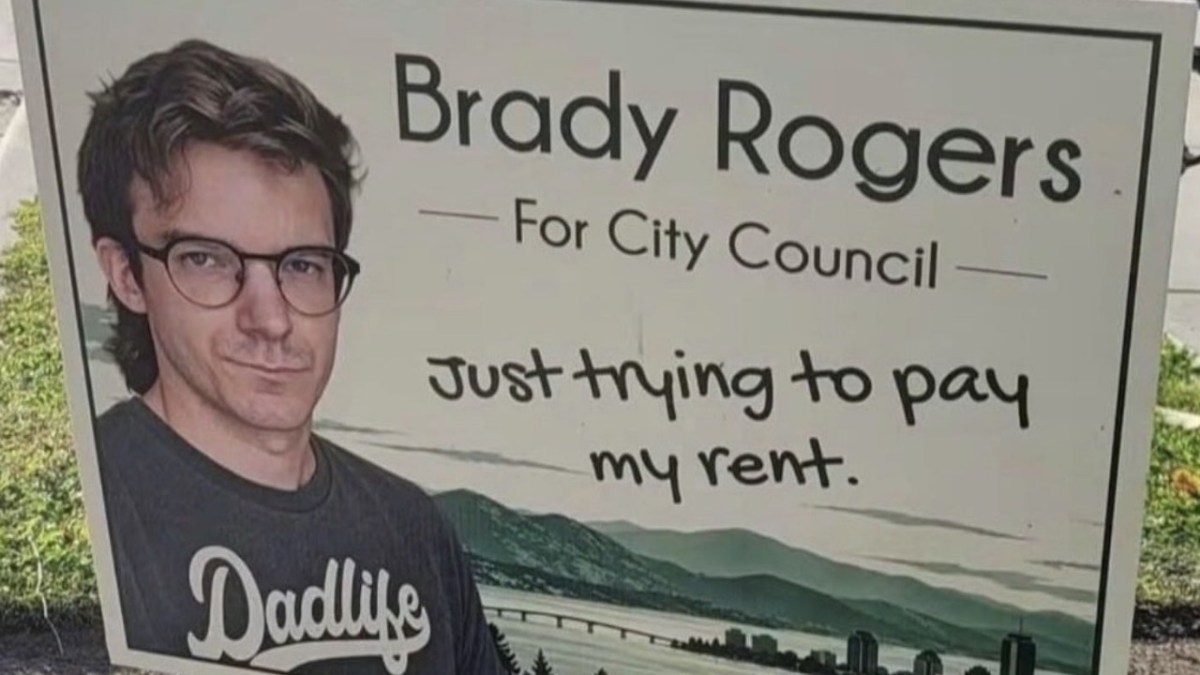

Brady Rogers has officially secured a seat on Kelowna City Council following the municipal election on October 17, winning over voters after his sarcastic campaign signs claimed he was completely unqualified for public office, Dexerto reported. His unexpected victory proved that a creative social media presence and self-deprecating humor can cut through typical campaign noise.
The 33-year-old business owner pulled in 12,635 votes, according to preliminary election results from the City of Kelowna. That tally put him in fourth place out of a massive field of 37 candidates who were competing for just eight open council seats. The official declaration of the final results is expected by October 21, cementing his new role in local government.
Instead of printing predictable political slogans, Rogers decided to go with pure comedy to get noticed. Visitors who checked out his official campaign website were greeted with a candid introduction that went completely viral: “Do I enjoy politics? No. Do I know what I’m doing? No. But am I qualified? Also no.”
His roadside signs were just as direct and funny
One sign advertised “Brady Rogers for Mayor” before clarifying, “Just kidding. City Council.” Another sign featured the message, “Just trying to pay my rent.” He also posted boards that read, “I barely want to do this,” along with text highlighting the fact he is under 60 years old. Another sign said, “Don’t worry, I’ll fix everything,” with a disclaimer: “terms and conditions apply.”
The humor blew up online, racking up more than 100,000 views across social media. American influencer Mandi Jung shared his campaign, which quickly sent the message far beyond British Columbia. “It’s been crazy,” he said. “It resonated locally quite a bit, but then somebody in the U.S. picked it up on Instagram, and now it’s all over.”
Even with all the jokes, Rogers clarified that he was not treating the job lightly. “I’m being a little bit tongue-in-cheek when I say I’m unqualified,” he said before the election. “I’ve never been a politician, but I certainly have experience that I think is very relevant and helpful.”
He brings genuine engineering experience to the table. Rogers worked for four years as a robotic automation engineer before starting The Rogerie, a company that turns plastic waste into new products alongside his wife.
He ran for office because he wanted to solve real community problems. Rogers aimed to help address major local concerns, including housing affordability, homelessness, and challenges affecting small businesses. “I’m really good at solving problems, and I also care about problems,” he said. “And sometimes that means I feel obligated to help with them when they arise.”
Following his victory, Rogers addressed his supporters in a late-night video. He emphasized that despite running a humorous campaign, he takes his new responsibilities on council seriously.
Rogers was not the only candidate trying creative tactics to stand out in a field of 37 contenders. Teresa May posted a video of herself wake-surfing on Okanagan Lake while wearing a suit jacket and high heels. “I want to look still professional enough to look like a city councillor and at the same time, it was to be sort of outside the box,” May said. She wanted to connect with younger voters and drive people to the polls. “With only 30 per cent of the population out voting the last time, that’s not good enough,” May said.
Across the bridge in West Kelowna, Garrett Millsap used a dog to make his bid friendlier. His campaign signs featured his 10-year-old Beagle, Cooper, alongside the message to re-elect his human. “I’m hoping they’re not confusing me with Cooper,” Millsap said. “He’s a little bit better looking, a little more handsome than me.” Millsap explained that the humor helped make politics feel accessible. “I want to engage people, let them see something different, give them a chuckle, and hopefully it engages them to vote,” he said.
Christopher Schneider, a sociology professor at Brandon University and former UBC Okanagan sociology professor, explained that these campaigns fit into a broader shift in how people present themselves online through the mediated self. Social platforms are packed with creators, forcing candidates to build personal brands to stand out.
However, Schneider warned that funny campaigns come with real risks. “There’s always a danger in a democratic society like Canada, where you have people who might be casting ballots for just names on a ballot sheet and not having a full idea or understanding of what that person is campaigning on,” Schneider said.
Rogers will now have the chance to show voters what his problem-solving skills look like in council chambers.




Published: Oct 22, 2026 03:00 pm