


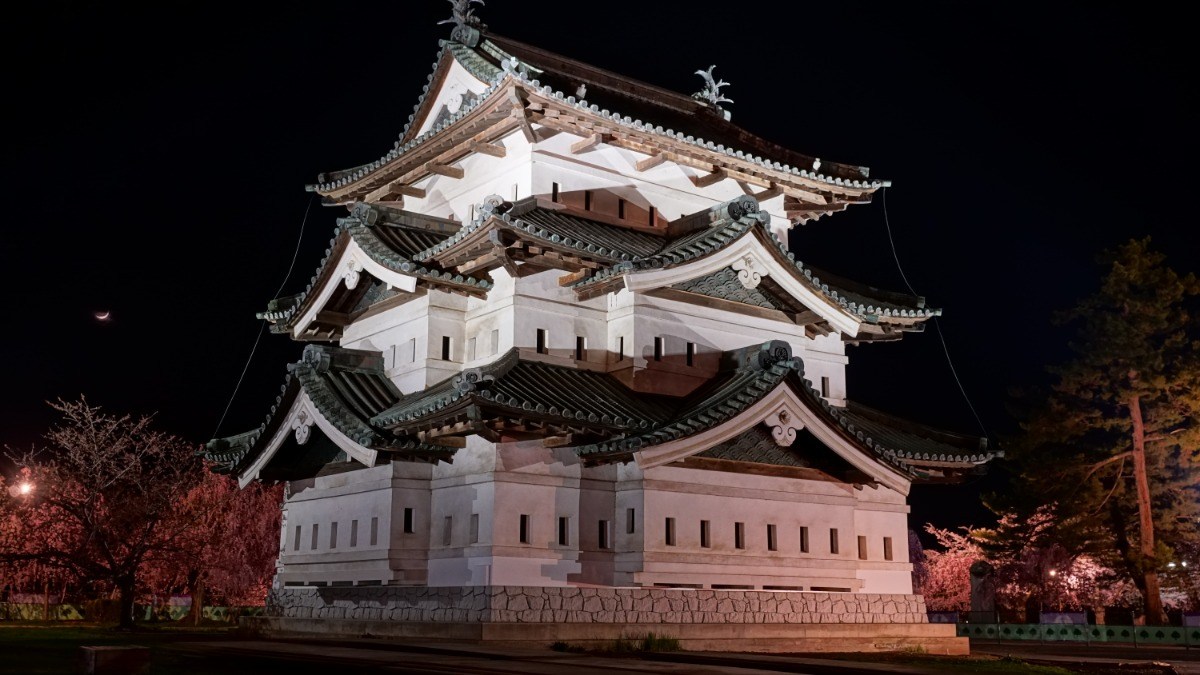

It seems hard to believe that people can physically move a building, let alone a castle, but that is exactly what happened in northern Japan over the weekend. To the rhythmic chants of “so-re, so-re,” about 1,800 people came together to pull the historic Hirosaki Castle, a 360-tonne keep (about 397 US tons), about 2.2 metres, or roughly seven feet, closer to its original foundation.
The Guardian highlighted that this community effort is part of an ongoing, years-long renovation project. The keep, which is a fortified tower, had to be carefully relocated so that experts could repair a wall damaged during a major earthquake. The renovation team moved the massive structure with a process called hikiya.
Kensuke Hayasaka, the head of the parks and green spaces division at Hirosaki City, told the Guardian, “Because the keep is a nationally designated important cultural property, we didn’t take it apart. We’re using hikiya, a building-relocation method that has existed in Japan since ancient times.” The team lifted and placed the keep on rails. Then, with rollers and sheer human strength, the team shifted the building without compromising its historic integrity.
A well-coordinated plan
The logistics of this operation are just as impressive as the history behind it. The Guardian reported that rotating teams of 80 people heaved on 30-metre ropes to nudge the castle forward. On Saturday, they managed to move it 1.13m (3.7 feet), and on Sunday, they added another 1.09m (3.5 feet) to the journey.
The interest in this project was massive. Hayasaka told The Guardian, “We had about 8,000 applications for the 1,800 slots over the last two days, roughly four times oversubscribed, so not everyone could participate. Not only from the city, but from across Japan and overseas; a fair number from south-east Asia and from Europe and North America.”
This is not the first time the public has been involved. According to France 24, the city first called for volunteers back in 2015 for the initial move. That event marked the first citizen-driven hikiya and the first time the method had been used to move a castle in a century. The tower was shifted 80 metres (over 260 feet) back then to allow for the stone wall repairs. This initial renovation was completed in December 2024 with all 2,185 stones returned to their original spots.
For many participants, the experience is deeply personal. Per the Guardian, Motoharu Nakata, 61, travelled all the way from Hiroshima to take part. He told a Japanese newspaper, Sankei Shimbun, “I pulled it 11 years ago too. It’s very moving to be able to participate again. There’s absolutely no other opportunity to pull a castle – it was fantastic.” At least this renovation is going well, unlike a Minnesota artist’s attempts to build a studio, only to have it vandalized.
Others found the physical challenge to be quite intense. Per France 24, Takahiro Kogawa, a 56-year-old local resident, described the task, stating, “It’s like trying to move a mountain.” Another participant, 82-year-old Katsumi Terada, even wore Japanese flags in his headband to celebrate the moment. He shared, “I wondered then, with some anxiety, if I would still be around to see it return to its base. But look, I persevered. I’m alive and well.”
According to France 24, the municipality plans to use heavy machinery starting in September to finish the remaining distance, aiming for a permanent installation by November. In a different case, a man destroyed part of his house with an excavator after an argument with his wife. The manual pulling will continue until the end of August, with about 4,100 people total expected to participate in moving the keep the final 5m (16.4 feet).
The Guardian noted that Hirosaki Castle is one of only 12 such structures left in the country and the only one in the north-eastern Tohoku region. Originally built in 1611, the current structure dates back to 1810 after the original was destroyed by fire. Because of the extensive preservation work, the castle won’t be open to tourists for quite a while.
Hayasaka explained to the Guardian, “Once it’s back on the original base, the preservation work on the keep begins and the whole structure will be covered over. As things stand, we expect it to reopen to visitors in 2033.”
It is clearly a long road to get the castle back to its former glory, but the effort to involve the public makes the project feel like a shared success. Per France 24, Hayasaka mentioned that involving the public was because “we wanted everyone to be able to experience history physically.” Now, these volunteers have a story to pass on to future generations.








Published: Aug 29, 2026 10:15 am