


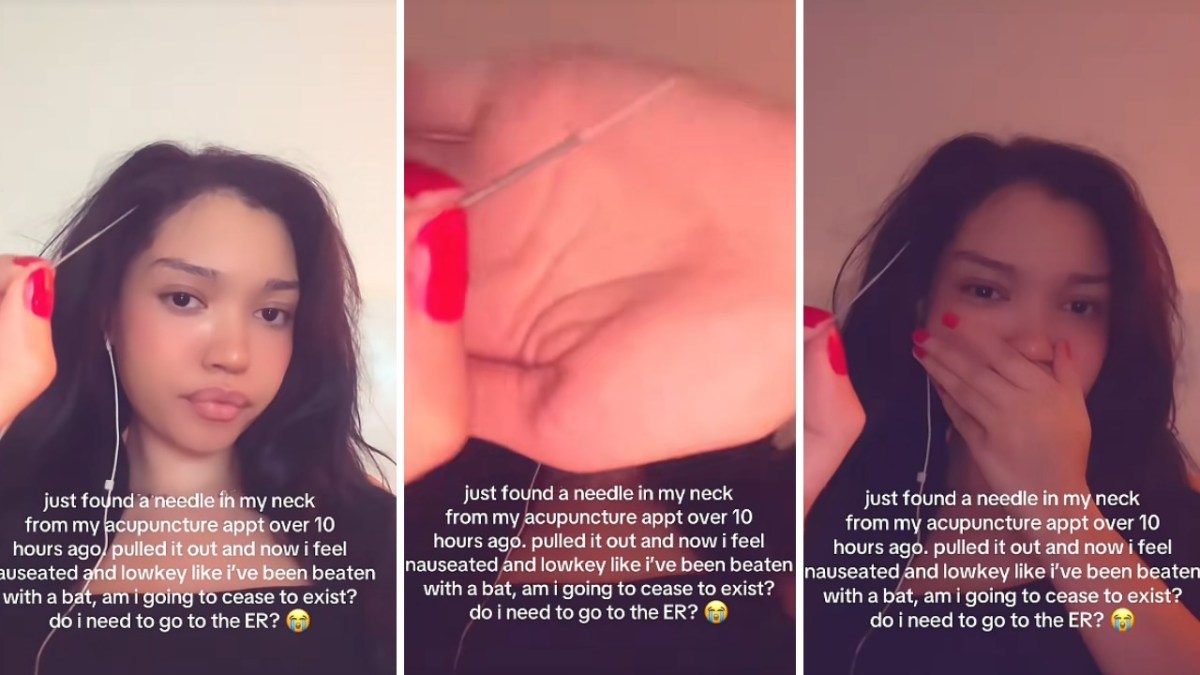

Acupuncture is a traditional health practice originated in China involves inserting thin, sterile metal needles into the body. But what happens if a needle gets stuck in your skin after a session Unfortunately for TikTok user Natalia (@thenataliaverse), she had that experience, which caused her to panic.
A video shows a needle she allegedly pulled out of her neck a long time after her acupuncture session had ended. “Just found a needle in my back from my acupuncture appointment over 10 hours ago,” she wrote via on-screen text. “I pulled it out, and now I feel nauseated and lowkey like I’ve been beaten by a bat, am I going to cease to exist, do I need to go to the ER?” Natalia actually went to the ER, as evident in her second video. Natalia replied to a comment that said, “Baby ER, I’m scared [that’s] a possible infection about to occur. Better safe than sorry!”
Continuing to use on-screen text to communicate, Natalia claimed, “Ok so I started shaking and sweating, and feeling like I was going to throw up and cry, and slight tingling in my legs and hands like cyclically, and feeling typical anxiety symptoms physically, but completely calm mentally. The nurse and doctor (both men) are lowkey [condescendingly] telling me [it’s] anxiety from my brain reacting to seeing the needle and getting me Benadryl. But at least it’s documented so I can get my nerves checked if necessary.”
The anxiety was real
In a third video, Natalia said she got antihistamine medication for anxiety at the ER. “I lowkey feel like I just got diagnosed with like female hysteria and sedated.” In the following video, she then updated, “Acupuncturist emailed basically saying to hydrate and still hasn’t called me yet. I did talk to my doctor though and am picking up an RX that should actually help today.”
In her fifth and final video, Natalia explained why she didn’t want to sue. She said it “could be difficult to prove direct cause” for three reasons. First, she doesn’t know yet whether the symptoms are long-term. Second is that, according to her, this pain is to be “expected” in the week after treatment. Her third and final reason was that it is hard to measure the reactions. It is worth noting that there is no information on how many acupuncture treatments were administered to the woman during that time frame and from which clinic she got her acupunctures.
According to the Mayo Clinic, acupuncture involves inserting extremely thin needles into specific points on the body. In traditional Chinese medicine, acupuncture is described as a method for balancing the body’s energy, or life force—called chi or qi (pronounced “chee”)—which is thought to travel along pathways known as meridians. However, in a U.K. publication, The Nursing Times, it was reported that acupuncture is not risk-free.
In a review of acupuncture treatments administered by the UK’s National Health Service, researchers identified 325 safety incidents. Researchers found that 95.5% of these incidents had little or no impact on patients. The symptoms included things like dizziness, temporary unconsciousness, and, as happened to the TikToker, acupuncture needles being kept in longer than they’re prescribed to be. However, 1.5% of these incidents involved collapsed lungs. In turn, 1% of incidents involved patients having pain and difficulty breathing. 19% reported a temporary loss of consciousness, while 12% experienced hot flushes, headaches, and vomiting. 30% also reported feeling dizzy and faint.







Published: Oct 15, 2026 10:03 am