


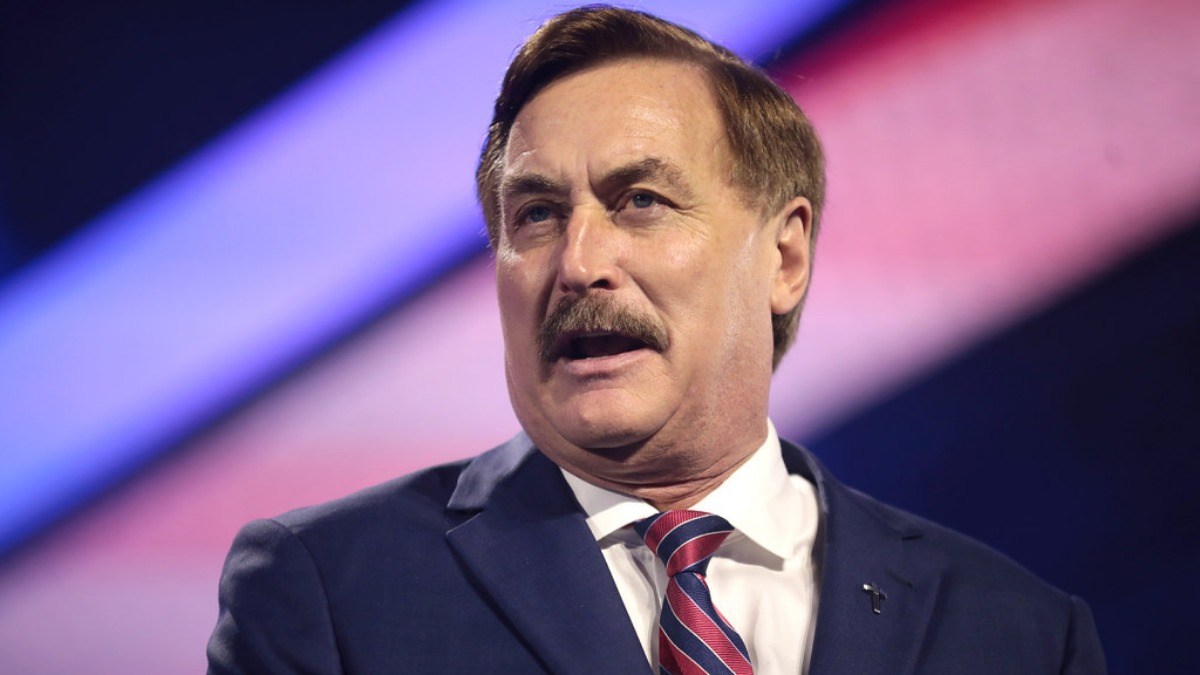

The Minnesota Supreme Court has officially rejected Mike Lindell’s request for a full recount of his loss in the Republican primary for governor. This decision marks a significant turn in the ongoing dispute between the MyPillow founder and Minnesota state election officials following the primary held on August 11.
According to NBC News, the court’s ruling on Saturday confirms that the Minnesota Secretary of State’s Office and the State Canvassing Board followed proper legal procedures. Chief Justice Natalie E. Hudson authored a six-page ruling that dismissed Lindell’s claims of wrongdoing, noting that the state officials were “not committing any wrongful act, omission, or error” as Lindell had alleged.
The legal battle stems from Lindell’s loss to state House Speaker Lisa Demuth, who secured the Republican nomination by a margin of 45,000 votes. Per CBS News, Lindell initially claimed he would personally fund an audit of every paper ballot. He noted at the time, “One of the few good election laws Minnesota does have is that as a candidate, I have the right to completely audit and hand count every ballot in the state.” Lindell added that he intended to use that right “to the full extent of the law.”
Demanding the recount on specific terms
The estimated cost for this effort was reportedly $825,000, which Lindell had pledged to cover. Since Lindell had lost by 11 percentage points, it was well outside the 0.25% threshold that the state would have covered. According to the law, Lindell had to “submit a request for a discretionary recount along with the funds” within five days of the primary.
According to The Hill, he refused to finalize the payment by the Monday deadline after learning that the state’s recount plan would only include ballots cast for himself and Demuth. Lindell subsequently sued the secretary of state’s office. He alleged that they had pulled a “bait-and-switch” by failing to include the other candidates in the field.
Lindell’s campaign reportedly argued that the state’s restrictions put him in an “untenable position.” The campaign stated, “The rest of the candidates’ vote would not be counted under their contingent plan. Nor would the Democrat ballots be recounted.”
The Hill noted that the campaign further questioned the logic of the state’s approach, noting, “In addition to being a violation of Minnesota state law, the anomalies on election night reporting identified by Mike Lindell’s team show an algorithm that applies to ALL of the candidates not simply Lindell and Demuth.”
Despite these arguments, NBC reported that the court found that Lindell’s interpretation of the law was flawed. In her ruling, Chief Justice Hudson clarified the purpose of the recount, writing, “But Lindell’s focus on alleged anomalies confuses the purpose of a manual recount with an election contest.”
Per the outlet, she explained that the plan approved by the canvassing board on August 18 was consistent with established protocol, ensuring that all ballots would be sorted and accounted for in a way that would allow Lindell to verify the results. “In other words, after all votes are sorted and counted, Lindell would know whether he is the winner over Demuth,” Hudson wrote. “And all ballots, in all piles, would be counted and subject to challenge.”
Lindell remains defiant despite the court’s decision. Speaking to NBC News in a phone call on Saturday evening, he confirmed his intention to appeal the ruling to the U.S. Supreme Court. He also indicated that his team is moving forward with requests for election data from all 87 counties under the Freedom of Information Act to conduct an independent investigation. “I’m willing to pay even more money. I don’t care what it costs,” Lindell said.
This isn’t the first time Lindell has faced legal challenges regarding his claims about election integrity. CBS noted that he became a prominent figure after the 2020 election by promoting unproven theories that voting machine companies manipulated results for President Trump. Recently, though, Trump brought up the conspiracy theory that the vote had been stolen by foreign actors.
These actions have led to substantial legal consequences. Per NBC, this included a defamation settlement with Dominion Voting Systems in June 2025. The Hill reported that he also owes $56,369 in sanctions to Smartmatic USA Corp. Lindell has maintained that he does not intend to pay those sanctions or the associated court fees.
As the situation stands, the Minnesota Supreme Court’s ruling reinforces Demuth’s victory. Per NBC, she will now face the Democratic nominee, Sen. Amy Klobuchar, in the general election on November 3. While Lindell continues to argue that there were “anomalies” caused by electronic voting machines, there have been no official findings of fraud or irregularity in the Minnesota primary results.



Published: Aug 31, 2026 08:15 pm