


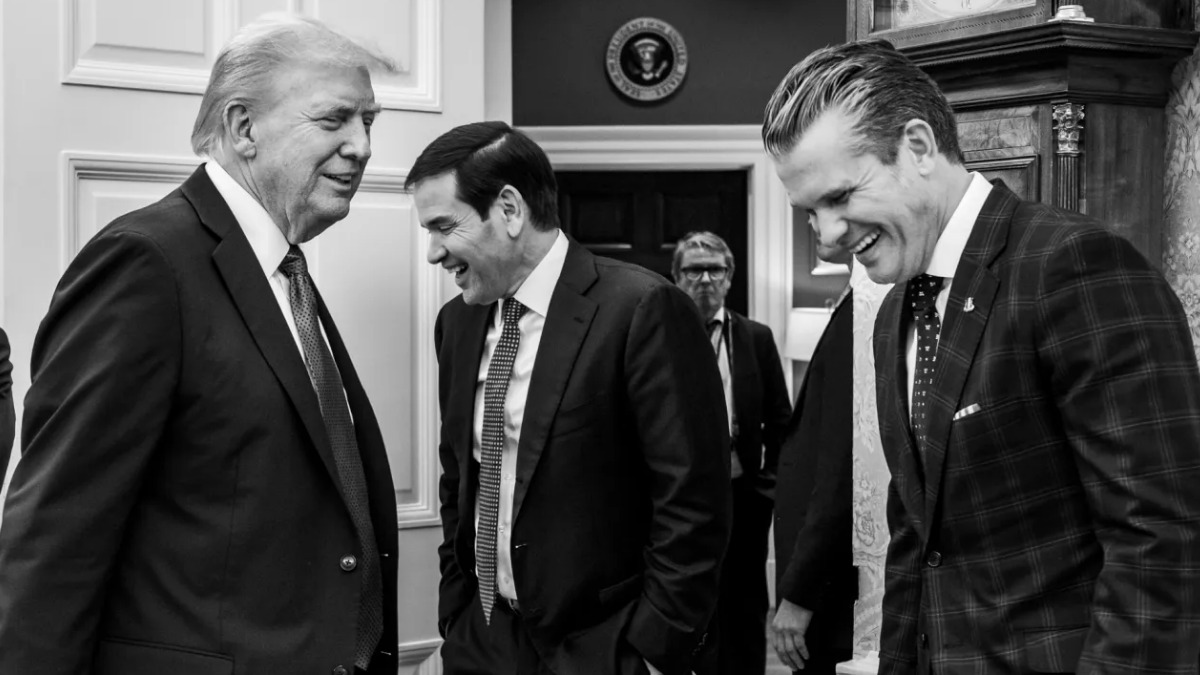

Defense Secretary Pete Hegseth recently made the decision to cancel the deployment of 4,000 troops to Poland at the last minute, leaving Pentagon staff and European allies scrambling to understand what comes next. It’s the latest in a series of abrupt personnel changes that have blindsided both sides of the Atlantic. However, what makes it really strange is that the troops and equipment had already started arriving in Poland when the order to halt came through.
According to three defense officials, it wasn’t clear why Hegseth issued the order. President Trump has frequently expressed frustration with European allies regarding their lack of support for the Iran war, even though he has praised Poland as a ‘model ally’ for its high defense spending. Now, per Politico, this shift has triggered anxiety in European capitals and the Pentagon that such moves could embolden Russia to target a new country.
One U.S. official put it bluntly: “We had no idea this was coming.” They added that officials on both sides have been trying to figure out if more surprises are in the works. Earlier this month, Hegseth announced the withdrawal of 5,000 troops from bases in Germany. It was a follow-through on Trump’s threat after the German Chancellor Friedrich Merz suggested the U.S. was humiliating itself with the conflict in Iran.
Obviously, the US is making it’s relationship with NATO clear
The 4,000 Texas-based troops from the 2nd Armored Brigade Combat Team, 1st Cavalry Division, were preparing for a long-planned nine-month rotation to Poland that included training with NATO allies. Beyond that, a memo signed by Hegseth also canceled the future deployment to Germany of a battalion specializing in long-range rockets and missiles.
The Pentagon has even directed that a command in Europe overseeing those capabilities be removed from the continent. As noted by CNN, these moves are part of a series of actions aimed at reducing the number of U.S. troops following criticism from the president about European support.
Lt. Gen. Ben Hodges, the former commander of the U.S. Army in Europe, expressed deep concern about the strategy. He explained that the Army’s role in Europe is all about deterring the Russians, protecting American strategic interests, and assuring allies.
He noted, “And now a very important asset that was coming to be part of that deterrence is gone.” He also pointed out that Poland has been a reliable partner, stating, “The Poles certainly have never criticized President Trump, and they do all the things that good allies are supposed to do. And yet, this happens.”
The White House has referred questions to the Pentagon, where acting press secretary Joel Valdez defended the move as a carefully considered process. He claimed, “The decision to withdraw troops follows a comprehensive, multilayered process that incorporates perspectives from key leaders in [U.S. military in Europe] and across the chain of command,” and insisted, “This was not an unexpected, last minute decision.”
Despite this defense, the broader strategy remains unclear to many. Some officials have suggested that these cancellations might be a way to work around the logistical challenges of quickly withdrawing forces permanently stationed in Germany, especially those with families on-site.
The Pentagon’s internal talking points have tied these decisions directly to frustration with Europe. It claims that European nations haven’t stepped up when America needed them and that recent rhetoric from Germany has been inappropriate.
Polish officials have reacted in various ways, with some taking to social media to defend the decision while others vented about its impact. Deputy Polish Prime Minister Władysław Kosiniak-Kamysz stated on X, “This matter does not concern Poland,” and linked it to the ongoing efforts to reevaluate the placement of U.S. forces.
Meanwhile, on Capitol Hill, the reaction has been sharp. Democratic Sen. Jeanne Shaheen told reporters that the cancellation was a surprise and that, as far as she knew, they weren’t notified. She called the move very short-sighted, saying, “It sends the wrong message — wrong message to Vladimir Putin, wrong message to China, wrong message to Iran.”
While the Pentagon continues to emphasize a shift in responsibility toward European nations, the reality is that Russia remains a significant concern. Gen. Alex Grynkewich, commander of U.S. European Command, has previously warned lawmakers that Russia remains an enduring regional challenger capable of threatening U.S. interests.
Interestingly, recently, to justify a power move that was clearly aimed at Iran, the Pentagon claimed that revealing the position of a nuclear submarine was just to support allies. However, with troop levels in Europe currently around 80,000, these changes represent a different stance and a tangible reduction in the American footprint.








Published: May 16, 2026 09:33 am