


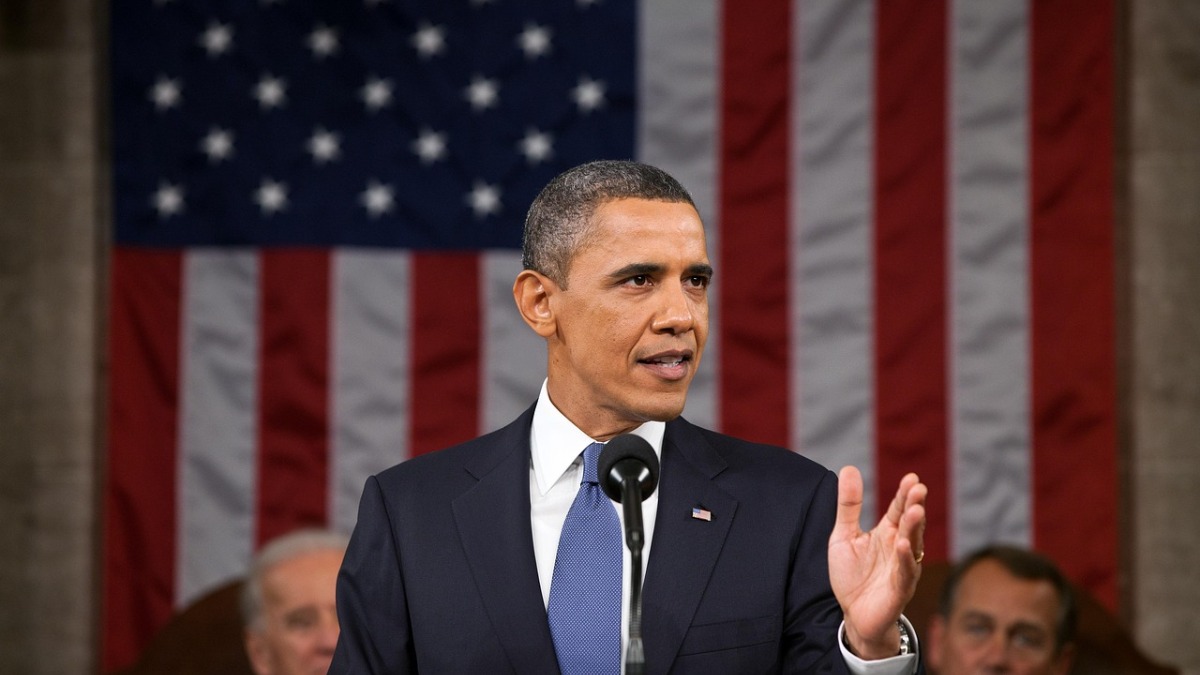

Former President Barack Obama is once again making the case for diplomacy with Iran, as tensions continue to rise. In a recent interview with Stephen Colbert on The Late Show, Obama argued that the 2015 Joint Comprehensive Plan of Action (JCPOA) was a major achievement that showed diplomacy could constrain Iran’s nuclear program without using military force.
“We went about trying to negotiate a diplomatic agreement that would get the enriched uranium out of Iran, that would assure they could not get to a nuclear weapon without us knowing about it… and that there were mechanisms in place to enforce it and verify it,” Obama explained, according to The Hill. “And we pulled it off without firing a missile.”
The JCPOA required Iran to reduce its stockpile of enriched uranium by nearly 98% and open its facilities to international inspectors. The deal also capped Iran’s uranium enrichment level below 4%. In return, the United States, Russia, China, France, the United Kingdom, and Germany lifted economic sanctions against Iran.
The Iran nuclear deal worked, and Trump’s decision to leave it made things significantly worse
Obama’s administration considered using military force against Iran but ultimately chose diplomacy instead. The former president recalled that his team believed Iran’s nuclear program was a serious threat to regional and global security, but that Iran was not entirely irrational and had a survival instinct.
Iran agreed to major restrictions on its nuclear program through long and complex negotiations. As Obama noted, the deal worked without military action or the killing of innocent people. The JCPOA remained in effect until President Trump pulled the United States out of the agreement in 2018, calling it a “horrible, one-sided deal that should have never, ever been made.” Trump’s history of using Iran tensions for political gain has been a recurring point of criticism from his opponents.
European partners tried to keep the deal alive after the U.S. withdrawal, but Iran accelerated its uranium enrichment the following year. Today, Iran holds a stockpile of uranium enriched to 60%, far closer to the 90% weapons-grade level. The deal’s sunset provisions, which critics argued would only delay Iran’s nuclear ambitions, have now become a major issue in current negotiations.
Trump has insisted that Iran cannot be allowed to possess any highly-enriched uranium, which remains a sticking point in ongoing talks. Still, he has claimed he can reach a better deal than Obama’s administration did.
“If a Deal happens under ‘TRUMP,’ it will guarantee Peace, Security, and Safety, not only for Israel and the Middle East, but for Europe, America, and everywhere else,” Trump wrote in an April post on Truth Social. Recent reports show that Trump rejected Iran’s peace proposal, prompting the Pentagon to reveal the location of a U.S. nuclear submarine in a show of force.
The BBC reported in 2019 that Sir Kim Darroch, the UK’s former ambassador to the US, wrote in a leaked memo that Trump’s decision to leave the JCPOA was an “act of diplomatic vandalism” driven by “ideological and personality reasons.” Meanwhile, Pakistani intermediaries continue to carry peace proposals between the U.S. and Iran, but the outcome of current negotiations remains uncertain.






Published: May 15, 2026 01:56 pm