


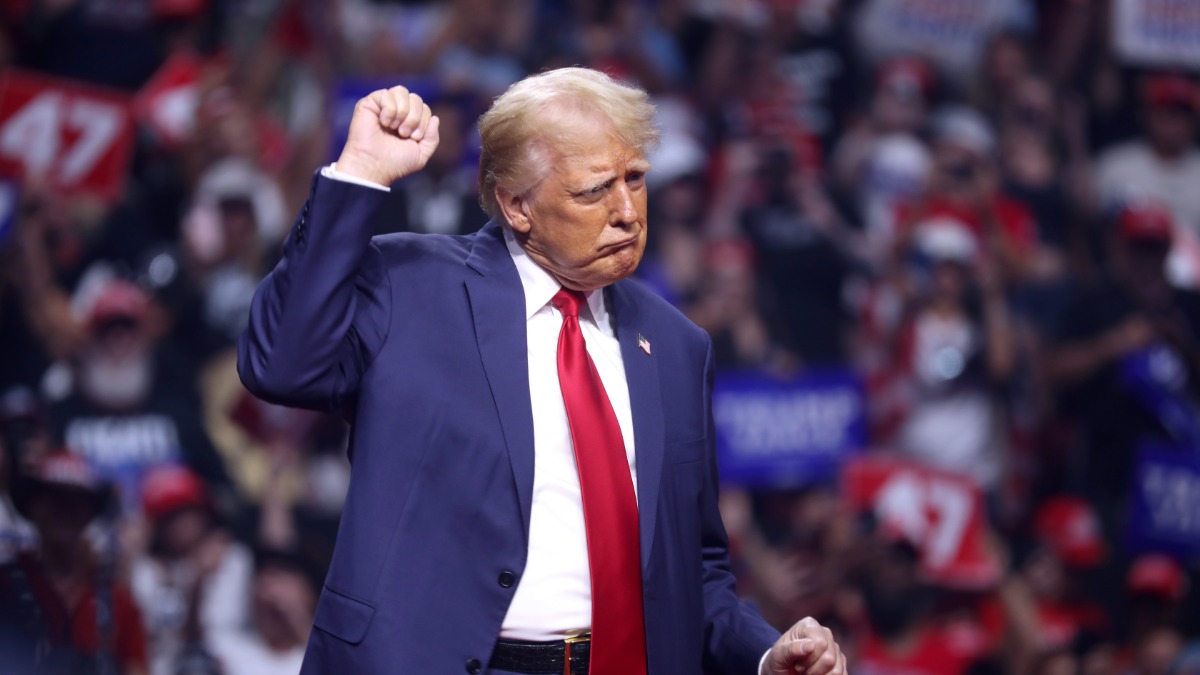

President Trump’s recent visit to Beijing, for a summit with President Xi Jinping, has ignited a really strange divide in how his behavior is being perceived on the global stage. I guess it isn’t surprising, given how vehement he has been in his comments about China. Everyone, including me, was expecting posturing and maybe some intimidation. Well, for one body language expert who did a breakdown for the NY Post, that is what she saw, and it is a little bit disturbing.
Lillian Glass, a Florida-based body language expert who has served as an expert witness in federal and state courts, was fawning. “I think that Trump feels the power, feels like this is a formidable meeting. He is not intimidated by Xi at all. He’s showing, kind of like a peacock or a lion, he’s showing his power,” Glass noted. She described his posture as “very straight” and “like a military person,” and that his actions “showing his gravitas, nothing contrived. He really felt it.”
Of course, she is just one person, and when you consider her observations with those of The New York Times, you begin to see a completely different picture. When Glass saw dominance, NYT saw a president who did a complete 180 from his usual rhetoric to be flattering towards Jinping. It was an interesting move, considering he even delayed this trip, seemingly over Hormuz. On the other hand, China came in with a tight script and disciplined strategy.
Honestly, though, Glass’s observations are just disturbing
In her breakdown, Glass further emphasized that the president appeared entirely focused during the proceedings. She pointed to the interaction between the two leaders as evidence of a genuine rapport, noting that there was a “mutual warmth” present throughout the visit.
“Trump was very friendly with patting him,” she observed. “They were in close proximity with each other. There were a lot of smiles.” According to her analysis, the back pats were a “power move” that also served as “an affection move.” She suggested that there is “some genuine affection between the two” and that “they really do like each other, you could tell.”
On the flip side, looking at words and actions, the NYT noted that rather than focusing on flattery, Xi Jinping wasted little time before setting firm boundaries. Xi reportedly made his stance on Taiwan clear early on, stating, “The U.S. must handle the Taiwan issue with utmost caution.” This warning served as a stark reminder that the Chinese leadership views the relationship through a lens of strategic positioning rather than just personal connection.
The NYT also highlighted that while Trump adopted a conciliatory tone, frequently praising Xi as a “great leader,” the Chinese side remained focused on long-term geopolitical stability. Xi’s approach involved using historical context at the Temple of Heaven to frame the modern relationship, while simultaneously warning that if handled poorly, the two countries could face an “extremely dangerous situation.”
This creates a jarring disconnect between the president’s optimistic rhetoric about a “fantastic future” and the substantive, often contentious issues like Taiwan, rare earths, and nuclear expansion that underpin the current global landscape. The difference in focus is striking.
Glass waxed on about Trump’s posture and pace as ways to silence critics who had concerns about his health. She also insisted that anyone who accused the president “needs to look at themselves,” because in her view, “there’s nothing neurologically impaired about him.” Clearly, she never looked at anything of substance or the actual meetings.
Meanwhile, the geopolitical reality involves the two nations trying to avoid what scholars call the Thucydides Trap. It’s where a rising power and a status quo power risk conflict. Xi proposed a focus on stability, yet his administration was clearly using the summit to lock in a baseline that favors China’s long-term interests.
Additionally, a delegation of business executives had traveled with Trump to show respect for the Chinese market. This included Elon Musk, who didn’t actually have permission to travel. However, they stood in contrast to the absence of top-tier Chinese tech executives on the other side of the table.
As the president prepares for smaller, leader-to-leader meetings, it remains to be seen which version of these talks will define the long-term outcome of this visit. Then again, other body language experts didn’t quite have the same view.




Published: May 15, 2026 01:52 pm