


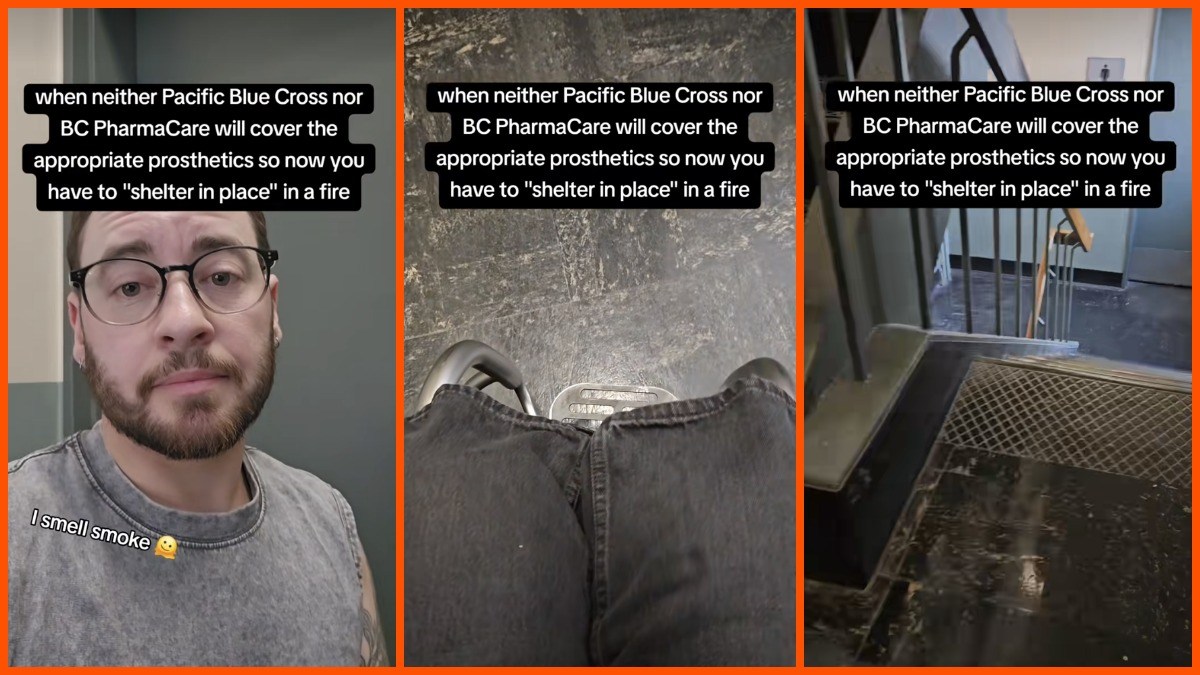

For most people, a fire alarm is a trigger for action: evacuate and call for help. Concern for belongings aside, for millions around the world, it’s the start of a terrifying wait. The Tweedy Mutant, a bilateral above-knee amputee living in British Columbia, Canada, recently highlighted this when an electrical fire broke out in his building. With the elevators out of service, he was forced to wait at a fire shelter for a firefighter to assist him.
The video, shared on Instagram and TikTok, has sparked a necessary conversation about the need for access to medical equipment like prosthetics so that people with disabilities can live safely and independently. Especially in a world controlled by insurance companies. The video itself is simple but powerful. He looked at the camera with fear, showed everyone his legs, then pointed down the stairwell. At the end, we see him again, and the overlay text read, “I smell smoke.”
What really hits the viewer, though, is the other overlay text attributing his fear and frustration to a company. He alleged, “when neither Pacific Blue Cross nor BC PharmaCare will cover the appropriate prosthetics so now you have to “shelter in place” in a fire.” The post went on to get over 252K views on the platform, validating his anger. That this situation would have been avoidable, and he wouldn’t have to fear for his life, if his prescription hadn’t been denied.
An old solution that saved a life on 9/11
The Tweedy Mutant really laid out his frustration in the caption, starting with a historical fact. He wrote, “On September 11th 2001, an amputee using a C-Leg microprocessor knee descended 70 flights of stairs to escape the World Trade Center.” He then alleged, “Meanwhile, I’m on the 9th floor wondering if an electrical fire is going to end me because neither BC PharmaCare nor my two Pacific Blue Cross plans will cover the microprocessor knees I have been prescribed.”
The insurance denial is something Tweedy claims, and as such it cannot be verified. However, the facts he mentioned are illuminating. Tweedy mentioned that the C-Leg prototype was invented by a Canadian named Kelly James in 1992 and hit the market in 1997. However, three decades later, the technology is still inaccessible to anyone in Canada who isn’t wealthy.
He claimed that he was quoted $138,000 for the equipment. The PhD student noted, “That’s not something I can pay out of pocket. That’s a “thank goodness I have insurance!” price tag — except that my University of British Columbia PBC plan only covers $1000 per leg per year and my individual PBC plan only covers $1000 per lifetime (which was used up on an AFO brace in 2023 because that plan considers braces and prosthetics as part of the same benefit).”
He claimed that neither of his plans covers microprocessor knees, and BC PharmaCare only provides coverage for mechanical knees. This, he argued, “are not adequate for a bilateral above-knee amputee like me to walk unaided in real-world settings.”
Tweedy also addressed the common misconception that Canadian care is inherently superior. He pointed out that through Medicare, the US covers microprocessor knees, even if the patient is a grandparent with limited activity levels, compared to his very active lifestyle. Tweedy emphasized that he believes everyone should have access. However, he pointed out that it is the coverage, rather than actual capacity, that is the real limiting factor.
According to Physiopedia, prosthetic knees are divided into two categories: mechanical and computerized. Mechanical knees, such as single-axis or polycentric designs, often rely on simple hinges or linkages. While they can be durable and economical, they lack the advanced control needed for complex movements like navigating stairs.
Computerized knees, or microprocessor knees, reportedly use sensors to adjust flexion and extension in real-time. These units are designed to lower the effort required for walking, provide better stability on uneven terrain, and allow for a more natural gait. Systematic reviews have shown that these devices improve functional mobility and balance confidence, which is why they are often the gold standard for active individuals.
His viewers agreed with his anger at the system. One Instagrammer commented, “I saw a thing today about a claim for a wheelchair being denied for a man with no legs. NO LEGS!! No wheelchair!! WTAF!!??” Another added, “As an American, Canadian healthcare scares the hell out of me and that’s saying something because our healthcare also sucks.”
On TikTok, one user shared something they learned after a broken ankle: “My classmates all asked what would happen in a real fire if someone couldn’t ass-slide down the stairs – and I had to tell them the GLOBAL protocol is to leave disabled people in burning buildings.”






Published: Sep 12, 2026 02:00 pm