


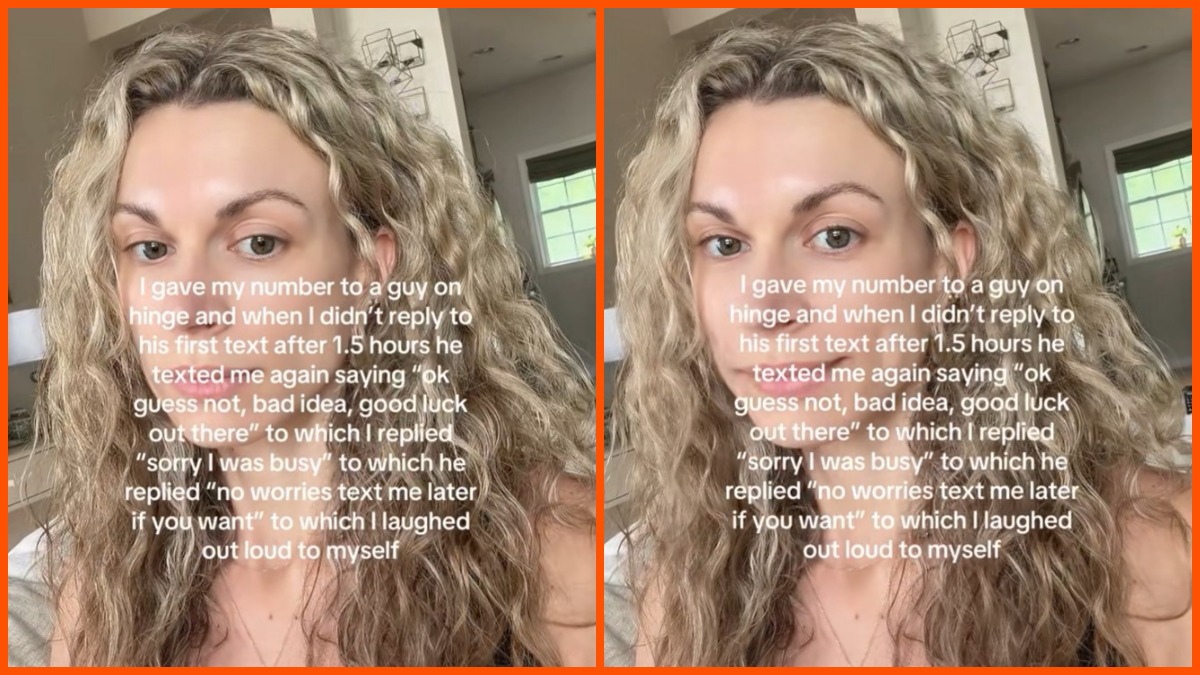

A Massachusetts woman is currently making waves on TikTok after sharing a communication hiccup with a match on Hinge. Ashley Esper’s video has already racked up over 250K views for detailing what happened when she didn’t respond to a man’s text within 90 minutes.
In the post, the TikToker explained the situation through the on-screen text. She alleged, “I gave my numer to a guy on hinge and when I didn’t reply to his first text after 1.5 hours he texted me again saying ’ok guess not, bad idea, good luck out there’ to which I replied ‘sorry I was busy’ to which he replied ‘no worries text me later if you want’ to which I laughed out loud to myself.” In the caption, she illustrated her feelings on the matter, writing, “dodged a bullet.”
Interestingly, the comments showed two different perspectives on her version of the story. It should be noted that we have no way to verify her claims. A large portion of the community saw his expectation of her attention as a red flag, while a smaller group thought she was the problem. One user addressed both, writing, “‘a text only takes 3 seconds. a simple i’m busy-’ that’s for people you have an established relationship with, not someone you just met.”
Staying available to text
The users who thought she was in the wrong faulted her for not giving her match a heads-up. One user argued, “You immediately let him know he was not important enough to respond to. You could have just let him know you were busy and you’ll chat later. A text takes literally under 30 seconds. He has a valid irritation.”
Another speculated, “Who wants to bet she did in fact use the phone during that time, and very much could’ve taken 15 seconds to say busy at work, but I can get back to you at 5pm when off.” This led one to declare, “Bro is the one that dodged.”
Despite that, a larger portion of commenters seemed to be on Esper’s side. One person noted, “the age of the cell phone has created a false sense of availability.” Another wrote, “this is insane… I feel like 48 hrs is reasonable for replies but maybe i’m just old?? like people have work, class, family, appts, friends. is he just sitting around staring at the phone.”
Others shared their own horror stories. One user shared, “I once didn’t answer a guy for 20 minutes he legit said ‘gotta do better than that sweetheart if you wanna be in a relationship with me’ I couldn’t block him fast enough. I had known him a day.” Another thing that has an impact is what is said, and texts that feel aimed at someone else, or to a dog, can throw off communication.
This situation perfectly illustrates the psychological weight we place on reply speeds. According to research summarized by Mosaic, the seconds between sending a message and receiving a reply carry profound psychological weight. They often reveal deep truths about attachment styles and emotional connection. Healthy relationships usually see response times of 3 to 5 minutes during active conversation and 1 to 3 hours otherwise.
Expecting that kind of speed from a total stranger, however, is a different story. The issue, Mosaic notes, often stems from our brains trying to apply face-to-face social rules to an asynchronous medium. In person, a 200-millisecond response is a sign of social attunement, as noted in research published in the Proceedings of the National Academy of Sciences. In today’s age, AI paranoia about the content of the message can also impact evaluation of attunement.
When we move to text, those natural expectations get warped. As Mosaic points out, our unconscious mind interprets delays through the lens of in-person interaction, where silence might signal rejection. This leads to what researchers call “communication performance anxiety,” where people feel like they’re constantly on stage.
Different attachment styles reportedly play a huge role here. People with anxious attachment styles, who make up about 20% of the population, are often hypersensitive to timing and might interpret a delay as a sign of disinterest. Meanwhile, those with secure attachment styles tend to adapt to the context without catastrophizing.
It’s also interesting to note that gender can play a part. Mosaic wrote that studies found that women are often more likely to adjust their expectations based on the situation. Men, however, are sometimes less concerned with response timing overall.
Mosaic suggests the goal should be to communicate with intention and empathy, rather than feeling obligated to be available 24/7. If you find yourself feeling stressed by responsiveness, yours or someone else’s, it might be worth remembering that everyone has their own life, schedule, and boundaries that have nothing to do with you.






Published: Aug 2, 2026 09:03 am