



Animals are capable of amazing things that most people never get to see. Unless a content creator like New Jersey resident Courtney comes along to share the little miracles of nature. Courtney has four geckos as pets, and most of her content on Instagram (murielthegecko) and TikTok (frecklesandgeckos) revolves around them. In August, she made a fascinating discovery in the enclosure of her Leachie gecko, Skitty.
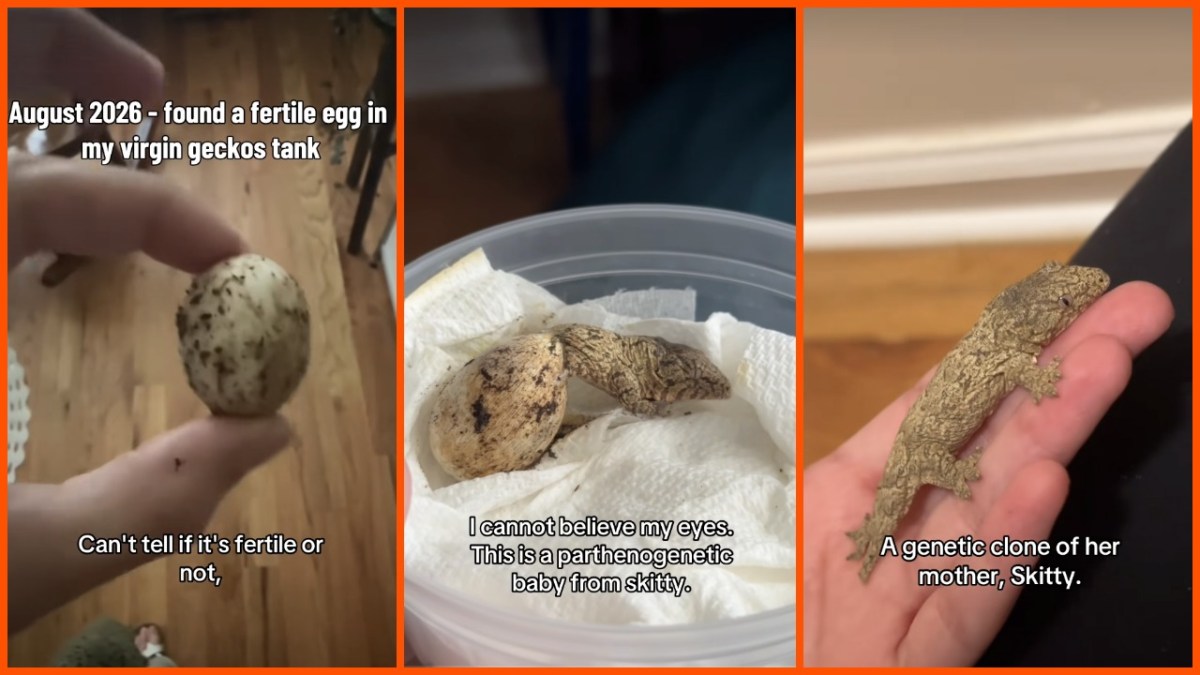
In a post with over 2.5 million views, Courtney held up an egg to the camera. She said, “I just found this egg in Skitty’s tank. Can’t tell if it’s fertile or not, but it’s like a perfect ball. She unearthed it while she was digging for superworms.” In the caption, she noted why this was special. “In positive news: I had my first egg via parthenogenesis hatch successfully!”
She wrote, “Skitty laid this egg a few months ago didn’t find It in her tank until recently. Leachie geckos have the ability to reproduce without a mate – Skitty has never been with a male before. Many partho babies come out deformed or don’t even breach the egg successfully. The babies are a genetic clone of their mothers.” Therein began Courteny’s wait to see if the egg was going to result in a new, healthy gecko baby.
A reproduction process that doesn’t need a male
Parthenogenesis, a term derived from Greek roots meaning “virgin creation,” is a biological marvel where offspring are produced without fertilization. According to National Geographic, this process allows a small subset of animals to have so-called virgin births.
Courtney was understandably excited as she watched the process unfold. In her video, she captured the moment the egg began to hatch. In the footage, half of the newt was outside the eggshell. She noted, “I cannot believe my eyes. This is a parthenogenetic baby from Skitty. He’s still in the egg, absorbing the yolk. I am praying that he is not deformed. Or she. This is a genetic clone of Skitty.”
“I’m praying that she is not deformed,” Courtney told her viewers. “Oh, my god. I’ve never had a healthy partho baby hatch. Courage (Skitty’s sister) made one that was deformed, and I cut the egg open, and, uh, obviously it did not survive. But this one is alive.”
The final portion of the video shows Courtney holding the tiny, healthy gecko. She tells her audience, “And here is Skitty’s partho baby, which is a baby laid from an egg without a mate. She looks fully healthy. No deformities. Here’s hoping she does well in the world. She is absolutely adorable. A genetic clone of her mother, Skitty.” At least there were no signs of warts or zombie-like features as seen on squirrels earlier this year.
The reaction online was enthusiastic. National Geographic even chimed in on the Instagram post, commenting, “This is AWESOME!” Other users were just as amazed, and many had questions. One TikToker was shocked, noting, “Back it up… they can CLONE themselves?!?”
One commenter explained, “For anyone asking. This is not gecko exclusive, this can happen in a lot of reptile species from snakes like anacondas & reticulated pythons, to leopard geckos all the way to Komodo dragons and Monitor lizards. Babies can be full or partial copies of mum and most are usually female replicas. This has been well documented amongst many species.”
Other followers had some fun with the news. One user joked, “Getting a clone of your pet for free is so rad.” Another added, “Geckos be bored and be uh I have no male I’m a clone my self cuz bored.” On TikTok, one user joined the many others suggesting names, writing, “Honestly I would name her mitosis.”
As National Geographic notes, parthenogenesis has been observed in more than 80 vertebrate species, including fish and lizards. While it is rare for complex vertebrates to rely on this method, it serves as a fascinating survival strategy that allows animals to pass on their genes without the energy-intensive process of finding a mate. Interestingly, Turkeys can reproduce this way.
Courtney ended her post with a mix of humor and affection for her grumpy pet. She noted in her caption, “Here’s to hoping Skitty’s little baby has a happy and healthy life ahead. Although I am not sure the world is ready for another Skitty since she is quite the grumpy b—h.”






Published: Oct 5, 2026 06:25 am