


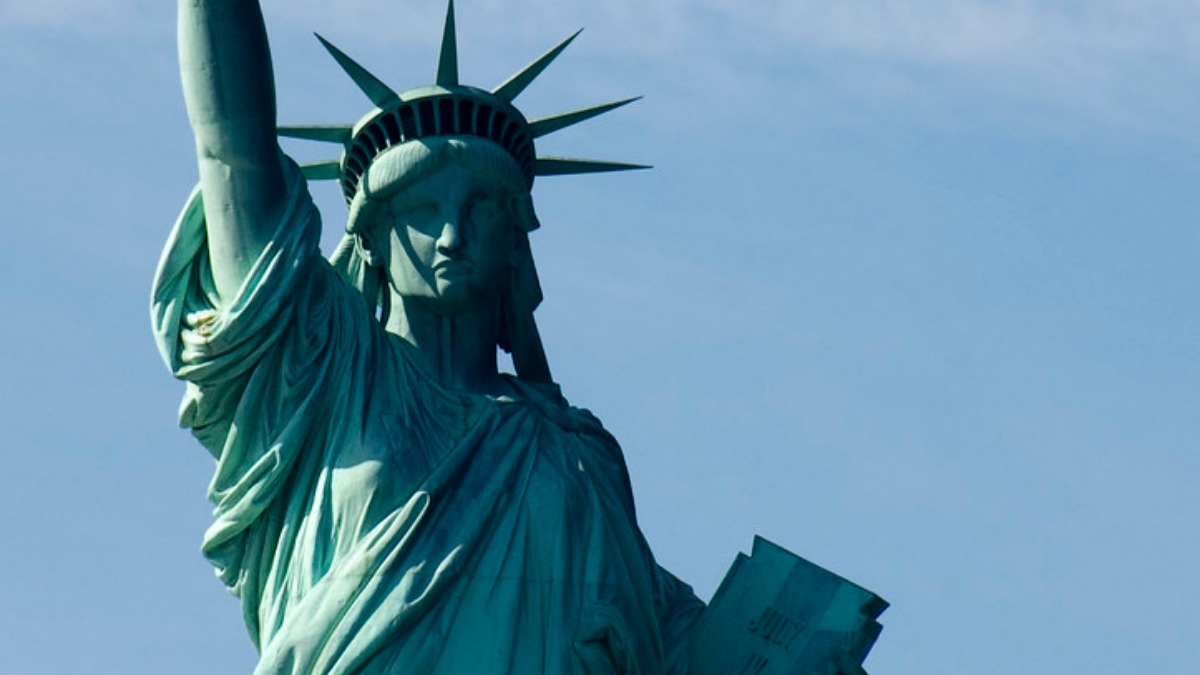

Iranian state media has released an AI-generated video showing the Statue of Liberty being destroyed by a missile. The one-minute clip ends with the slogan “One vengeance for all” and has been linked to Iranian state broadcaster IRIB. It was also shared by Russian state outlet RT.
The video references several moments in American history, including the treatment of Native Americans, the atomic bombings of Japan, the Vietnam War, and recent conflicts in the Middle East. The final sequence shows a missile in Iranian colors flying into New York Harbor and hitting the Statue of Liberty. In the video, the statue’s head has been replaced with that of Baal, a biblical false idol, and it is shown holding the Talmud.
The use of Baal imagery connects to conspiracy theories that surfaced around a resurfaced 2009 email exchange in which Jeffrey Epstein reportedly requested money to a bank account that some claimed was named “Baal.” According to the New York Post, pro-regime crowds in Tehran also burned an effigy of Baal with a Star of David on its forehead and a picture of President Donald Trump attached to it.
Iran is using the Epstein scandal and anti-war sentiment as tools to turn American audiences against the war
The video also shows a child on what it labels Epstein’s “pedo island,” as part of an effort by the Iranian regime to suggest President Trump launched the war to distract from the Epstein scandal. Other shots in the video feature AI-generated images of Ayatollah Ali Khamenei and Qassem Soleimani looking upward, making the Iranian state’s involvement clear.
Iranian officials have stepped up efforts in recent weeks to portray the US as responsible for decades of conflict. The messaging appears aimed at left-leaning audiences in America, with the goal of increasing domestic opposition to the war. This comes as Iran’s foreign minister has made stark warnings as the US and Israel coordinate their response.
Darren Linvill from Clemson University noted that “The propaganda includes memes and cartoons that aren’t meant to be perceived as real but are very good at spreading political messaging.” He also said that “The deepfakes portray a version of reality that [seems] genuine and often paint Iran as more successful in the conflict. Both are being shared widely among communities that are critical of the war and hungry for this messaging.”
This video is the latest in a series of AI-generated propaganda clips that have appeared since the start of the current conflict involving Iran. The debate over how far the US should go has also divided politicians at home, with Lindsey Graham’s contradictory stance on seizing Iranian territory drawing attention.
Other countries have used similar tactics as well, including Chinese state television outlet CCTV, which recently shared an AI-generated video about the Strait of Hormuz crisis featuring martial arts-fighting Persian cats representing Iran and a human with an eagle’s head representing the United States.
These AI-powered propaganda efforts are becoming more common and more advanced, with state media from multiple countries using artificial intelligence to shape how audiences around the world view ongoing conflicts.








Published: Mar 26, 2026 02:52 pm