


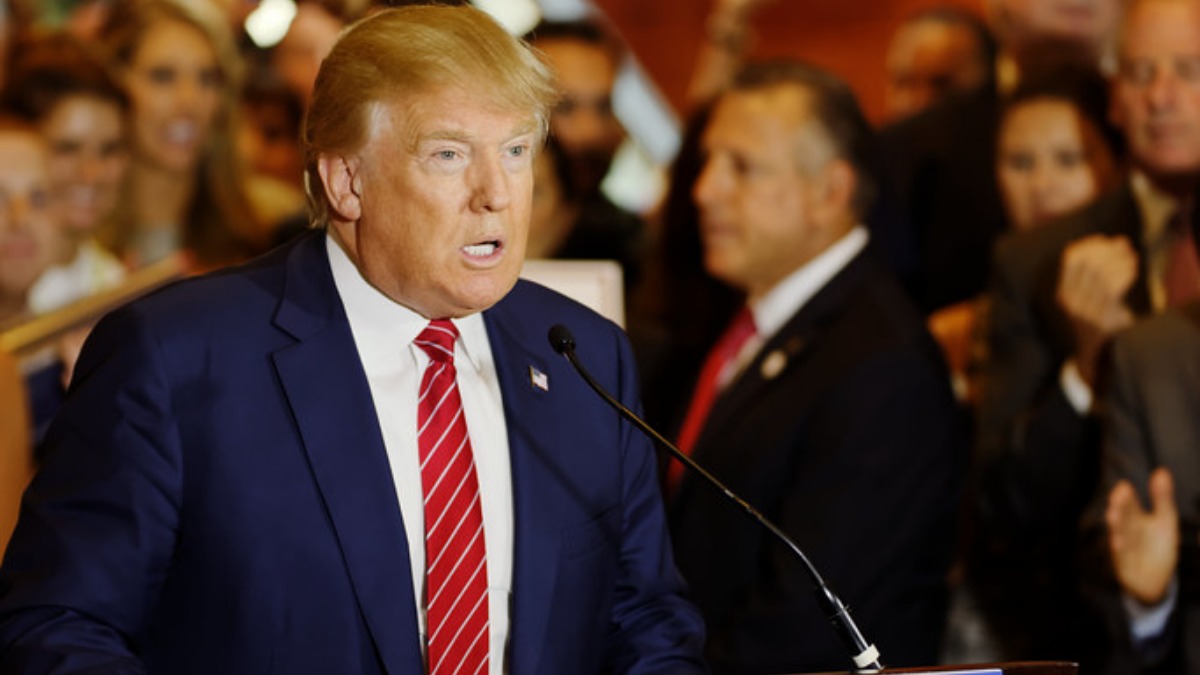

President Donald Trump has warned of further military action against Iran over the next two to three weeks, and oil prices jumped almost immediately after his statements. This has dampened hopes of any quick end to the ongoing conflict. The warning follows weeks of mixed signals from the president, creating uncertainty in global markets.
According to CNBC, U.S. West Texas Intermediate crude futures for May rose 4.76% to $104.89 a barrel as of 1:26 AM ET. June futures for Brent crude, the international benchmark, climbed 5.7% to $106.96 per barrel. This came after oil had briefly dipped below $100 a barrel earlier in the week, when Trump had suggested military operations might be winding down.
In a national address, Trump said the U.S. will “hit” Iran “extremely hard” over the next two to three weeks. He blamed the rise in oil prices on “the Iranian regime launching deranged terror attacks against commercial oil tankers and neighboring countries that have nothing to do with the conflict.” At the same time, he said the war would not last long and that talks with Tehran “are ongoing,” leaving the door open to a diplomatic outcome.
Trump’s mixed signals are making an already severe energy crisis worse
“We are going to finish the job, and we’re going to finish it very fast,” Trump declared. This came after a month-long U.S.-Israeli war on Iran that began on February 28. While Trump said the military was close to completing its mission, he also repeated earlier threats to bomb Iran back to the Stone Age, even as he spoke of ongoing discussions.
A major driver of the energy crisis is the Strait of Hormuz, which normally handles about a fifth of the world’s oil and gas flows. Traffic through the waterway has effectively stopped since the war began. Giles Alston, a political risk analyst at Oxford Analytica, said oil tanker traffic through the Strait is unlikely to resume anytime soon.
Alston also noted that the U.S. position on securing oil flows through the Strait appears to be shifting. Washington has largely “washed its hands off” the issue, suggesting those who transport oil through the waterway will need to “sort out for themselves.” Trump has repeatedly called on countries that rely on Gulf oil to take responsibility for reopening the route, arguing the U.S. does not need energy from the region. Western allies, however, have largely refused to join a war started without their input.
Earlier on Wednesday, Trump had briefly raised hopes by posting on social media that Iran had asked for a ceasefire. He said he would only consider the request if the Strait of Hormuz was “open, free, and clear,” adding, “Until then, we are blasting Iran into oblivion or, as they say, back to the Stone Ages!!!” Iran quickly denied the claim, saying the waterway would not be reopened based on Trump’s “absurd displays” and that it remains “decisively and dominantly under the control of the IRGC Navy.”
This back-and-forth has kept markets on edge. George Efstathopoulos, a portfolio manager at Fidelity International, said markets had expected either a clear exit signal or further escalation. “Clearly we seem to be on the latter path right now,” he said, expecting the speech to fuel a “risk-off sentiment” as investors wait for clarity.
In his address, Trump claimed the U.S. had destroyed Iran’s navy, air force, and ballistic missile and nuclear programs. However, Iran still holds a stockpile of highly enriched uranium that could potentially be processed to bomb grade, though it is believed to be mostly buried underground after U.S.-Israeli bombing in June.
Trump told Reuters that he no longer cared about the material because it was “so far underground” and U.S. satellites could monitor the area. Iran has consistently denied seeking a nuclear weapon. Despite Trump’s claims about destroying Iran’s conventional military, Iran has continued using missiles and drones to target Israel, U.S. Gulf allies, and American military installations.
U.S. intelligence has largely considered the Iranian government to still be intact. With Trump’s approval rating falling to 36%, its lowest since his return to the White House, and gas prices remaining high, the GOP’s decision to spend $20 billion bombing Iran while cutting healthcare could pose a real challenge for the Republican Party in November’s midterm elections.








Published: Apr 2, 2026 11:44 am