


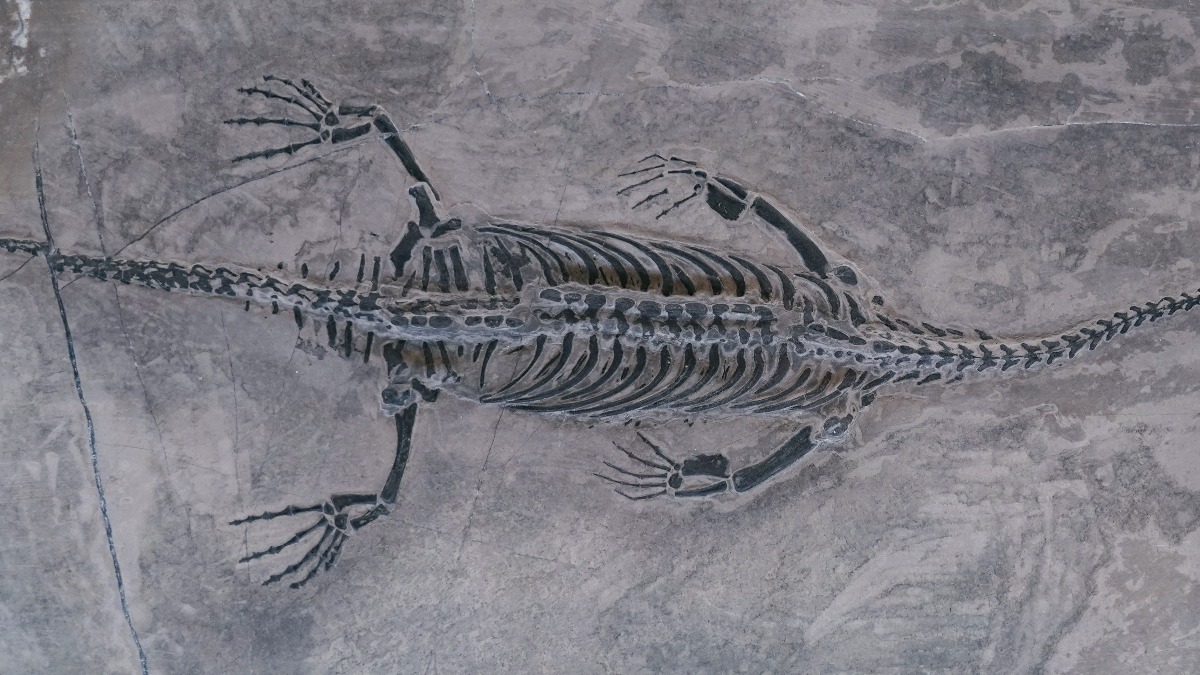

A young boy from Kansas made a remarkable fossil discovery during a geology club field trip in September 2025, according to FOX Local. Corbin Bullard was just 11 years old at the time when he reportedly spotted several large vertebrae sticking out of rock at a quarry near his hometown of Clearwater, Kansas, during an outing with the Sedgwick County 4-H Geology Club.
“I didn’t know what it was, but I knew that it was something big,” Bullard said in an interview with FOX Local. He added that what followed were three more excavation trips to the same site, during which Bullard and his fellow club members carefully uncovered what appeared to be nearly a complete tylosaurus, a large marine reptile that is believed to have lived during the Cretaceous Period.
The fossil reportedly measured more than 15 feet long, and included the animal’s skull along with most of its skeleton. According to researchers who dated the specimen to the Smoky Hill Chalk formation, it appeared to be a fossil-rich layer of rock that stretches across parts of Kansas, and they estimated the creature lived roughly 82 million to 87 million years ago.
A nearly complete skeleton from millions of years ago surfaces in a Kansas quarry
The quarry where the discovery was made is one where commercial crews reportedly shave away layers of rock on a regular basis, which exposes material that has been buried for millions of years. According to FOX Local, club members had mostly found shark teeth and fish fossils at the site before Bullard’s find.
The tylosaurus is a species of mosasaur, a group of large, predatory marine reptiles that are thought to have been among the dominant creatures in the oceans during the Late Cretaceous Period. Some enthusiasts and theorists have long been fascinated by the idea of whether ancient reptiles could still exist today. Fossils of the tylosaurus species have previously been found in the Smoky Hill Chalk formation, which is considered one of the more significant fossil sites in North America, according to researchers.
Bullard, now 12 and preparing to enter seventh grade, plans to display the fossil’s skull at the Sedgwick County Fair in July, per the outlet. “I hope [the judges] say that it looks really nice and that we put a lot of effort into it,” he said. Popular culture has also shaped how the public imagines Cretaceous-era creatures, though science has challenged many film portrayals of prehistoric animals.
The Sedgwick County 4-H Geology Club, of which Bullard is a member, conducts field trips to sites in Kansas where members search for and study fossils. “None of this would have happened without first of all 4-H, then the geology club, then the landowners and the leaders and permission to make it all happen,” Bullard said. “This is not something he and I can go out together and do on our own. It’s a 4-H community.”







Published: Jun 11, 2026 08:55 pm