


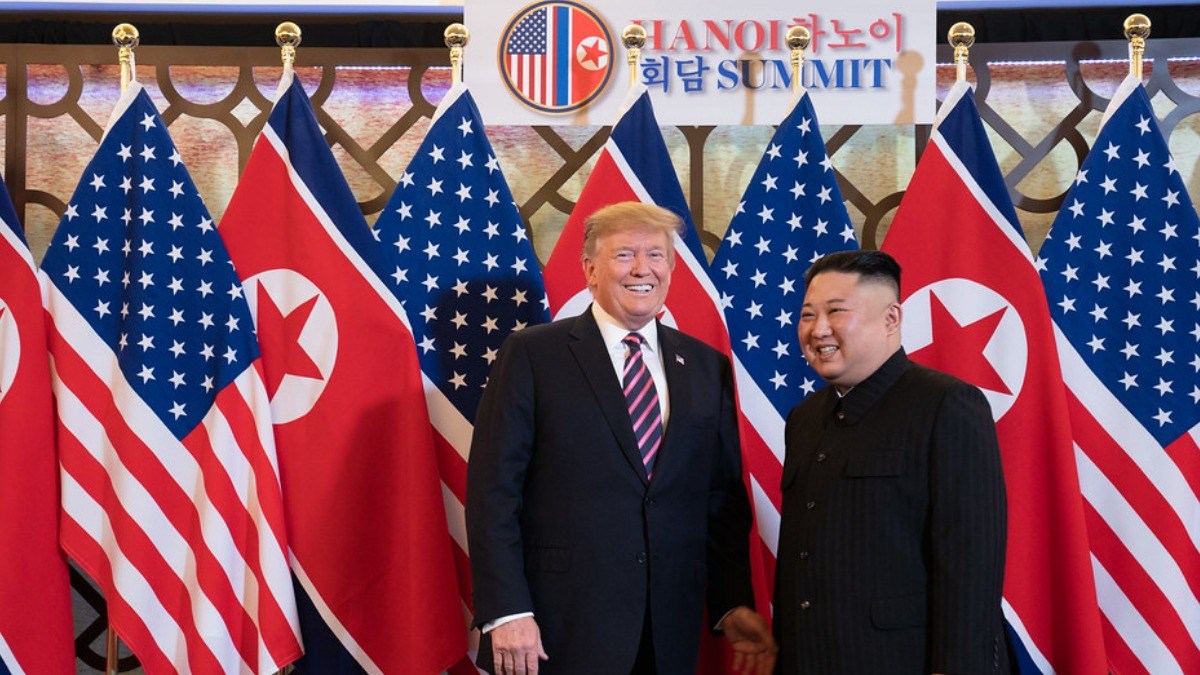

President Trump is actively pushing to revive his diplomatic connection with North Korean leader Kim Jong Un. According to The Hill, the president has expressed a clear interest in meeting with Kim again later this year. However, he hasn’t provided specific details regarding the timing or location of such a summit. The move is an indication of his ongoing strategy of personal diplomacy, even as the geopolitical landscape remains incredibly complex.
Trump has also already taken steps to scale back joint military exercises with South Korea. The president reportedly framed this interest, and the orders issued to the Pentagon, as a way to ease tensions. He described his personal rapport with the North Korean leader as a positive asset for American foreign policy. Per the Wall Street Journal, Trump privately discussed the possibility of setting up an in-person chat with Kim during his next trip to Asia.
This could potentially align with the Asia-Pacific Economic Cooperation gathering in China this November. While no official planning is underway, WSJ noted that the president’s focus on this meeting underscores his search for a major foreign policy win. The stakes are undeniably high, especially considering that the North Korean nuclear program has continued to advance since their last meetings in 2018 and 2019.
The nuclear leverage
The president’s approach is not without its critics. The Hill reported that experts are raising valid concerns about the potential impact on the alliance with South Korea. Michael Sobolik, a senior fellow at the Hudson Institute, reportedly noted, “It’s pretty clear from the first term that he views America’s relationship with South Korea as a complicating factor in his ability to negotiate directly with Kim.”
The Hill reported that during his first term, Trump met with Kim three times, but those efforts eventually hit an impasse regarding denuclearization. Today, the situation is even more complicated by global events, including the war in Ukraine and the ongoing trade tensions between the United States and China.
Independent experts and intelligence assessments suggest that North Korea’s arsenal has grown significantly. Jeffrey Lewis, an expert at Stanford University, told WSJ that previous estimates of North Korea’s nuclear capability were likely far too low.
Lewis noted, “North Korea’s arsenal is probably in the low hundreds at this point, based on the hundreds of missile launchers it has displayed and the growing amount of plutonium and highly enriched uranium it produces every year.” According to The Hill, Trump himself acknowledged the severity of the situation when speaking with reporters.
He stated, “The fact that I get along with him — that’s a good thing, not a bad thing,” before adding, “He has 57 very powerful nuclear weapons. Should have never allowed it to happen. If I was president, I wouldn’t have allowed it to happen. But he’s got them.”
The perspective from Pyongyang remains cautious. The Hill noted that Kim Yo Jong, the sister of the North Korean leader and a top adviser, has publicly pushed back against claims that there has been active communication between the two leaders. In a statement translated by The Chosun Daily, she noted, “There has been no communication between the leaders of North Korea and the U.S. that we are aware of.”
Furthermore, North Korea has continued to demonstrate its military posture. Per The Hill, they recently launched short-range ballistic missiles toward the sea, which serves as a reminder of the volatility in the region.
The role of regional powers like China also remains a significant factor. Andrew Yeo, the SK-Korea Foundation chair at the Brookings Institution, reportedly suggested that Chinese leader Xi Jinping could assist in facilitating a meeting if Kim views it as beneficial. He noted that Washington holds the key to some valuable things for Kim, like political normalization and reduction of a military threat.
Yeo told The Hill, “Even if Kim is unable to secure formal U.S. recognition of North Korea as a nuclear weapons state, simply meeting with Trump with denuclearization off the agenda, or with Trump tacitly acknowledging North Korea’s nuclear weapons as a reality, would be a win for Pyongyang.” Notably, things are already shifting after Trump’s order regarding the military exercises just before it began on Monday.
According to the Associated Press, the U.S. and South Korean militaries wrapped up the annual Ulchi Freedom Shield exercise six days earlier than initially scheduled on Friday. South Korea’s military confirmed that the exercise, which was intended to simulate defensive and counteroffensive operations, concluded early.
Despite these efforts, AP News noted that Kim Yo Jong brushed aside the overture. She stated that reducing the duration and size of the drills won’t change their “provocative, aggressive nature.” Thus, the North reportedly said the step isn’t enough to persuade it to return to talks.









Published: Aug 22, 2026 11:00 am