


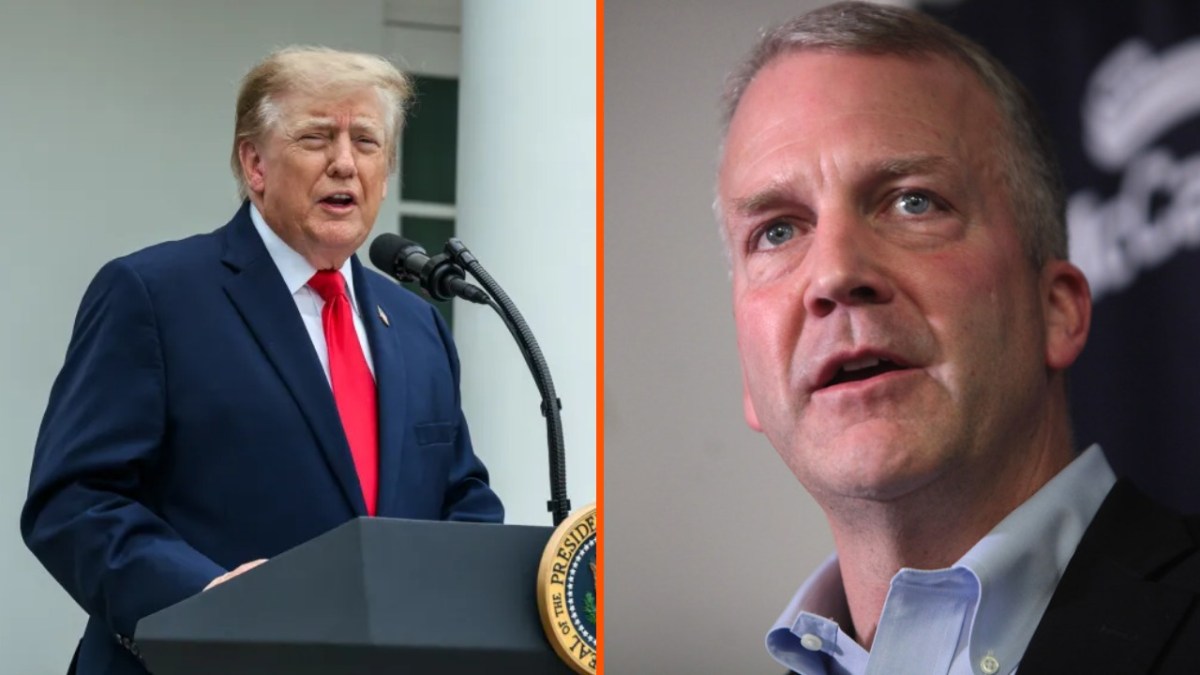

The Department of Justice has preemptively filed a lawsuit aimed at blocking the certification of Alaska’s US Senate election results if incumbent Republican Senator Dan Sullivan loses. This move comes as the race between the senator and Democrat Mary Peltola remains a key battleground that could decide which party controls the Senate.
President Donald Trump confirmed he directed the legal action, telling reporters in Florida on Friday that he was the one who said to do it. The President has frequently expressed frustration regarding the presence of a second candidate named Daniel J. Sullivan on the ballot, even holding a rally in Wasilla, Alaska, where he called the situation “cheating.”
The lawsuit alleges that the presence of the second candidate, who is a registered Republican but listed without a party affiliation, could confuse voters. The administration wants a court to potentially delay certification if the incumbent is defeated but would have won if all votes for the other Daniel J. Sullivan had been cast for the senator instead.
Attorney General Todd Blanche stated that the DOJ did not coordinate with any campaign or candidate regarding the filing
In a social media post, Blanche wrote, “This litigation seeks to ensure that after Alaskans cast their ballots, they are preserved in a manner so that only Alaska’s governing officials have the information necessary to make a determination as to whether Alaskan voters were confused or misled.”
Legal experts are questioning the viability of the case. Derek Muller, an election law professor at Notre Dame Law School, described the legal theory as strange and unusual. He pointed out that the DOJ appears to be pulling language from the preface of a federal voter registration law to argue it has the power to intervene. Muller noted that he has never seen this approach before and expressed doubt that a court would accept it.
Alaska uses a ranked-choice voting system. This means voters can rank candidates in order of preference. If no candidate receives a majority of first-choice votes, the candidate with the fewest votes is eliminated, and their votes are reallocated to the next highest choice. This system could mitigate voter confusion, as a voter intending to support the incumbent could simply rank both Sullivans on their ballot.
Alaska’s state election officials have already taken steps to distinguish the candidates. The ballot identifies Dan S. Sullivan as the incumbent and includes middle initials for both men. The Alaska state Supreme Court also ruled in June that the second Daniel J. Sullivan should remain on the ballot after the state’s Division of Elections initially removed him.
Reaction to the lawsuit has been sharp. Senator Lisa Murkowski, a Republican from Alaska, criticized the move in a post on X, writing, “Alaskans don’t need any help voting for their preferred candidates, and the State of Alaska has already handled this by clearly distinguishing the candidates on this year’s ballot. The Department of Justice should never have filed this lawsuit.”
Peltola’s spokesperson, Harry Child, called the lawsuit a “despicable political threat to overturn an election.” Meanwhile, Nate Adams, a spokesman for Senator Sullivan, said the incumbent will let the DOJ complaint run its course.
The case has been assigned to Judge Sharon L. Gleason. Election law attorney Ben Ginsberg noted that there are many reasons a federal court might be hesitant to grant this request, including the principle that federal courts should not alter voting policies close to an election.
With Alaska officials expected to start the ranked-choice tabulation on November 18, it remains to be seen if the court will take any immediate action.







Published: Oct 25, 2026 03:00 pm