


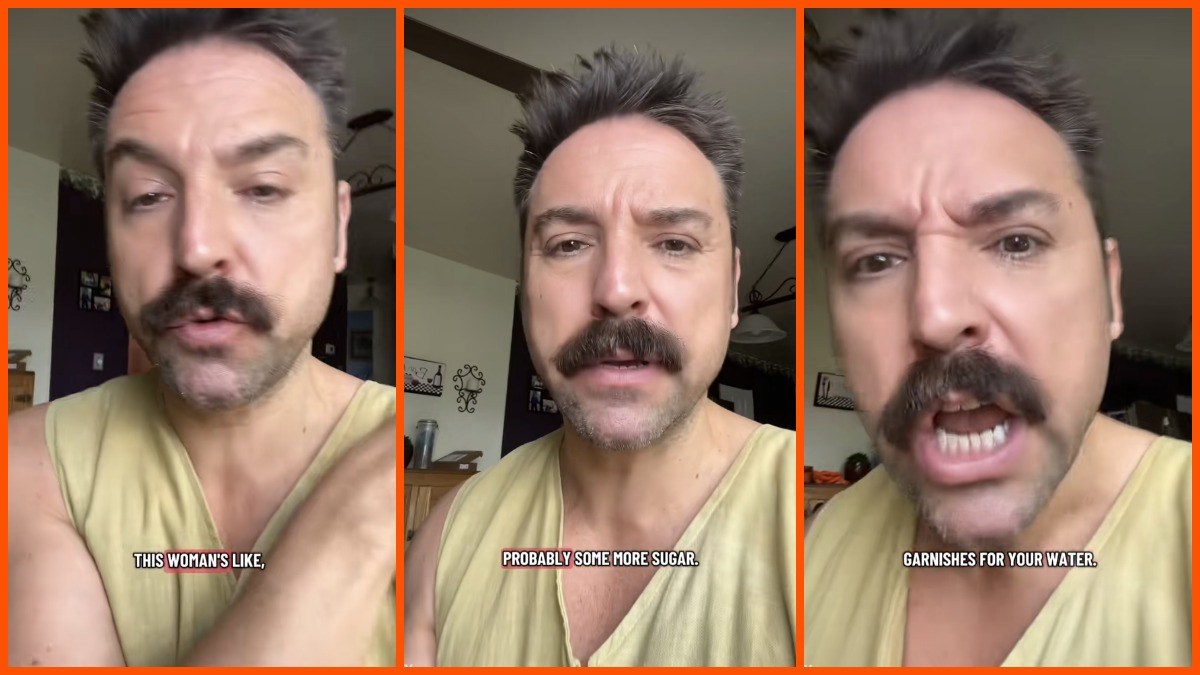

A recent TikTok video posted by Jon Jeffrey Frederick has been blowing up, racking up over 834K views and 124K likes in just two days, all because he decided to shut down a customer who was trying to pull a fast one at his restaurant. The video, captioned simply with “Don’t try it,” highlights a situation that many servers have probably faced at least once: the DIY lemonade hustle.
In his post, the TikToker claimed, “Today for brunch, this woman’s like, ‘Can I have a water with some extra lemon? And can you bring me some sugar?’” Jon noted that he immediately knew what was going on, especially when she asked for more lemons and sugar after he brought out the first batch. So he told her, “Ma’am, can we just stop this right now? How about I bring you a lemonade?” Purportedly, she immediately told him, “I don’t want a lemonade.”
Jon tried to resolve the situation by saying, “I won’t even charge you for it. I’ll bring it to you for free.” He alleged that the suggestion upset her, prompting her to retort, ”What? Don’t you think I can afford a lemonade?” Jon went with her request, but he accounted for all the extra lemons. As he said, “Then I charged her 25 cents for each lemon that I brought her.” Jon’s customer was shocked.
Paying for what you consume
According to Jon, this is how the rest of their interaction went down: “‘Wait, what are these charges?’ And I said, ‘These charges are for the extra garnishes for your water.’ And she’s like, ‘But I didn’t ask for that.’ I was like, ‘But you did ask for that.’ And it ended up being more than what a lemonade would have cost. So win!”
All we have is Jon’s version of events, which isn’t verifiable. However, TikTok was incredibly amused by Jon’s take on the incident. One TikToker shared a similar experience, noting, “I had a woman request a plate of lemons and I thought she was trying to make her own lemonade… She was dipping the wedges in a pile of sugar and eating them like orange slices.” Interestingly, a man recently annoyed TikTok by doing the same thing when asking a server to surprise him at Olive Garden.
Another commenter pointed out the absurdity of the behavior, writing, “Never in my life have I wanted lemonade bad enough to make my own.” A third commenter had a theory, writing, “I think so many people legitimately get off on the idea that they are somehow pulling one over on food service workers.”
There is a pattern of behavior that supports the theory. According to Food and Wine, restaurants often face trouble with customers taking items like ramekins, salt and pepper shakers, steak knives, and even toilet paper. The article notes that customers often feel entitled to take whatever they want, but the price of an entree does not include anything other than the food on the plate.
The outlet pointed out that when customers help themselves to things that aren’t for the taking, it eventually leads to higher prices for everyone else. Whether it is cramming sugar packets into a purse or sharing a single iced tea to avoid paying for two, these small acts of theft are a constant headache for restaurant staff.
While servers definitely hate this, there is a strategic side to giving things away. According to Gourmet Marketing, offering freebies is often a better long-term strategy for restaurants than using percentage discounts. Discounts can make customers focus too much on price, which might make them question the value of the food or the restaurant’s pricing structure.
Freebies, on the other hand, can short-circuit that price awareness. When a restaurant gives away a free dessert or an appetizer, it acts as a valuable incentive that makes the customer feel special without devaluing the rest of the menu. Gourmet Marketing noted that it’s all about perception. A discount on a burger will lead to the thought that the burger was overpriced. However, a free side, like fries, feels like a prize.
Per the outlet, restaurants that successfully use freebies often do so to encourage customers to try new menu items or to celebrate milestones like birthdays and anniversaries. These events bring in large parties and build loyalty in a way that a simple discount never could.
Ultimately, TikTok felt like the DIY lemonade customer was just trying to bypass the system rather than engage with the restaurant’s hospitality, to the detriment of the workers. As one TikToker opined, “These are the same people that will not tip and say ‘employers need to pay their employees’. How can they pay more IF YOURE STEALING FROM THEM.”



Published: Sep 10, 2026 12:45 pm