


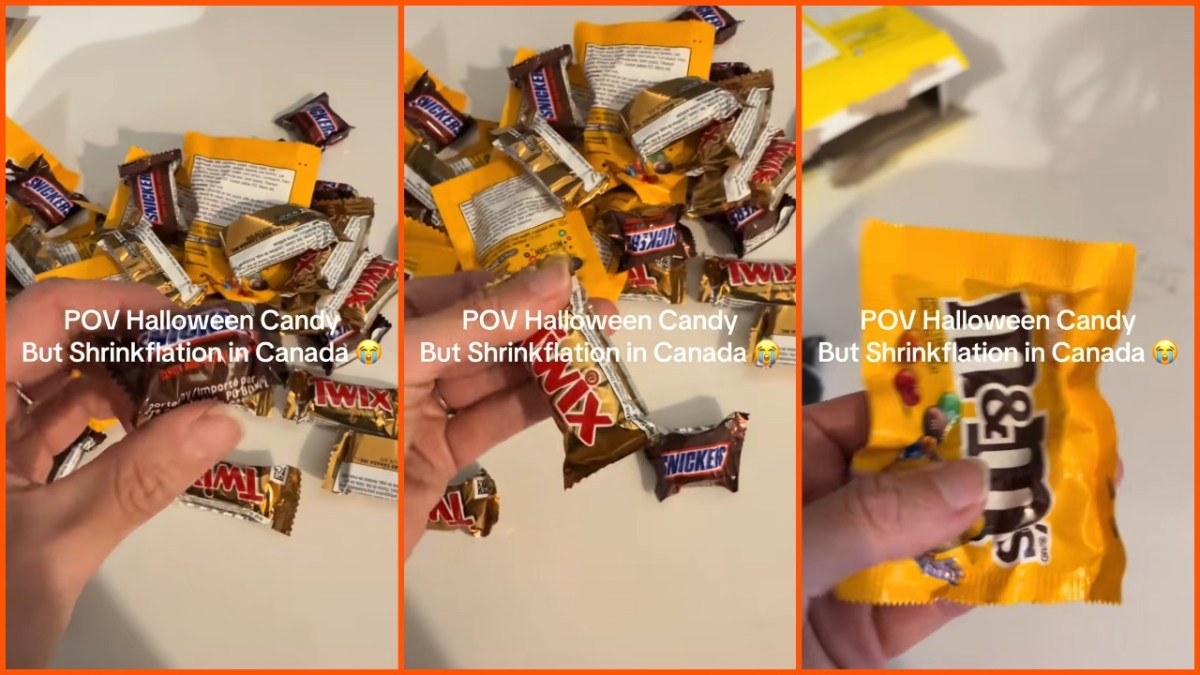

A Canadian realtor named Veronica Cousins said in her TikTok video that she noticed the Halloween candy she bought looked unusually small. Veronica, who posts as @veronicacousinsrealtor, shared a first-person view of assorted candy including Snickers, Twix, and M&Ms scattered on a white surface.
On-screen text in the video read, “POV Halloween Candy But Shrinkflation in Canada.” The post had gained 100,000 views. In the video, Veronica held a small Snickers bar up to her hand and said, “What the actual- it’s like, look at how small that is. Look.” She then picked up a Twix bar and turned it over in her fingers while continuing to describe the size. She stated that the packaging appeared to contain very little product.
She later held another Snickers bar between her thumb and forefinger and said, “dude, this is a package of air. It’s air. There’s nothing in here.” Veronica squeezed the bar while speaking. She then opened a small yellow bag of M&Ms and counted the contents out loud, saying, “This has 4- 1, 2, 3, 4- 4 M&Ms,” before pouring the four candies onto the surface. The video caption read, “POV you buy Halloween candy and you live in Canada. Why is everything half the size?!”
Statistics Canada tracked quantity changes in grocery items from 2021 to 2023
Statistics Canada reported that 29.6 percent of eligible grocery items tracked in the Consumer Price Index experienced shrinkflation between 2021 and 2023. Eligible items exclude all fresh fruits and vegetables as well as most meat products, according to the agency. Shrinkflation occurs when a product is sold in a smaller quantity than before, but for the same price. The trend isn’t limited to groceries either, as one McDonald’s customer found when she received a half-size Filet-O-Fish at double the price.
The agency said that nearly half, or 49.5 percent, of the quantity adjustment instances during that period occurred in 2022. That year, grocery inflation reportedly reached its highest annual average in 41 years at 9.8 percent. The remaining instances were split between 2021 at 24.4 percent and 2023 at 26.2 percent.
Statistics Canada also reported that a much higher proportion of name-brand products, 77.6 percent, experienced shrinkflation compared with house-brand products at 22.4 percent. The agency listed food products with the most instances of shrinkflation as margarine, pasta mixes, cookies and crackers, mozzarella cheese, breakfast cereal and other cereal products, and cheddar cheese.
According to the Government of Canada, per unit pricing is one way shoppers can compare the cost of products when package sizes differ. Innovation, Science and Economic Development Canada stated that per unit pricing calculates the price using a set unit of measurement such as weight or volume. The department said this can help consumers identify when they are paying the same price or more for a lesser quantity of product, a practice it referred to as shrinkflation.
According to the Government of Canada, there is currently no mandatory requirement to post per-unit pricing information across Canada except in Quebec. Some retailers display it voluntarily, though the department noted that the lack of standardization and smaller font sizes can make comparisons difficult. The government said it has been collaborating with provinces and territories on options for a standardized approach.
Viewers responding to the video described their own experiences with smaller candy packages and higher prices. One person explained that they had changed their approach after noticing the size difference, writing, “This is why I switched to getting full size bars from the cheapest dollar store.”
Another commenter pointed to local costs when discussing whether they would still hand out candy. They wrote, “In my town a box of nestle chocolate 100pc is 49.99 at this point I’m just gonna give out tricks for Halloween.” Shrinking sizes have frustrated shoppers in other places too, like an Ohio woman who questioned a smaller McDonald’s drink cup.
A third viewer said this would mark the second year they had decided against buying Halloween candy. They wrote, “This will be my second year not giving out Halloween candy. I refuse to cave anymore to the unmitigated corporate greed the prices are through the roof, and the candy can’t get much smaller. An utter disgrace.”








Published: Oct 15, 2026 12:15 pm