


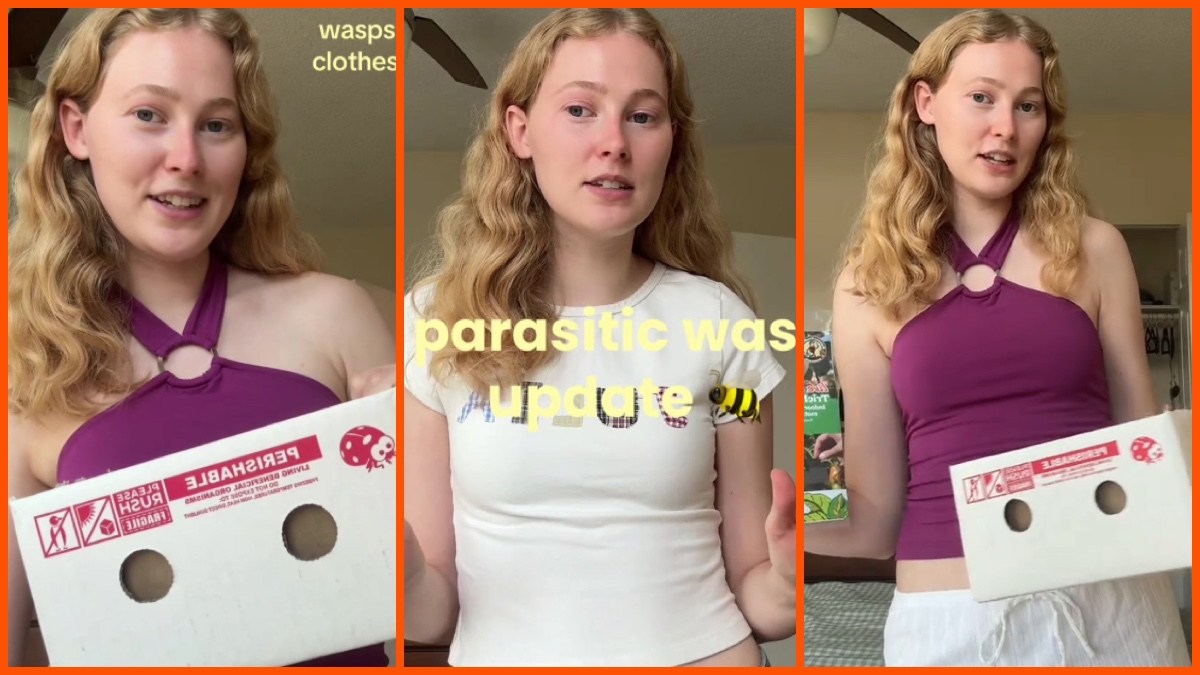

Viewers were alarmed after a Washington, D.C., vintage clothing influencer announced plans to release parasitic wasps in her closet. While the idea sounds startling, science does support the plan.
TikTok creator Julia (@julesisthrifty) shared the approach after dealing with clothes moths in her vintage wardrobe. The problem became especially frustrating when she discovered that a vintage Taylor Swift dress in her collection had developed holes. She attributed the damage to the moths.
That damage prompted Julia to turn to her followers for ideas. Commenters suggested using parasitic wasps to target the moth eggs. Julia decided to give the method a try. In the first video of her wasp series, she said she planned to release “10,000 parasitic wasps” into her closet.
The idea initially sounded strange even to Julia.
She said she wondered what people meant by “parasitic wasp.” She also acknowledged that she has no professional background in insects. Still, she ultimately ordered the wasps and said she was excited to try the method.
According to Julia, the wasps hatch gradually and then lay their own eggs inside moth eggs, preventing the moths from developing. She said the tiny insects already appeared to be hatching and compared their appearance to “puppy seeds.”
Julia also removed much of the clothing from her closet. She laundered some items and placed wasp cards around areas where she had noticed holes. She put another hanger in her coat closet to protect her leather jackets and said she planned to use the remaining wasp bags as well.
No one wants their vintage finds to get ruined. In Minnesota, a woman found what she thought were curtains at Goodwill — her $10 buy turned out to be a $1,000 designer dress. Other thrifters have gotten even luckier, like the Portland teen whose $3 find turned out to be worth thousands of times more.
Meanwhile, the wasp strategy has a scientific basis. Some species of Trichogramma, a group of tiny parasitoid wasps, attack moth eggs by laying their own eggs inside them. The University of Maryland Extension says these wasps can be extremely small and “are not interested in humans, so therefore do not sting.”
The National Museums Scotland has also documented Trichogramma evanescens as part of an integrated pest management program against webbing clothes moths. The museum said the wasps target moth eggs and reported moth reduction after introducing them. However, it also noted limitations to the treatment.
The second TikTok video gave viewers an update two days later.
In her follow-up post, Julia said the wasps can take about five days to hatch and stressed that they are microscopic and do not sting people or pets.
Julia showed pheromone traps in the follow-up and said one had caught an adult moth. She noted that the traps catch male moths and therefore do not address every stage of an infestation. Her explanation also answered one of the most common reactions. “Mothballs weren’t an option?” one commenter asked.
Julia said she had not tried mothballs because she considers them toxic and was concerned about her cat ingesting one. The National Pesticide Information Center says mothballs can pose a health risk to people and animals if used improperly and should be used only according to their label directions, which generally call for placing them in airtight containers.
Even so, some commenters remained skeptical. “I don’t see how this is possibly a good idea,” one wrote, while another said, “I have horrible anxiety over this now.”






Published: Sep 12, 2026 10:00 am