


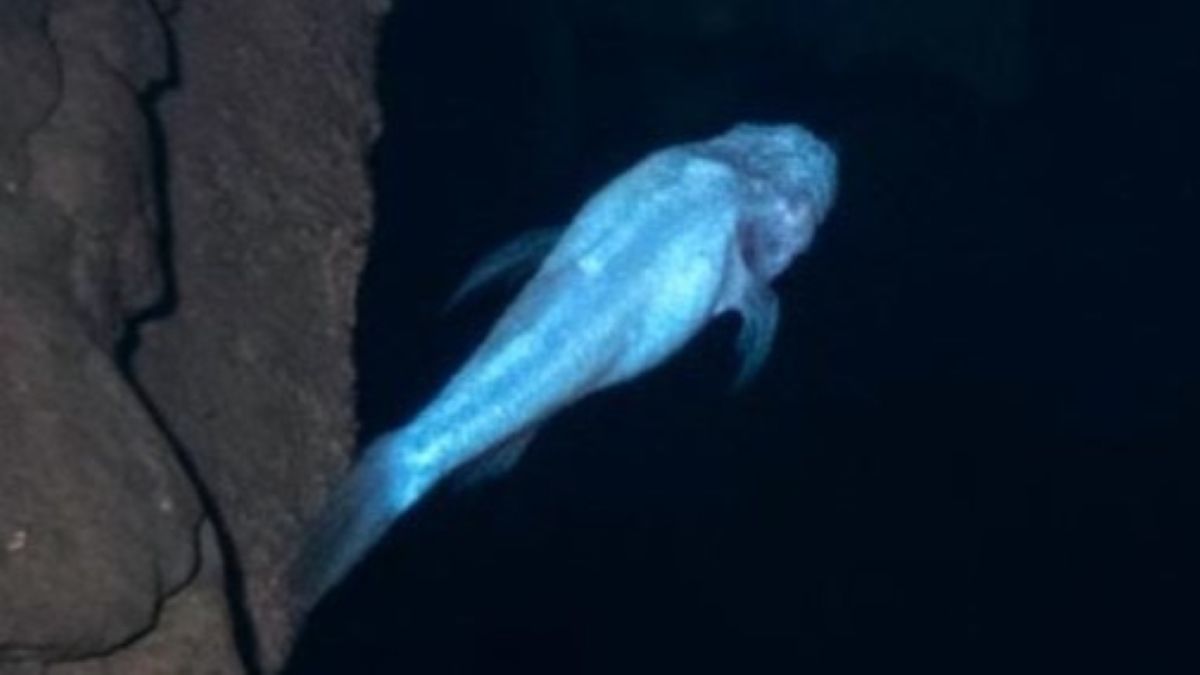

Last year, Dr. Matthew Niemiller, an associate professor of biological sciences and director of the Cave Bio Lab at The University of Alabama in Huntsville (UAH), set out to survey Bobcat Cave near Huntsville.
He was expecting to document the usual residents, such as the endangered Alabama cave shrimp, two species of cave crayfish, and the southern cavefish. Instead, he stumbled upon a creature that looks like it crawled straight out of a science fiction movie.
Per CNN, Niemiller discovered a bizarre-looking, eyeless fish with a hunchback, spiny rays, and a snout shape that is completely different from other known cavefish species, which scientists have described as a game changer for how we understand subterranean ecosystems.
The fish is entirely colorless and has a faint electric blue hue, its skin is translucent, meaning you can see its brain beneath the surface.
The team behind this research, which includes experts from UAH, Auburn University, The University of Alabama, and Mississippi State University, eventually gave the fish a name that fits its mysterious, otherworldly aesthetic: Demogorgonichthys arcanus, or the demon cavefish.
The name is a nod to the monster Demogorgon from the Netflix series Stranger Things, while the species name arcanus translates to hidden or secret.
A creature that managed to stay under the radar in a frequented place
According to the University of Alabama, the demon cavefish was hiding in one of the most studied cave systems in the southeastern United States. Bobcat Cave is situated only about eight miles from the UAH campus as the crow flies, sitting beneath the U.S. Army’s Redstone Arsenal.
As Niemiller explained to the publication, “This is one of the last places we’d have bet on it. Finding an entirely unknown, new genus of freshwater fish in eastern North America today is a little like finding a new kind of big cat. The group is so well known, we thought the big surprises were behind us. To have one turn up in a cave we’ve watched for three decades is a real reminder to stay curious. It was genuinely surprising.”
UAH reported that the demon cavefish managed to escape detection for so long because it looks incredibly similar to the southern cavefish, which already calls the cave home. Niemiller admitted that he had been fooled before by animals that looked different but were genetically similar. However, this time the differences held up under intense scrutiny.
The team reportedly performed CT scans, genetic tests, and detailed anatomical studies to confirm their findings. “It’s distinct on every line of evidence we examined,” Niemiller explained. “A new genus is warranted when an animal simply doesn’t fit within any existing one, and this fish met that bar in its anatomy, its CT imaging and its DNA all at once.”
Niemiller continued, “The Demon Cavefish shares its cave, and the very same pools, with the Southern Cavefish, yet the two aren’t close relatives. Each found its own separate way into the underground world and lost its eyes and pigment independently, millions of years apart. … It’s a vivid case of convergent evolution. The cave environment sculpts very similar-looking animals, i.e., blind, pale, with heightened non-visual senses, out of completely distinct lineages.”
In the study of human evolution, archeologists in Indonesia noted that Earth’s ‘Hobbits’ actually evolved as scavengers dependent on Komodo Dragons, rather than hunters as originally thought.
CNN noted that we still have a lot to learn about these fish, including their reproductive habits and exact population numbers. Since the species is known from only a single site, it is considered highly vulnerable, particularly to groundwater pollution. The good news is that because the cave is on restricted land at the Redstone Arsenal, it is somewhat shielded from direct human disturbance.
Still, as Niemiller noted, the real challenge is protecting the water that flows into the cave from the surface. The team’s findings were first published in the journal Scientific Reports on July 6th.








Published: Aug 3, 2026 03:01 am