


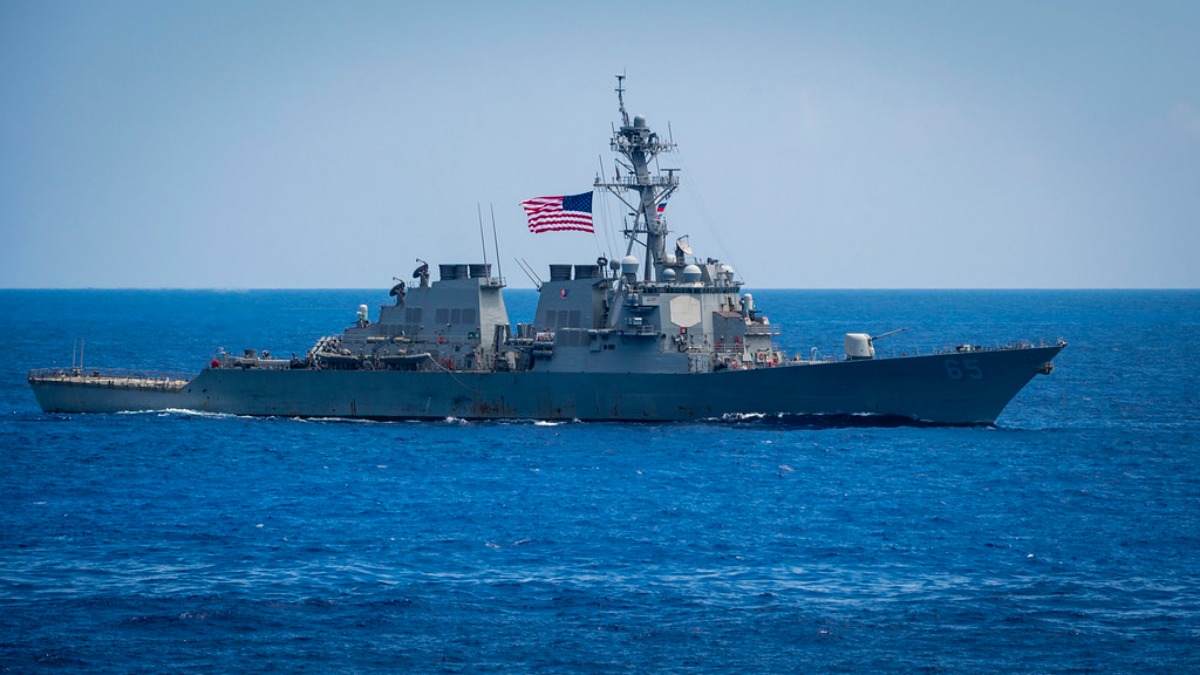

The USS Benfold, a guided-missile destroyer in the US Navy, recently spent four days drifting in the South China Sea without power or the ability to navigate. According to CNN, this incident, which occurred last month, left the nearly 10,000-ton warship without essentials like functioning toilets, air conditioning, and galley services. The US 7th Fleet confirmed that the ship suffered an engineering failure on July 24 while conducting routine operations.
The South China Sea is notorious for its brutal, humid heat, with temperatures in late July often climbing between 89 degrees and 98 degrees Fahrenheit. According to the outlet, the loss of power means that the 300 crew members lost access to air conditioning. Beyond the heat, the ship also lost potable water and sanitation services. Navigational capacity was lost as well.
Navy Cmdr. Matthew Comer, a spokesperson for the 7th Fleet, reportedly noted that the crew handled the situation with remarkable composure. As Comer stated in his official remarks, “There were no injuries to the crew, who demonstrated resilience, grit, professionalism, and unwavering steadiness in their response.”
Operational Failure
The technical cause of the outage remains under investigation. USNI News reported that the incident involved an engineering casualty related to the ship’s generators. During the outage, the ship had to rely on support from other vessels. The guided-missile cruiser USS Robert Smalls, part of the USS George Washington Carrier Strike Group, stepped in to provide cooked meals to the Benfold’s crew while they were powerless.
Eventually, contractor tugboats towed the vessel to Subic Bay in the Philippines to undergo repairs. The ship arrived in Subic Bay on July 28, and according to USNI News, the crew was moved to contracted lodging off the ship the very next day. Power was restored by July 30, and by August 8, the ship was fully repaired and ready to return to duty. Ship spotters in Japan have since reported that the vessel arrived in Yokosuka, Japan, following the ordeal.
This breakdown highlights the growing concerns regarding the operational strain on the US Navy. As reported by CNN, the incident is being looked at alongside broader worries about how global commitments, including operations related to the Iran war, are impacting the fleet.
The Navy has been under increased scrutiny lately, especially following reports of low morale and mental health challenges on other vessels, such as the USS Abraham Lincoln, which spent more than 200 days at sea without a port call. Analysts and Democratic lawmakers have frequently pointed out that the Navy is being stretched thin by these constant, high-stakes deployments. Despite these concerns, the president has ordered redesigns of aircraft carriers under construction.
Carl Schuster, a former US Navy captain, offered some insight on the intensity of such an outage. According to CNN, Schuster once experienced a four-hour power loss on a destroyer near Puerto Rico and described the environment as extremely stressful.
As Schuster explained, “It would have been quite stressful. Operations officers were worried about crew morale and operational concerns, the engineers were focused on how to solve it and the navigator was worried about the direction they were drifting and what weather was coming. The crew was worried about weather, food and what was next. The (commanding officer) and (executive officer) were worried about all of that and when help would arrive.”
Schuster emphasized to CNN that his own four-hour experience paled in comparison to the four-day crisis faced by the Benfold. “I can assure you four hours in the waters southeast of Puerto Rico is not nearly as stressful as four days in the South China Sea,” he added.
According to the outlet, the USS Benfold is an Arleigh Burke-class destroyer, a type of ship that serves as a workhorse for the US Navy. With more than 70 of these ships in service, they are vital to global operations. This incident marks the second time a destroyer in the Pacific Command’s area of responsibility has lost power recently.
In May, the USS Higgins reportedly suffered an engineering casualty in its electrical system that left it without power and propulsion for several hours. As the investigation into the Benfold moves forward, the Navy is clearly facing significant pressure to ensure that these essential ships remain operational in some of the most demanding waters on the planet.








Published: Aug 18, 2026 11:04 am