


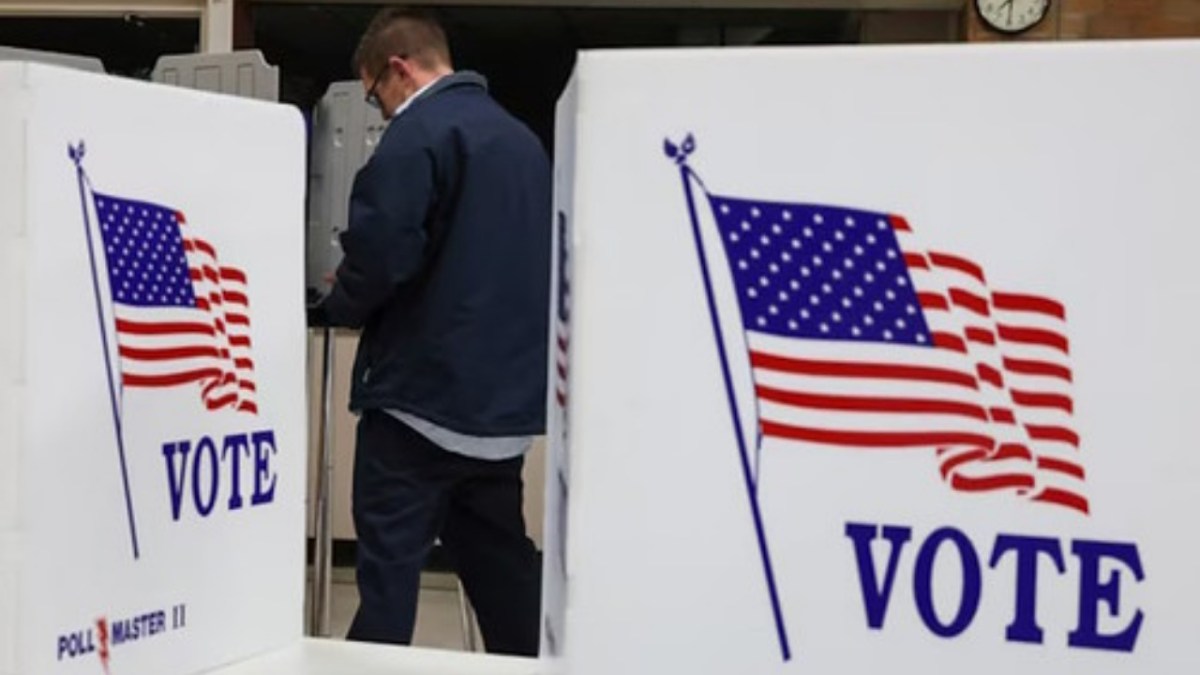

A federal judge has officially put a stop to a controversial Department of Homeland Security initiative that sent agents door to door to verify voter identities, Truthout reports. This move comes after a lawsuit filed on October 19 by labor and voting rights groups challenged the legality of the program.
The court order specifically demands that federal agents halt all elections-related field operations and interviews across nine states, including California, Wisconsin, New York, Missouri, Connecticut, Nevada, Georgia, Pennsylvania, and Washington.
The initiative, dubbed the Unlawful Voter Initiative, launched in August. It involved agents from the Department of Homeland Security, which oversees Immigration and Customs Enforcement, knocking on doors to check voter registration status. According to the court order issued on Wednesday, the agency created target lists of potentially fraudulent registrations by gathering more than 48 million records from independent and commercial sources.
Many experts and advocates view the program as a way to intimidate voters and suppress turnout
David Janovsky, a senior policy analyst at the Project On Government Oversight, believes there is a reasonable question about why the federal government is focusing these efforts on specific regions. He noted that many of these states are home to high-profile races that could determine control of the Senate or the House.
Janovsky pointed out that the federal government often lacks accurate data for these kinds of investigations. He mentioned that agents showing up at homes could make people nervous about participating in the democratic process.
The Trump administration has been pushing for access to state voter rolls for over a year to search for evidence of widespread fraud. While states are responsible for running their own elections, the Department of Justice demanded access to these rolls under an executive order issued in May 2025.
Many states handed over data, but others pushed back, leading to lawsuits that were dismissed by federal courts. Janovsky noted that these efforts have largely been rejected by the courts because the federal government has no real business micromanaging every state’s voter rolls.
The records obtained through the Freedom of Information Act link these efforts to Heather Honey, a senior advisor to the Department of Homeland Security and Immigration and Customs Enforcement. Honey is known as a prominent 2020 election denier.
Elizabeth Laird, the director of equity at the Center for Democracy and Technology, stated that the court decision establishes a legal basis that it is illegal to weaponize personal data in ways that lead to harm for individuals who are wrongly targeted. She added that the case highlights the significant dangers of the current administration’s ongoing efforts to compile and use personal information from across federal and state agencies.
The administration’s data has already faced scrutiny for its accuracy. In Nevada, officials claimed to have identified nearly 16,000 non-citizens on voter rolls, but further investigation revealed that the number was actually zero, as all those individuals were confirmed to be U.S. citizens. Despite this, the Department of Justice recently announced charges against 28 non-citizens in California for election crimes.
Janovsky said it is entirely possible that some of these individuals are actually citizens who were properly registered, and that the federal government is simply working with bad data.



Published: Oct 25, 2026 04:30 pm