


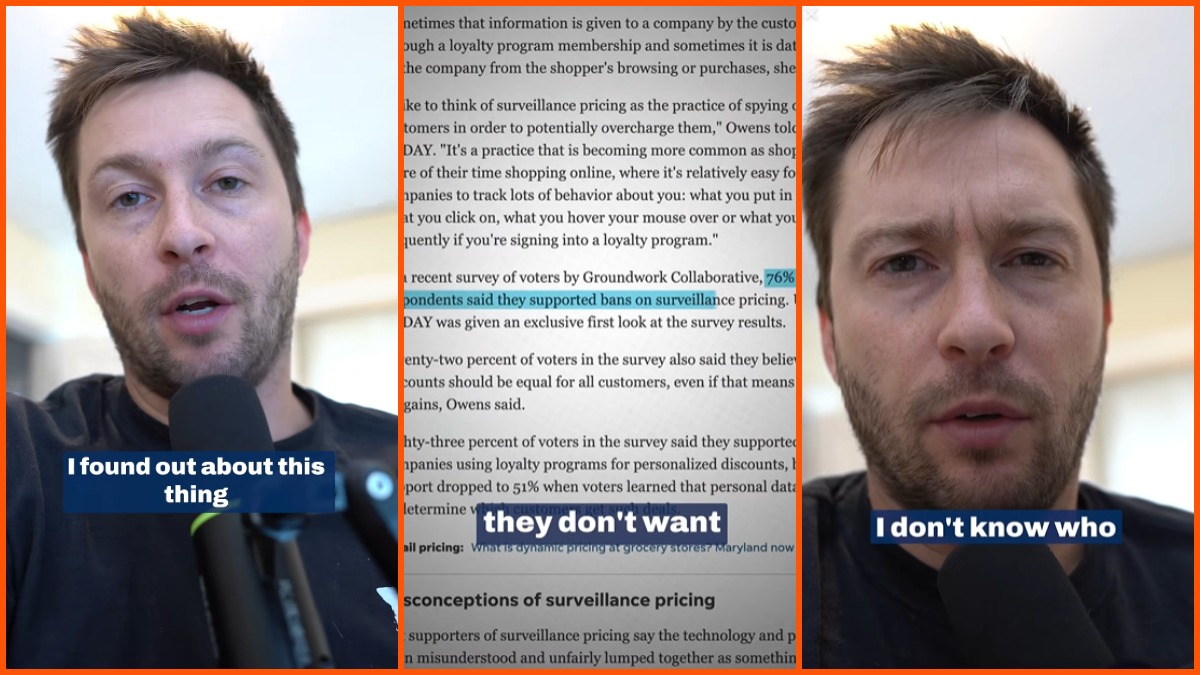

A Minneapolis based content creator who goes by Chris the Producer ran a personal experiment to check whether apps and websites charge different people different prices for the same products and services. He shared the results in a TikTok video that has drawn 4.3 million views and more than 13,500 comments.
Chris said he first learned about the practice, known as “surveillance pricing,” a few months ago. He explained that companies can charge different prices to different customers based on data they collect about each person.
To test this, he asked his brother, his mother, and his best friend to each check the price of the same item or service he was also checking. “It’s like price tags are dead now, and I wanted to put it to the test,” Chris said in the video.
Friend, brother and mother each got a different price than the creator
For the first test, Chris asked his best friend to look up the price of a can of Spam on Instacart. His friend reported a price of $4.99. Chris then shared his own price for the same item, which was $4.59. His friend responded, “That’s b******t, dude.”
Next, Chris asked his brother to book an UberX ride from Target Field to the airport for the following day at noon. His brother’s price came to $36.94. Chris then revealed his own price for the identical ride: $52.95. Chris pointed out that this was “a 30% difference in price,” to which his brother asked, “And for what?” Chris replied, “No difference.”
For the final test, Chris asked his mother to look up a room at the La Quinta Hotel in Denver for the same night. Her price is seen to have come to $122.50. Chris then shared his own price for the same room, which was $84. His mother responded with repeated exclamations of “Wow.” Such pricing inconsistencies have sparked broader debates about fairness, like a recent viral confrontation over a Walmart price tag dispute.
Chris ended the video by saying, “kind of sucks.” He then showed a screenshot of a USA Today article stating that 76% of people surveyed supported bans on surveillance pricing. He added, “I don’t know who the 24% are,” and asked viewers, “How much does spam cost for you?”
The article Chris referenced cited a survey by Groundwork Collaborative, a research and advocacy organization. According to the survey, 72% of voters said discounts should be the same for all customers, even if that means smaller savings.
The survey also found that 83% of voters supported companies using loyalty programs to offer personalized discounts, but that support dropped to 51% once voters learned that personal data was being used to decide who gets those deals. The frustration can extend to unexpected charges, as when Planet Fitness charged a woman $500 and refused to explain the charge.
Lindsay Owens, executive director of Groundwork Collaborative, told USA Today that surveillance pricing involves using customer data, whether shared through loyalty programs or collected through browsing and purchase history, to potentially charge more. “I like to think of surveillance pricing as the practice of spying on customers in order to potentially overcharge them,” Owens said.
Not everyone agrees that the practice causes harm. Drew Ambrogi, policy manager for the Chamber of Progress, a tech industry policy group, told USA Today that data-driven pricing tools are often used to offer legitimate discounts, such as loyalty program savings or incentives to complete an online purchase. Ambrogi said there is “very little evidence” that individual shoppers are seeing higher prices because of surveillance pricing.
Surveillance pricing is different from surge pricing, which is a temporary price increase during periods of high demand. According to the New York Post, the key difference is transparency, since surge pricing is shown to everyone at the same time, while surveillance pricing can show two different people two different prices for the same item without either person knowing it happened.
One commenter on Chris’s video claimed that Uber factors in a rider’s phone battery level when setting prices, charging more when the battery is low. A similar claim was raised in the New York Post, where Tom McBrien, counsel at the Electronic Privacy Information Center, said one ride-sharing company had applied for a patent to detect a rider’s battery level, based on the idea that someone with a low battery might be more desperate for a ride.
Several commenters on Chris’s TikTok video shared their reactions to the price differences he found. One commenter wrote, “This should illegal.” Another suggested expanding the test, writing, “Now try it with a black friend, Hispanic friend, college student, etc.”
A different commenter claimed a factor beyond personal data may affect ride-share pricing: “apparently for uber, they monitor your phone battery as well. the lower your batt, the more expensive the prices are.” Another commenter offered a tip for avoiding higher prices: “You all need to use the Incognito tab, I use it every time I’m shopping around for something.”






Published: Aug 4, 2026 07:27 am