


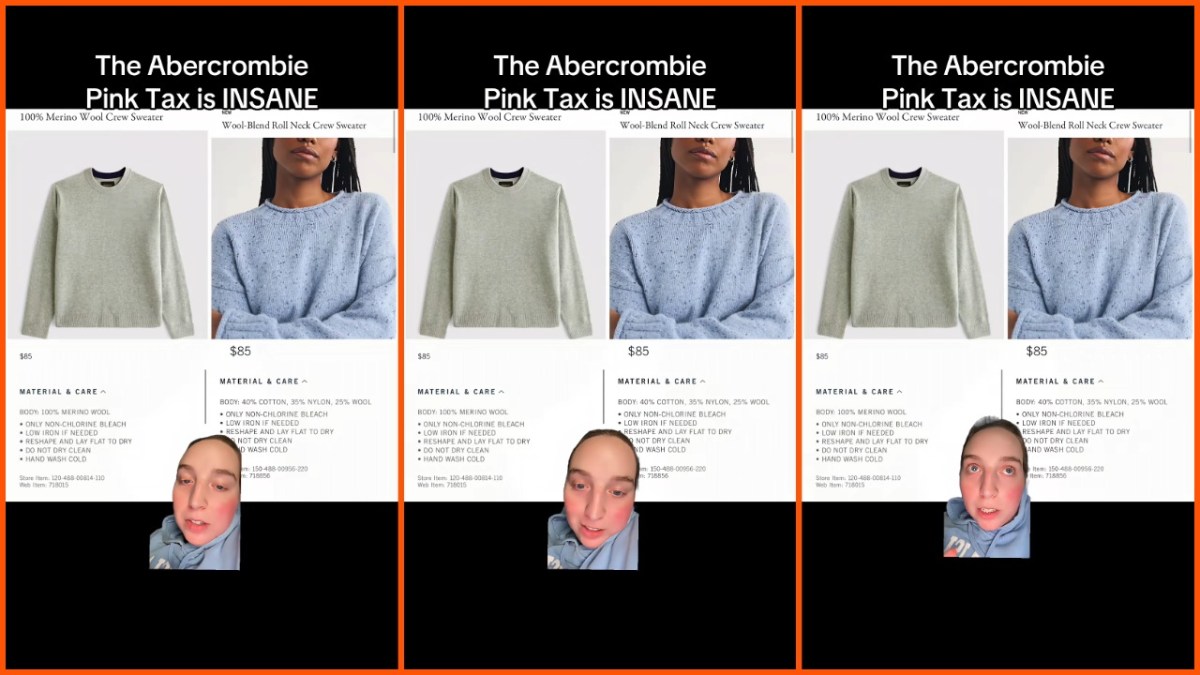

A TikTok video by Elyse, who posts as @elyse9438, has drawn hundreds of thousands of views after she compared two Abercrombie & Fitch sweaters priced at the same amount. In the clip, she displayed the product listings side by side while speaking to the camera against a green-screen background. Large white text at the top of the frame read, “The Abercrombie Pink Tax is INSANE.”
Elyse opened by saying, “I don’t know why more people aren’t talking about this Abercrombie Pink Tax situation, but this is blasphemy.” She described the item on the left as a men’s 100% merino wool crew sweater listed at $85. She said, “Okay, $85 for 100% merino wool, cool.” She then pointed to the listing on the right, which she identified as a women’s wool-blend crew neck sweater also priced at $85.
According to the details she read aloud, that sweater was made of 40% cotton, 35% nylon, and 25% wool. She said, “That’s weird, they’re the same exact price. No excuse in the book could justify something like this. This is ridiculous.” Elyse added, “Always nice to see that Pink Tax is alive and well. Don’t get it twisted, I say this with sarcasm.”
California law and federal findings on gender-related pricing differences
In the video, Elyse asked viewers for suggestions from other brands and mentioned Quince, which she described as highly renowned, though she said she was not familiar with the brand. She asked whether it could be a better alternative. The background of the clip later showed a cream-colored Quince sweater hanging on a wooden hanger next to a pair of brown trousers.
According to the State of California Department of Justice, the “Pink Tax” is illegal in the state under AB 1287. According to the department, gender-based price differences for substantially similar consumer products violate California law. The law, codified at Civil Code section 51.14, prohibits charging different prices for goods that are substantially similar but priced differently based on the gender of the target audience.
The department described the Pink Tax as the higher price women pay when items marketed to women or girls cost more than the same or substantially similar items marketed to men or boys. It noted that women make up as much as 85% of consumer purchases in the United States and that unequal pricing can create financial impacts for women, girls, and their families. Adult clothing is listed among the product types where such differences may appear.
AB 1287 does not ban different prices when there is a gender-neutral reason. The law identifies examples such as the amount of time to manufacture the goods, the difficulty of manufacturing them, the cost incurred, the labor used, and the materials used. It also allows for any other gender-neutral reason. The Attorney General has enforcement authority and has asked the public to file complaints about potential violations.
The U.S. Government Accountability Office states that it examined gender-related price differences for goods and services. The GAO found that after controlling for product size and other factors, prices for half of the personal care items it reviewed were higher for women, including deodorants and fragrances, while some men’s items cost more. The report stated that whether the differences are due to gender bias is unclear, since ad costs and consumer preferences also affect pricing.
The GAO noted that no federal law prevents firms from charging different prices for men’s and women’s products. It reviewed data on personal care categories and found the target gender was a significant factor in some price differences, but said it did not have enough information to determine how much of any gap came from gender bias versus other factors. Three federal agencies that oversee antidiscrimination laws received few consumer complaints about gender bias in pricing between 2012 and 2017.
Some viewers responded to the video with their own observations. One commenter wrote, “Uniqlo does this and im sure every other company as well.” Another stated, “It’s a war on our fertility.” A third commenter said, “I’ve started buying from the men’s section more and the products are usually so much more comfy. It is so infuriating.” Pricing disputes in clothing aren’t limited to gender, as one shopper flagged Target’s 3X versus size L pricing.
Another viewer asked, “I don’t understand what they would gain from putting less wool in the women’s shirt versus the men’s shirt?” One more commenter wrote, “They prob think we are dumb and won’t notice.” Another shopper also made a similar discovery after finding the same Walmart shoe cheaper in the men’s section.









Published: Oct 18, 2026 12:15 pm