


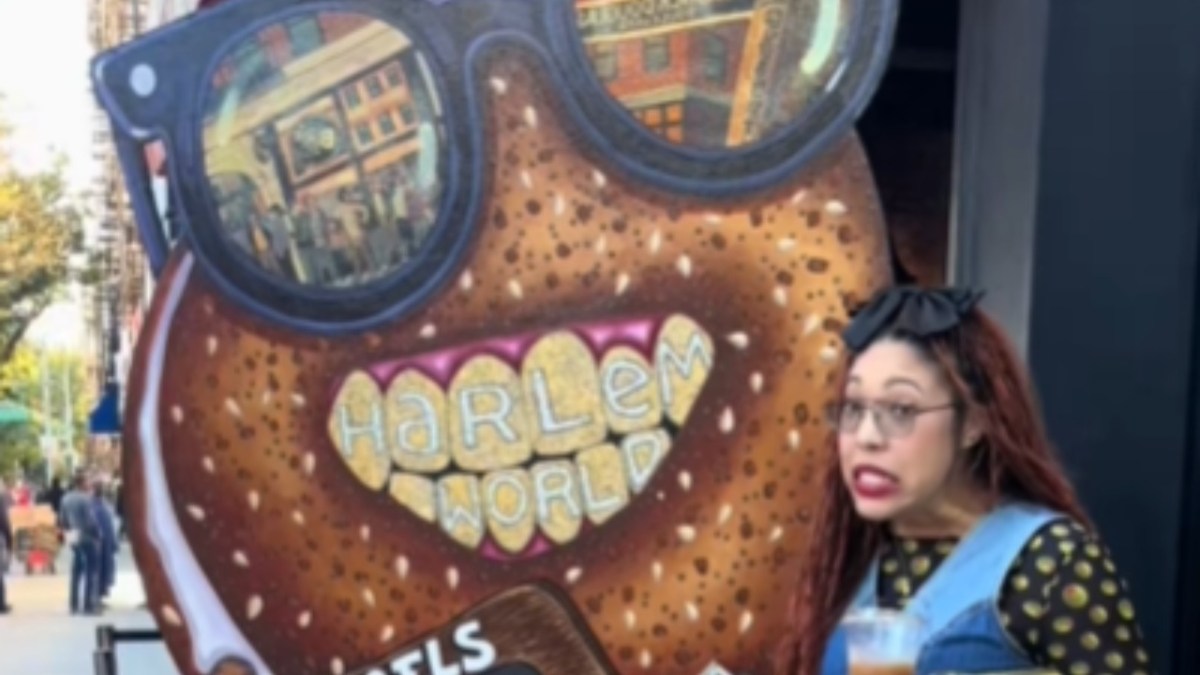

A New York bagel shop has reportedly taken down a cartoon sign after a viral TikTok video accused the artwork of having a “blackface owner.” Up until recently, Bo’s Bagel in Harlem had displayed a large cardboard cut-out of a cartoon bagel outside the store. The sign, which also served as a chalkboard, depicted the bagel wearing sunglasses, gold grills with “Harlem World” inscribed on them, and a gold ring reading “NYC.”
However, the mascot became controversial after several content creators claimed it was racist. Threats and harassment from the viral video forced the sign off the sidewalk and into hiding, according to business owner Andrew Martinez. “It got completely out of hand by a bunch of people who know nothing about us. And the rage was coming in from people who just wanted to call us racist,” said Martinez to the New York Post.
The backlash against the bagel mascot started when Harlem-based photographer Carl Broady criticized the cartoon in an Instagram post last Monday, claiming it as “disrespectful caricature of black people.” Broady, who is Black, said, “The sign’s exaggerated features, bulging lips and teeth, and darkened skin tone […] recall the racist caricatures historically used to degrade Black people.” Broady has since set his Instagram account to private and has not responded to requests for comment.
Harlem supports Bo’s Bagels
Following Broady’s comments, TikTok user Anastazia X posted a viral video saying the shop was “white owned,” and displaying a photo of Martinez. She said she’d messaged Martinez about her concerns but received no reply, claiming that she’d been “left on read.” “It was a kind email, it was a curious email, but it got no response,” Anastazia X explained, adding that she later addressed her concerns directly with the store manager during a visit.
“I asked if anyone had complained about the bagels … and if the complaint had reached the owner,” she said. “The answers were ‘Yes,’ there have been complaints. ‘Yes,’ the owners are aware. But ‘No,’ nothing has been done. Interesting.” The TikToker described the mascot as “not funny” and “problematic,” and also suggested that other artwork in the store was “a little askew.”
Martinez claimed that people began making threatening phone calls to his employees, while other influencers visited to film harassing videos. “They’ve reached out to my Black employees and told them, ‘You need to leave there because your owners hate you,’ and that’s just not true,” he explained.
Martinez argued that his company has a strong reputation in the neighborhood. “This feels almost strange to us because Harlemites love us. They know what we do. We donate to schools and provide food to homeless shelters,” he said.
Meanwhile, Anastazia X issued an apology statement to the owner and staff in a statement to the New York Post for the harassment they experienced because of her video. “I’m sorry that employees and the owner have been harassed as a result of the video,” she said. “That was not my intention, and I don’t condone or support any behavior of that kind.”
Harlem-based artist Tom Sanford designed the bagel mascot, whose work includes life-sized caricatures of the New York Knicks displayed in City Hall in June during the team’s championship-winning run. Speaking to the New York Post, Sanford defended his work, saying: “Personally, I do not see uptown streetwear culture in a negative light at all. … To me, these items represent overwhelmingly positive cultural contributions that came from the streets of my neighborhood and crossed over into the mainstream.”

Published: Oct 22, 2026 05:00 am