


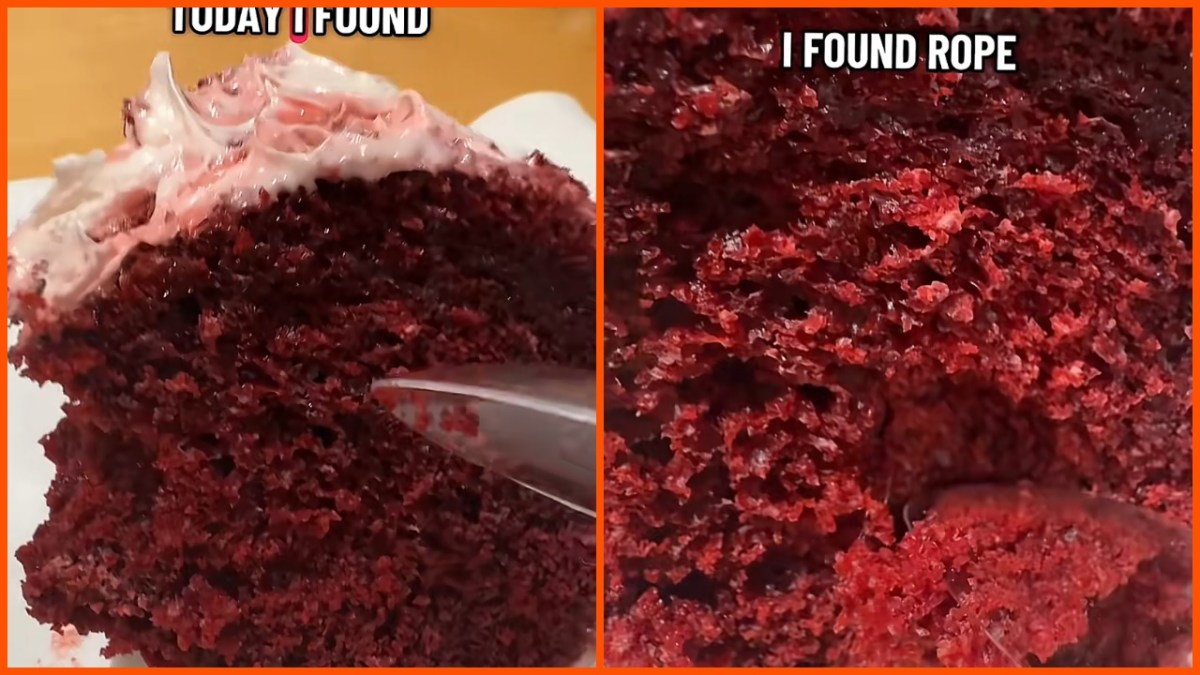

An Alaska woman recently pulled a clean skewer through a slice of restaurant cake while filming the whole thing. She wanted to rule out an obvious explanation first because what she found inside looked pretty strange.
The creator, who posts on TikTok as LittleHouseBigAlaska, bought the slice as takeaway from a restaurant. As she pulled the dark red crumb apart, thin strands stretched between the pieces. She identifies the strands as rope spoilage, a type of bacterial spoilage that can affect baked goods.
The name is easy to misunderstand, and she clears that up right away. “No, I didn’t find a piece of rope in my cake,” she says. “I found rope spoilage in my cake.”
What causes rope spoilage in baked goods?
She says the bacteria can come in through wheat flour. The problem can develop when a cake spends enough time somewhere warm and moist. One of the first clues, she says, is a sweet smell, like rotten fruit. Next come thin, wispy threads inside the cake. “It’s not hair in your cake,” she says. “That’s the rope spoilage.”
She switches to a clean skewer to show that she isn’t simply dragging frosting through the cake. Other creators have filmed similar checks of store-bought sweets. She also stresses the cake did not come from a home baker. “This cake came from an established restaurant,” she said and adds that the restaurant sold it by the slice and kept it under a cake dome.
Seven days later, she posted a follow-up. By then, six million people had watched the first video. She explains, “Baking kills the bacteria, but not the spores, and the spores wait.” She lists what the spores need. “Moisture, warmth, and days of time. Not hours, days.” She believes storage was the problem. “It’s not bad luck. It’s bad storage.”
The videos cannot confirm which species of bacteria caused the spoilage, since that would require lab testing. Rope spoilage is most commonly associated with bread and other baked goods, where it can leave the crumb sticky and produce the stringy strands seen in the video. According to the American Society of Baking, how quickly it develops depends on the level of contamination and storage conditions, including temperature and humidity.
She warns that eating the cake can cause food poisoning. The UK Health Security Agency says spores from some Bacillus species can survive cooking and later grow under the right conditions. Consuming food where large numbers of the bacteria have grown can cause gastrointestinal illness. UKHSA lists nausea, vomiting and diarrhea among the symptoms associated with certain Bacillus species, while its food safety guidance notes that not all strains produce the toxins that cause illness.
Sometimes people don’t spot the problem until they’ve already started eating. One Burger King customer recently said she found mold on her Whopper after eating most of it. One user wrote, “I’ve 100%eaten this before thinking it’s just sticky.” That comment had 81.2K likes.
Another wrote, “I didn’t know the saccharine rot smell was from bacteria!!” The user added that family members called them crazy for skipping a treat that smelled “too sweet.” Others joked about the timeline. “Bold to assume a baked good lasts 72 hours in my house,” wrote one.
From the comments, it seems plenty of people had seen something similar. They just didn’t know what they were looking at.







Published: Sep 28, 2026 10:18 am